Category: Rants

  • Why I’m Unsubscribing from the MKBHD Waveform Podcast

    Why I’m Unsubscribing from the MKBHD Waveform Podcast

    As someone who’s recently taken up walking again, I’ve gotten into the habit of downloading and trying out podcasts. These short form pieces of content are a great way of keeping up to date, potentially learn a bit more about subjects you love, and learning more about the content creators that we all watch and listen to on a daily basis.

    Given that I’ve been watching MKBHD for years now, I decided to give his “Waveform” podcast a go.

    The breakdown of a typical episode

    It started off well – the hosts, Andrew Manganelli, and Marques Brownlee, do a pretty good job of vibing off one another – they have knowledge to add to most tech subjects, especially when it comes to Marques talking about the business strategies of big companies, frequently giving ideas and insights into reasons a company has done something that I would never have imagined. But most of the extra knowledge comes from the host’s early access to tech thanks to their press credentials.

    Each week typically revolves around the hosts finding a few tech news stories to talk about within an hour episode. When it comes to tech-tober and other tech release weeks, the hosts have a lot to say about a specific manufacturer (for example Apple during iPhone launch week, and google with Pixel launches), but as a whole the hosts are pretty good at finding multiple news stories to talk about, and give their opinions on what is happening.

    The show has multiple ad breaks, with the hosts answering trivia questions just before. They’ll proceed to hear the answers to their trivia questions at the end of the show, and have a scoreboard as to who is winning.

    For a 60 minute show, it’s pretty tight-knit, and has been a /mostly/ pleasurable thing to listen to on my walks, given the topics discussed, and the casualness by which the hosts present it all.

    One off’s

    Having guests on like Jerry Rig Everything, and even the co-host David Imel coming on every now and then definitely mixes things up, with David Imel being a breath of fresh air given his extreme detailed knowledge when it comes to all things android and smart phones as a whole, which can be seen when he manages to get most questions right in the host’s gameshow-esque trivia (To say David is one of the most knowledgable in all of MKBHD’s staff is an understatement).

    These one-off’s definitely help to keep the show fresh and entertaining, and help to keep listeners on their feet each week, not knowing whether they’ll get a normal episode, or something completely different.

    Why I’ve unsubscribed

    MKBHD is a video focused channel. We all know this, and it’s easily one of the biggest reasons Marques has so many subscribers on YouTube. The sheer quality of his videos on YouTube is enough to make any video producer, or cinematographer jealous given how crisp and well executed his b-role is.

    The issue is, the team seems to forget that podcasts are traditionally audio only, meaning that they will constantly “show” something to the camera’s in the studio, giving almost no insight on the audio as to what it is that they’re showing.

    It’s as if the audio part of the show is a second thought – you’ll constantly have the hosts show something to the camera’s without any thought as to what they’re doing.

    This issue isn’t unique to the waveform podcast; I listened to the Giant Bombcast for over 5 years and they had a few instances where they would “show, not tell”, but these were one offs, and the team would instantly know they were wrong for doing so and go back, apologising to the listeners and ensuring they described in as much detail as possible what they wanted to show.

    For the team at the Waveform podcast, this never seems to be the case. There’ll be occasional jokes about how “this won’t work well for the audio-only listeners”, but acknowledging the issue doesn’t fix it. It happens easily once or twice every episode, and will take you out of listening completely.

    The straw that broke the camels back was the latest episode, released on October 21st. The first 40 minutes of the episode went fine, David Imel and Andrew Manganelli started by talking about SMS/MMS changes to google pixel, and how it would change the landscape when it comes to texting in North America. But around the 40 minute mark, a separate segment starts where Marques is interviewing Austin Evans, and rather than have a traditional interview, they proceed to play a game where they hide phone’s behind their backs, with the camera showing the two phone’s they’ll be guessing.

    As you can imagine, this was impossible for myself walking around the park. It was jarring, and kinda insulting at the end of the day that a person who chooses to consume MKBHD’s content in a slightly different way was treated like a mug.

    MKBHD did well to get where he is today, and I admire him for getting where he is. But as an audio-only listener of his podcast, I can’t help but constantly feel like a second class citizen, like I’m missing out on things every week, like I should be watching, not listening. For that reason alone, I no longer have any interest in listening to the show, and so as of today, I unfollowed on Spotify, and will just go back to watching his normal content on YouTube.

  • The Editing Room Floor: How a review transforms from a draft to being published

    The Editing Room Floor: How a review transforms from a draft to being published

    Warning: This is going to be a long one!

    Any piece of literature, be it books, magazines, blogs and even reviews go through several iterations before the editor and author are happy with the content. Whilst this is a fact of life for writers, it usually happens out of sight, leading many to believe the end result is what the author originally intended.

    Unfortunately, this has happened to me many times throughout my (limited!) experience within the games industry thus far, so today I’m going to go through my latest review (Doom – for those of you who don’t frequent here often) and compare it to my original piece that I submitted.

    I’m doing this article as I’m concerned about the state of play in games writing and games journalism. Too many times articles are edited to fit a narrative, and whilst that didn’t happen here (my editor keeps to gaming and gaming alone – he’s awesome like that) it’s nice to be able to show you all the changes that happen between what the author originally intended, and the final published piece.

    This article is going to be a learning experience for me too – writing only as a hobby in my spare time, I rarely have the time to chuck a piece back and forth between edits, meaning what’s changed by the editor before being published is accepted without me reading it. In an ideal world I would, but doing this in my spare time whilst also developing games and working full time rarely gives me time to read these pieces again.

    To make things easier, I’ll colour code the paragraphs, with the following being consistent throughout:

    VGChartz.com published review = Red
    My draft which was submitted = Blue

    So lets start with the opening paragraph, which reads as follows in the review published on VGchartz.com:

    “It’s been 12 years since Doom 3 graced computers and consoles worldwide. At the time it was an absolute stunner in terms of presentation, heralding in an era of more atmospheric shooters that was spearheaded by impressive real-time shadows tech, but many fans were left feeling hollow after completing the campaign; gone was the fast-paced, strafing combat of Doom and Doom 2, and in its place was an entirely story driven game. This identity crisis perhaps explains both why it’s taken so long for the series to receive another entry.”

    Not that bad. Granted, there’s a grammatical mistake in there that was not in my original (the “both” at the end is not neccessary), overall I feel it’s all a bit… disjointed. The opening sentence just doesn’t flow into the others, and as such, it feels weird. Here’s what I originally wrote below:

    “It’s been 12 years since Doom 3 graced our computers (and consoles) world-wide, and at the time, it was an absolute stunner in terms of presentation; with its heralding of fantastic real-time shadows in games being a major selling point. But there were many fans left feeling hollow after completing Doom 3’s campaign; gone was the fast strafing combat that played out in Doom 1 and Doom 2, Doom 3 was an entirely story and atmosphere focused game. Whilst some could argue this was a good thing (I personally enjoyed Doom 3), it was certainly the coming of a new age in FPS’, so much so that it’s taken 12 years for a proper Doom sequel to be released.”

    The heralding sentence could have definitely done with being tidied up, but by making the first sentence so long I felt it was natural to flow into what I felt was a good comparison.

    The next paragraph was basically not my doing. In fact, it’s only the last sentence of mine that’s kept between my draft and the end result, so like before (and throughout this article) I’ll do the VGChartz.com review first, then my original after.

    “DOOM is in many ways a love letter to the shooters of yesteryear and should appeal to many of the series’ original fans. Yes it’s been given a fresh coat of paint, and yes the control style and feature set has been updated to appease certain modern gaming sensibilities, but a real effort has been made to bridge the gap between that atmospheric, graphics-driven style of shooter that Doom 3 was the precursor to and the gameplay-centric style of earlier entries. The results of this balancing act won’t appeal to everyone, but for the most part DOOM is a great success for iD and a return to form for the series.”

    and my original paragraph:

    “I give this context as it’s worth remembering how games once were: with graphical fidelity being a limiting feature in games of yester-year, everything was centred around the gameplay itself. With graphics no longer being a worry, games are ever-more trying to strive towards realism, much to the detriment of gameplay. Doom is a love letter to these games of yester-year, albeit with a brand new shine to the graphics and a slightly updated control style that’s sure to make fans go crazy.”

    As can be seen, I was setting the review up by giving context about the state of the games industry right now. Whilst you could argue it’s not the time or place to discuss this change in games, I felt that it helped paint the reason why DOOM is so damn good. The published paragraph just feels like it’s putting words in my mouth that I don’t necessarily feel are true and didn’t say in the first place. Yes it does bridge a gap between new and old shooters, but I didn’t feel like that needed to be said this early when the rest of the review does a better job of explaining why.

    Onto the next paragraph:

    “The campaign starts off as it means to go on, providing little in the way of story or context; rather you pretty much get straight into the action. After a few seconds spent donning your suit, it’s time start demon killing. DOOM wastes no time in giving you plenty of demons to take on, either. The short thrift given to the narrative and any contextual background forces you to focus on the gameplay and the visual spectacle of combat (rather than the scenery), which is a fantastic change of pace compared to Doom 3. “

    Compared to:

    “The campaign starts off as it means to go on – giving relatively little story/context and getting you straight into the action. After a few seconds of donning your suit, it’s time start demon killing, and Doom wastes no time in giving you plenty of demons to take on. This short-hand way of giving you tidbits of story and background whilst forcing you to partake in the gameplay 90% of the time is a fantastic change from Doom 3, and means there’s rarely a moment where you calm down and take in the scenery.”

    I really like my editors way of changing up my last sentence, using “the short thrift” rather than my “short-hand way”. I write like I talk at times, and don’t really have the vocabulary of many writers out there, so these edits are always greatly appreciated.

    Next!

    “One of the first things you notice when you begin navigating DOOM’s corridors is its incredible sense of pace. After years of shooters gradually slowing down, becoming more and more realistic, DOOM’s fast pace feels like a breath of fresh air. This speed works really well in combination with the game’s large levels, especially the more open ones that give you a large sense of freedom with how you approach combat with the demon hordes. You traverse the environment so quickly that it almost causes you to overlook the beautiful levels and art that are on display.”

    and the original:

    “One of the first things that’s apparent when you first start navigating Doom’s corridors is it’s insane speed. After years of FPS’s getting slower due to “realism” Doom feels like a breath of fresh air. This speed not only works in conjunction with how large the levels are, but also in the large open expanses where you get to battle demons without being constrained to tiny corridors. It’s fantastic, and allows you a sense of freedom as you decide how to go about destroying a horde of demons within an arena. You traverse the environment so fast in fact that it feels like a shame that we’re ignoring the beautiful levels and art on display.”

    My use of the word “insane” and other terms was to push the point home that DOOM’s speed and level design truly stands as a testament to how good the game is. Changing this to “this speed works really well” takes away from my awe at what iD and Bethesda have done.

    The next two paragraphs were cut down and shortened, so I’ll paste both together here:

    “It’s not long before you’ll also start ‘glory killing’ demons that you’ve weakened enough to stammer. These brutal animations split up the action somewhat, allowing you to witness the brutal and gory destruction of demons close up. At first this seems like mindless violence for the sake of violence, but it’s actually an essential gameplay mechanic because each time you kill an enemy this way you’re rewarded with health (the amount depends on the size of the demon you kill). However, if you glory kill in the middle of a fight then once the animation finishes you’ll briefly be vulnerable to attack from other enemies, which creates an inherent risk/reward element with the mechanic.

    DOOM also has a great sense of rhythm and flow; you emerge in a new area, then proceed to run in circles, strafing out of the way of incoming imp fire while pelting out your own.”

    and my own:

    “It’s not long before you also start “glory killing” demons that you weaken enough to stammer. These brutal animations take 3-4 seconds away from the madness, and in return gives you a close up of demons getting destroyed by your own hands. What at first seems like mindless violence for the sake of violence, soon becomes apparent that it’s actually a gameplay mechanic, and an essential one at that. Each time you kill an enemy in this way you’re rewarded with health (the amount depends on the size of the demon you kill). This risk/reward mechanic really helps to keep combat entertaining, but also a puzzle. I found myself consistently having the thought pattern of: “if I glory kill this enemy at the side, it’ll allow the other imps chasing me a chance to hurt me the second I get out of the animation, but I’ll get much needed health” – which is an insanely difficult decision to make given the speed of the game. 

    Before long you’ll be getting into a rhythm of how to take on demons; run to a new area, and proceed to run in circles, strafing out of the way of fire from imps, and proceeding to mow everything in sight down. It’s when you’ve started to master the combat that the true genius of Dooms design becomes apparent; it’s level design.”

    In these two paragraphs the biggest changes are my internal monologue towards the end of the first paragraph, and the second paragraph being chopped in half. First up, my internal monologue. I can understand why it was taken out; it’s rare that a review would do things like this. I wrote it because I thought it would be a fantastic way of presenting the thought processes a player will entail whilst playing DOOM, and how fast and difficult it is to judge those thoughts on the fly.

    The next paragraph’s edit just feels disjointed to the rest of the article. My intention was for this paragraph to foreshadow the next one, giving a nice flow to the review as a whole. Unfortunately, the edited version just makes the sentence stick out like a sore thumb; it has no context, and doesn’t feed nicely into the next paragraph at all.

    Onto the next one!

    “As with classic Doom games, DOOM contains plenty of secrets. There are also side objectives and enough bonus loot to drive you insane. Each side objective can relate to either combat or map searching, for example some may require five different imp glory kills, with others require you to find three secrets on the map.”

    And my original:

    “Like classic Doom games, Doom has plenty of secrets throughout the levels, along with plenty of side objectives and enough bonus loot to drive you insane. Each side objective can relate to either combat or map searching, for example some may require 5 different imp glory kills, with others being to find 3 secrets on the map. These were enjoyable in their own right, and had me staying on a level well past killing everything in sight, backtracking and platforming (yes! A FPS has platforming sections!) through parts of the levels that I thought I had explored to their utmost, only to find a lever I never saw the first time round. It’s exciting and clever in an age where levels are frequently used as decoration rather than actual things that have an impact on gameplay.”

    Now from here you can clearly see that the paragraph has been tidied up. I don’t blame my editor for that, I can indeed ramble, but I felt this entire section was justified in the features it explained to readers. It’s one of the only times that I mention the platforming, which is something I really wanted to do a paragraph on, but couldn’t find a way to make it fit, so proceeded to add a little note into an already existing sentence. I felt it got the point across whilst not being offensive, and maintained the flow of the review as a whole, so it’s a shame this section was edited in this way, as it throws off the rest of the review.

    Onto the next couple of paragraphs!

    “Where most modern shooters have you focussing on the weapon with the left trigger, in DOOM there’s no need to zoom in. There’s no need to reload either. Instead there’s a new ‘gun mode’ system in place of the traditional left trigger zoom which activates a second mode on the currently equipped gun. For the assault rifle, for example, pressing the left trigger activates a missile mode which uses twice as much ammo but mows down demons like it’s nobody’s business. 

    These weapon mods can be acquired from utility robots that are scattered throughout the game and can be upgraded using points unlocked by either defeating enemies or completing the aforementioned side objectives. Each mod has an upgrade tree which accumulates to a ‘master’ unlock, which naturally makes the weapon even more powerful. The upgrade tree also applies to your suit, should you find the necessary upgrade parts hidden in levels – from health and armour boosts to increased explosion resistance.”

    And my original draft:

    “The weapons you can use are a breath of fresh air in our current gaming world where every shooter is pushing us to “focus” on the weapon (including Halo!) by pressing the left trigger (on controllers). Not so with Doom, where every gun doesn’t need to reload (ever!) and there’s no need to zoom in. Given the speed you run throughout the levels, it would be crazy to have a smart zoom system, even so, it’s absence feels fantastic. In it’s place is a new “gun mode” system, when by pressing the traditional left trigger activates a second mode on the currently equipped gun. For the assault rifle for example, pressing the left trigger activates a missile mode which uses twice as much ammo, but my god does it mow down demons like nobodies business. 

    These weapon mods can be found from utility robots throughout levels, and can be upgraded using points unlocked through either defeating enemies, or completing the aforementioned side objectives. Each mod has an upgrade tree which accumulate to a “master” unlock, which in all cases makes the weapon even more powerful. The upgrade tree also applies to your suit should you find the right upgrade parts hidden throughout levels – from health to armour to explosion resistance it all can be upgraded doing so makes for an overpowering feeling whilst taking on demons.

    Yet again, the first paragraph is almost half as long, which, again, is fine if that’s what you like, but I feel there’s a lot of chopping were there doesn’t need to be. I was trying to put the fantastic mechanics of DOOM into a greater context of the industry at large, giving examples of the fact even Halo has gone down this “focus on the weapon” path. I also added the sentence about the speed of the game being at odds with a smart zoom feature, something I think players could do with knowing, as this gives context to an action they’re used to doing in other games, and one which isn’t present in DOOM.

    The second paragraph in the above two examples thankfully doesn’t change much, and is a perfect example of editing done right – I rambled towards the end, and as a result the sentence was tidied up in the published version.

    As before, I’m going to link the next two paragraphs together once again:

    “Naturally, the campaign isn’t the only mode DOOM has to offer; there’s the obligatory multiplayer mode present and more interestingly a new ‘SnapMap’ mode. The former is what you’d expect from an iD title – fast, hectic, free-for-all multiplayer across numerous maps and game modes. Strangely, though, the multiplayer doesn’t feel as fast as the campaign or SnapMap modes, with the ‘hacks’ and weapons all feeling clunkier and more akin to other modern shooters. It is not DOOM at its best and is a case I fear of the developer shying away from the approach it took with the campaign

    SnapMap mode is more appealing to me personally and I expect this will hook a great many players in the coming months and years. In this mode people can make their own custom maps and game types by utilising contextual information and most (though not all) of the assets from the campaign. Current early offerings from the community are raw but packed full of potential, from boss rushes, to story modes, and time trials, all with the same gameplay from the campaign but played with friends should you so wish. It reminds me somewhat of Left 4 Dead’s hectic and frantic mod scene on PC, where all-new stories and modes were crafted by the community.”

    And my original draft of these very same two paragraphs:

    “The campaign isn’t the only mode Doom has to offer, with a Multiplayer mode present and a new “snap map” mode. The former is what you’d expect from an ID title – fast, hectic crazy free-for-all multiplayer across multiple maps and multiple game modes. My only gripe with this mode is that it doesn’t feel as fast as the campaign or snap map mode, with the “hacks” and weapons all feeling clunky and more like modern FPS’s than a true representation of Doom in all it’s glory. It’s still enjoyable, don’t get me wrong, but the multiplayer doesn’t hold a candle to the campaign.

    As for the snap map mode, holy crap can I foresee this being something players come back to time and time again for the next few years. Put simply it’s a mode where people can make their own custom maps/modes, with contextual information and most (not all!) assets from the campaign being available. Current early offerings from the community include boss rushes, story modes, and time trials, all with the same gameplay from the campaign – albeit with friends should you wish. It reminds me of Left 4 Dead’s hectic and frantic mod scene, where all new stories and modes can come up from the community, and for that reason alone I look forward to seeing what comes of it.”

    In the first paragraph I like how my editor has taken the entirety of what I was trying to say, and tidied it up into something more presentable. In doing so, we get the point the the multiplayer is still competent, but no where near as good as the campaign.

    It’s in the second paragraph where I feel edits have been made that weren’t needed. My reasoning of putting “holy crap” was to truly show how mind blowing and fantastic the snap map mode truly was, something “is more appealing” fails to portray. Also, towards the end I really liked putting my personal feeling into the mode once more by saying I look forward to it’s future, giving readers good reason to believe that DOOM has legs that’ll carry it for years. It being taken out feels like I’m merely reading off a checklist.

    This is where things become trick yin the comparison: I submitted another 4 paragraphs in my draft, but the published version only has another two. The next paragraph is my own, but was never put into the end review:

    “It’s hard to state how damn additive this complete package is. Even before completing the campaign, I was quietly hoping that there would be a new game + so that I could jump straight back into the campaign on a hard difficulty and take on everything Hell had to throw at me with all my upgraded weapons. The satisfaction you get whilst traversing the world is genuinely enthralling, and whilst I got most collectibles during my initial play-through, I still wanted to go back to find more.”

    I can kind of understand why this was taken out; what was said in this paragraph had already been said (in different ways) throughout the rest of the review thus-far. My intention in writing it was to drive the point home that the campaign and game as a whole was so exhilarating, so fantastic, and so damn addictive that even before finishing it I was hoping for more. It’s a shame its missing, as I feel it’s absence makes the next paragraph seemingly come out of nowhere:

    “DOOM is also absolutely stunning. Everything is pristine and sharp, demons look beautifully gory, and the environments feature some fantastic particle effects which really help bring the action to life. It can get a little overwhelming at times; the fast action and explosions galore make for an extremely active screen, but it’s all planned destruction rather than random effects. The weapon sound effects are stand-out too, giving you a great sense of feedback. Finally the soundtrack, whilst actually quite sparse, is especially entertaining during intense battles when heavy metal booms out of your speakers.”

    And the original draft (two paragraphs):

    “Presentation wise, Doom is absolutely stunning. On PC at Ultra settings, everything is pristine and sharp, with demons looking as gory as ever, and environments having fantastic particle effects which really brings the action to life. It can get a little overwhelming at times; the fast action & explosions galore do make for a very active screen, but its all planned destruction rather than randomness, and makes for an entertaining adrenaline filled action sequence everytime you get into a fight with demon hordes.

    On the topic of presentation, we also have the sound, which in Doom’s case is absolutely stellar. Every weapon’s sound effects are awe-inspiring, adding to the weapons feel and feedback. The music, whilst sparse, also helps to keep you entertained during intense battles, with heavy metal booming out of your speakers whilst you’re running around punching demons.

    Here I am definitely not a fan of the removal of “PC at ultra settings” in the first paragraph of my draft. I included this tidbit, not to show of my machine, but to clarify that I was definitely playing on PC, and whilst I think the presentation is absolutely stellar, I was playing with specific settings.

    As for the fact the two separate paragraphs were combined into one; I am not impressed. I felt DOOM’s intense sound and graphical prowess deserved a statement by themselves, something the published article subtracts from. As a result, the published paragraph just makes it feel like I added it purely to fill up space, when in fact I wanted to make valid points about how amazing DOOM’s graphical fidelity was in adding to it’s overall feel.

    Finally we have the conclusion:

    “DOOM is a more authentic Doom experience than many will have expected; it pays careful homage to shooters of yesteryear while – for the most part – only making minor concessions to the modern shooter era that most new players will be much more familiar with. It all then comes together to form a package that’s worthy of any gamer. The high-octane action will take some getting used to if you weren’t born and raised on old school shooters like most older Doom fans but it’s well worth the plunge regardless because DOOM really is great fun.”

    and my draft version:

    “Doom is a love letter to fans of the games from yester-year, taking the best advancements of the last 12 years, and putting them into a package worthy of any gamer. Should you take the plunge and buy Doom, be warned that the high-octane action will take some getting used to, but it’ll be worth it by the end. Given how much fun this “classic” form of gameplay has been, I’m concerned I may not be able to enjoy current FPS’ on the market, a testament if any to how grand and ridiculously fun Doom is.”

    Here it seems my editor has gotten rid of my grandiose statements (I truly stand by my last sentence, playing DOOM has altered my perception of what makes a good FPS), and whilst a review is always going to be subjective, I hugely disagree with the direction the review took.

    I’ll say it here and I’ll say it proud: DOOM is easily my GOTY of 2016 (so far). It is a genuinely amazing FPS, and has made me so excited for games again that I went around my family and friends telling them that they must play this just after completing it.

    I wrote my draft with that excitement in mind, trying my best to portray that excitement through the medium of writing. Unfortunately, the edits toned my excitement down dramatically, meaning the end result, whilst fair, didn’t come across anywhere near as revolutionary as I believe DOOM is.

    Anyway, if you’ve made it this far, thank you! This has been a learning experience for myself, and I hope for you too. As can be seen throughout this article, small changes that one perceives to make the sentence work better can have a massive impact on the general tone of a review. When writing my draft, I wanted each paragraph to flow into each other, but with small cuts here and subtle sentence changes there my overall flow was completely disregarded.

    If you take one thing away from this article, please let it be this:

    What you read on a site is not necessarily what the original author intended. Subtle changes can have huge implications on the final message/tone of a written piece of work, so bear that in mind the next time a review enrages you or a news article takes on a political statement of it’s own.

    I will always strive to be as transparent as possible when writing about games, and I hope this article helps in showing that.

    Anyway! Massive thanks for reading, and especially to my editor who allowed me to do this.

    Til next time!

    -Dan


  • Why I Feel Double Fine Studios Are Taking The Piss

    Why I Feel Double Fine Studios Are Taking The Piss

    Spacebase DF9

    Disclaimer: The following is an opinion piece. People may not agree with what is being said, but I by all means encourage readers to engage in discussion about the following views and opinions.  

    I originally wanted to write an article about the frustration I felt towards Double Fine when they announced that Broken Age would be split up into two pieces and the first part would be sold on Steam Early Access. I felt that Double Fine were taking advantage of their fanbase, and were gambling with fan’s money as if no risk is involved. Double Fine themselves had admitted that they had taken their idea to publishers before, only for publishers to turn them down, saying there wasn’t a market for adventure games. For all we know, Double Fine has that entire market already invested in its project, but are acting as if their sales for Broken Age in January are all but confirmed. I decided to skip writing this article in the end as I felt it was a bit hypocritical of me to be frustrated when I hadn’t kickstarted the project, and let it be.

    To the public’s surprise, yesterday saw Double Fine release a new game called Spacebase DF9, a game that was conceived during their “Amnesia Fortnight” where the whole company makes new game concepts that may one day turn into a product. I say this is a surprise as Double Fine still have 2 other projects that are yet to finish, and they’ve decided to add a third to the fray.

    FUCKKK THE BROKEN AGGEEEE
    Broken Age does indeed look pretty, but was it really necessary considering it’s over budget? Double Fine are from the same camp that says graphics do not make a game, yet go out of their way to generate reflections in water, something which I would class as “graphics and aesthetic not needed to fulfil the core game”.

    In the past, Double Fine have indeed worked on multiple projects, as many fans have been quick to point out. The difference this time is their use of Kickstarter and Steam Early Access, 2 services that were built to support and maintain indie developers that don’t have access to publishers, something which Double Fine has. In the past, fans didn’t complain about these multiple projects because Double Fine were using publisher’s money, which is the same for every developer in the industry. What makes this wrong is that Double Fine are now messing with their own fan’s money directly, rather than fans just being annoyed that a game has been delayed. It sets a bad precedent that Kickstarter can indeed fail if Broken Age’s sales don’t meet expectations in January, something which everyone seems to gloss over and act as if it’s not a big deal.

    I can’t help but feel that Double Fine has been getting a free pass with fans lately. First they overspend on their project which made 8x as much as was needed, and the fans rushed to bless them for making a more ambitious game and being open and transparent with everyone. Next, we don’t hear much about their second game in development, Massive Chalice, and now we get a new alpha game that is still early in development, yet is being sold at a premium price. If any other company were to do any of the above, the gaming industry would be up in arms, telling the developers where they could stick it. But ohhhh no, since Double Fine have a few legendary staff who helped make nostalgic games of yesteryear, fans  rush to save them from hostility. It’s a bit ridiculous when you look at it from afar, as Double Fine are still yet to deliver on any of the promises they have made with Broken Age and Massive Chalice, and yet fans are still eager to trust them. Some may claim that Double Fine is composed of 60 employees, and they can’t have people sat around doing nothing, so why not make another game? Which would usually be true in most studios, but when Double Fine have the press and the whole community of Kickstarter watching them, why would you risk your game being mediocre? You’d ensure as many staff were working on the main game as possible to ensure that your reputation isn’t tarnished.

    FUCK THE CHALICCEEEE
    Whilst massive chalice wasn’t as big of a success as Broken Age, it still broke $1million, meaning it easily has a bigger budget than a lot of indie games and Kickstarter projects out there.

    Finally, I’m not sure how I feel about early access games recently. I believe that if a customer is willing to buy your broken unfinished game, they should be given an incentive to do so, similar to Minecraft. I bought Minecraft for £8 when it was in beta and was still being fixed and expanded. I felt that was a good price, and it continued to get better and better. With the £8 I spent, I got to watch an enterprising, ambitious and unique project grow into the huge success it is today, whilst becoming engrossed in a diverse, intelligently made world, seeing requests and demands for game additions being fulfilled, brilliant customer service in several other ways and a copy of the game in its entirety upon official release. I was rewarded for my belief in an otherwise unproven product and company.  But I’m seeing a growing trend of developers charging premium for this “early access”, like with Double Fine’s recent release. As it stands while I type this, they’re charging £18.99 for the privilege of playing a short, broken game, because apparently at that price it’s already a better game than Fez, Super Meat Boy and Braid, to name a few. Fans should be rewarded, not punished, for supporting developers.

    Double Fine have access to publishers, have access to the industry at large, and have a loyal fan base. These means of funding were made for small, independent developers who don’t have access to the same contacts as big businesses, yet Double Fine seem to be abusing the system. They want all the money to develop a game without any of the responsibility. If Double Fine had to go to a publisher and announce they were delaying their product, the publisher would go insane, possibly dropping funding for the rest of the project, yet if Double Fine do the same with fans that invested and they get applauded for being so open and transparent.

    And that, my friends, is why I think Double Fine are taking the piss.

  • EuroGamer Expo: My First Ever Gaming Expo

    EuroGamer Expo: My First Ever Gaming Expo

    FUCK THE ADVERTISINGGGG
    I’m surprised by how much advertising there was for Wolfenstein. I can’t help but think it’s trying to replicate Homefront’s success through brute marketing.

    So here’s my confession: I’ve never been to a gaming exhibition.

    I know it’s strange considering I’ve been passionate about games for most of my life, but alas, it is true.

    I’ve never got around to planning one out, so after seeing @the_rami tweet that prospective game developers need to go to as many expo’s as possible, I jumped in at the deep end, browsing countless websites that grouped all gaming conventions together. The big one’s like GDC and E3 are both exclusionary, and extremely expensive, meaning there was no way in hell I’d get around to going to one of these within the next few years. I started looking for more consumer friendly shows, one’s that needed no certification to attend; that’s where Eurogamer came in. It was big enough that I’d get a feel for gaming conventions, but extremely cheap: £15 for a day pass was a drop in the ocean compared to $75-$1500 for GDC.

    The show was big enough to have knackered me by the end of the day due to how much walking was involved, but small enough to see everything I wanted. There were big games from big developers, like The Elder Scrolls Online, Batman Arkham Origins, COD: Ghosts, Titanfall to name a few, but there were also sections dedicated to board games and indie games, some even appeared side by side with the AAA games. It was obvious though, that the vast majority of gamers were there for the AAA games, evidenced by the massive queues to even get your hands on one. It’s a shame that most gamers are mindless when it comes to games, but I suppose that happens in every stroke of life, with some people being passionate about a subject, and others being sheep.

    FUCK THE AGE RATINGSSSS
    There were 2 floors to the convention, with the first floor being exclusively for 18+ only, whilst the ground floor had everything else.

    I didn’t get to speak to as many developers as I would have liked, but it was still enjoyable to play a few games and talk to people like Leigh Alexander (freelance journalist) and Mitu Khandaker (Redshirt Game), but this wasn’t the place to talk business, and was purely a consumer event for the developers to sell their ideas to the public.

    The one thing I truly did not understand for the life of me, was Microsoft. They have a new console coming out in the next couple of months, one that they need as many people as possible to buy into and love. Yet at Eurogamer, they had every single Xbox One game hidden behind a black wall, meaning I saw no Xbox One games at Eurogamer, not even the controller. Sony did a similar tactic of walling the PS4 section off, but were clever and only had waist high walls, so I could still watch and gander at all of their exclusive games coming soon. I understand that this could be psychology, allowing people who do queue and wait to feel superior than others, but it contradicts everything about a exhibition. Why should I wait in line for something I don’t know a thing about? Surely allowing public viewing would encourage more people to check out the Xbox One and it’s games? Surely Microsoft want people to talk about what they saw? Either way, I can’t help but feel more excluded by Microsoft’s actions at Eurogamer, and feel more included with Sonys.

    FUCK THE STUFFSSS
    Playing Luftrausers made me genuinely more excited for the final game. I’ll most definitely be buying it on my Vita.

    Overall I enjoyed Eurogamer, I shall be attending for the next few years, even hoping that one day my own game is in amongst the rest of the industry. One can dream.

  • Ouya’s FTG’s campaign loses one project due to suspension.

    Ouya’s FTG’s campaign loses one project due to suspension.

    The following post is a follow up to my previous post on Ouya’s Free The Games campaign which can be found here:

    Why I call Bullshit on Ouyas Free The Games campaign successes

    Today, a marvellous victory has been won for all indies everywhere that want to one day use Kickstarter as a valid investment source. Elementary, My Dear Holmes (made by Sam Chandola), has recently been suspended due to unusual activity on its account (this was the Kickstarter project that had many fake profiles, included a poor lady that has been missing for months and many fake celebrities).

    FUCK THE SCAMMERS
    Elementary, My Dear Holmes has been suspended, and with it, one foul Kickstarter has been taken down. The Developers of EMDH are still in the comments section, claiming they knew nothing of it, so time will tell what actually happened.

    Sam Chandola, the creator Elementary, My Dear Holmes has stated in the Kickstarter comments:

    “We love point-and-click adventure games and this will, by no means, stop us from pursuing Elementary, My Dear Holmes. We are devoted towards the project and will be seeking private equity to finish this up. And I’m happy to say that based on the initial traction that we got here, we are already in talks with some Venture Capitalists who are willing to back this project privately. Elementary, My Dear Holmes will see the light of day – and will see the light of day sooner than later.”

    This is a great victory for those of us that want to keep Kickstarter a clean and safe place for the small independent studios of the world, and goes some way towards clearing Kickstarters name, but the campaign isn’t over. MogoTXT (the developers of Gridiron Thunder), the worst culprit of the Free the Games campaign, is still at large and racking in the thousands through rich investors:

    As can be seen, Gridiron Thunder continues to get funding that's impossible for any ordinary project. Take for example the 5th of September, they managed to lose 3 backers but still gain almost $5k? Image courtesy of Kicktraq.com
    As can be seen, Gridiron Thunder continues to get funding that’s impossible for any ordinary project. Take for example the 5th of September, they managed to lose 3 backers but still gain almost $5k? I call bullshit. Image courtesy of Kicktraq.com

    I hope that within the next 47 hours (at the time of writing), the internet can join together to get rid of this evil from Kickstarter. Technically, what MogoTXT is doing isn’t breaking any rules, but it is breaking the spirit of Kickstarter, a site for those that don’t have the means to find investors in their projects, that just want a chance. What MogoTXT is doing is a blatent rip off, for Kickstarter and Ouya. You can’t defend the project on the grounds it’s a game the community wants when only 142 backers have backed the project, showing that no one actually wants this game. I mean, look at the quality of it:

    Does Girdiron Thunder really look like a game that a team of talented developers have poured their souls into? Especially one thats going to be released in less than a week and has now got itself over $220k of funding? Ask yourself, why do MogoTXT need the money? They’ve already made the project, meaning they’ve already had the funding needed to release the game. What you’re seeing here is just a scam, pure and simple, to get as much money as possible whilst releasing a sub-par project. It’s a disrespect to Kickstarter that MogoTXT would even dare host this campaign, and extremely disrespectful to Ouya themselves.

    The Free The Games campaign was meant to be a fantastic publicity stunt for Ouya, but it’s turned into a bigger mess than any AAA publisher or developer could ever cook up.

    I shall keep this blog updated if any more news comes to light in the coming days.

  • Why I call bullshit on Ouya’s “Free The Games” Kickstarter successes

    Why I call bullshit on Ouya’s “Free The Games” Kickstarter successes

    This morning, I awoke to some seemingly good news coming from my Flipboard news app. Polygon reported that Ouya’s “Free The Games” fund had been successful twice on Kickstarter. I was amazed, astounded even, as never in my wildest dreams would I imagine any game prospect would actually be able to raise $50,000 in funds for an Ouya exclusive game. The news article I read can be found here: http://www.polygon.com/2013/8/27/4664654/first-ouya-free-the-games-campaigns-surpass-funding-goals

    To summarise, it states that 2 kickstarter campaigns (Gridiron Thunder and Elementary, My Dear Holmes) have successfully got their needed money, and so Ouya will give them 100% extra funding over the course of their development. This is all well and good until you actually take a look at each Kickstarter page:

    FUCK ALL THE FISHESSSS
    126 backers pledged $78,234 to this one kickstarter campaign. You can’t tell me that doesn’t seem fishy?

    The above, for example, only has 126 backers that have seemingly managed to be the most charitable backers in the entire world. Upon inspection it’s very suspicious: 110 of the 126 backers only want rewards totalling $5063. We all know that backers can indeed pledge more than the reward they’ve chosen but this is extremely rare. To add to this, some of the biggest backers want to remain anonymous, which adds further fuel to the fire and just cries out that this is a scam. To break it down even more, other very clever online sleuths  have done some investigating and have come to some very interesting conclusions:

    http://www.neogaf.com/forum/showthread.php?t=662865&highlight=ouya

    In the above post, people have found multiple backers that have the same name or are in no way affiliated with the games industry, or worst still, don’t exist entirely:

    FUCK THE SCAMMERS
    Alivia Das is one of the scammed accounts seemingly backing Elementary, My Dear Watson, and it’s likely the most disturbing of the lot. My heart goes out to the family of this poor lady who is now being used in ways they never imagined. (Credit goes to Zach Roth for this compiled image)

    It’s sickening to think that developers could be trying to pull the wool over our eyes to make a sub-par product and a quick buck in the process. All these two games have to do is release a game, any game, whether it is good or bad to the Ouya Marketplace and they’ll get double what they initially invested. When people reached out to Ouya, to find out what they would do about these highly suspicious projects, Ouya just simply responded:

    FUCK THE OUYAAAA
    This is all Ouya had to say on the matter at this time of writing. This reply has even lead to further speculation with Ouya’s involvement in this scandle.

    They blew it off. Ouya’s official response has led to many speculations that it was Ouya that has been making these fake accounts and giving the developers money. Rumours have been flying around that Ouya was always going to pledge to these developers, but to get more publicity decided to do a “Free The Games” campaign. When it came to light that there was no way these developers could get their initial $50,000 required to qualify for the fund, Ouya themselves started backing them. It makes sense when you think about it. Why would Ouya want their campaign to fail? It would show lack of demand (a reality Ouya have had to deal with almost all of its commercial life) if no projects were able to reach their kickstarter goals, and would show a failing platform. By Ouya funding the projects with scam accounts, it makes it look like the whole community really loves Ouya, and it’s a platform everyone needs to be on. It shows demand, which is exactly what Ouya is struggling with.

    FUCK THE DODGINESSSS
    Spend two seconds yourself on Kicktraq.com, and you too will find how dodgy Gridiron Thunder is.

    There are many people saying it’s the developers themselves that seem to be conning Ouya out of money. I don’t agree with this concept when it comes to Elementary, My Dear Holmes. Sam Chandola, the creator, has been very helpful in responding to people’s concerns on his Kickstarter comments section, even going so far as to email Amazon payments to get to the bottom of this fiasco. MogoXT (Gridiron Thunder) on the other hand have been the complete opposite, even going so far as to answer questions that were never asked when Gamasutra questioned their seemingly dodgy funding system:

    http://gamasutra.com/view/news/199083/Doubts_cast_on_funding_for_Ouyas_Free_the_Games_recipients.php

    Gamasutra themselves are surprised that MogoXT answered questions that were never asked, and points out that they should definitely be further researched. To me this shows guilt, and it appears they are trying to cover themselves in areas, which have yet to be queried.

    This entire scam is bad for many reasons. Firstly, it makes users trust Ouya even less. They’ve already had a terrible marketing campaign, one which puts a foul taste in fan’s mouths, and Ouya is walking on thin ice in regards to what they’re going to do in their future to make the Ouya everything they promised. Secondly, it’s terrible for Kickstarter itself, and can open up many projects in the future to scams. It sets a terrible precedent for all indie campaigns, and may even discourage people from investing.

    I’m not saying people didn’t back the projects, I’m sure their were a fair few that did legitimately want the games that were advertised. I just think it is extremely improbable these campaigns could have raised over $50,000 without these scam accounts giving large backing. Making a successful campaign in itself for any game that requires $50,000 is hard, we’ve seen more games fail than succeed in the history of Kickstarter. A game exclusive to one platform, that next to no-one owns, managing to succeed, seems just damn well impossible. Ouya needed these campaigns to succeed to make it look like the Ouya is still a viable platform, something communities’ want and love, and something developers would be interested in capitalising on.

    Ouya are doing these campaigns for publicity, and like all their other marketing campaigns recently, they’ve been called out.

  • The Ouya and its many problems

    The Ouya and its many problems

    THE CONTROLLERS SO HUGE!
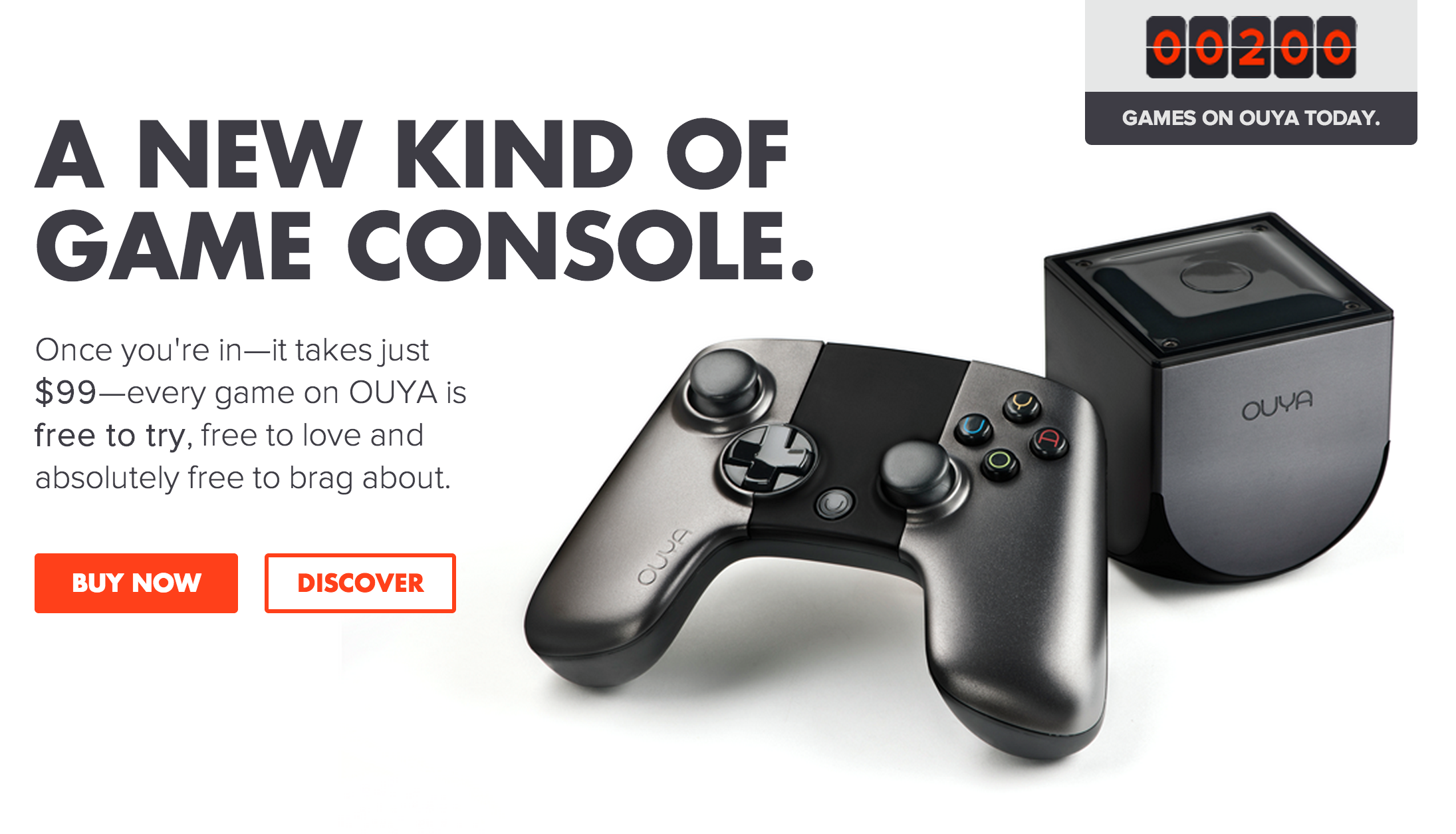
    It’s definitely a new kind of game console, but is Ouya the future?

    I start this article by saying that I’ve had the Ouya a few days now, and am thoroughly enjoying the emulation software on it. I’ve managed to get my collection of classic Sega and NES games running perfectly, and it really takes me back to my childhood having a dedicated experience for games. When I emulate games on a PC or laptop, I can easily get distracted due to the multitasking nature they inhabit, constantly switching to facebook to message people or jumping out of a game to look up a news article breaks the immersion video games offer. The Ouya fixes this for me by being on a TV like a dedicated games console, making sure I concentrate on just the game, nothing else. So whatever else I say about the Ouya, I do like it, and feel like has a great (if not scary) future. In this article I’ll go through the main points that have stuck out to me in my 4 days of owning the Ouya.

    FUCK THE CONTROLLER MANNN
    Just in case you’re thinking about buying a Ouya, this is where the batteries go, this took me far longer than I’d like to admit to figure out.

    Set up:

    One of the first problems you’ll come across when setting up the Ouya is the lack of any good instructions. The instruction manual that comes with the Ouya doesn’t even tell you how to put the batteries in the controller, which in itself is a challenge. I pride myself in being tech savvy, but I couldn’t see a single way into the Ouya controller to insert batteries. Something as small as a little sticker that showed you have to take metal pads off the sides to insert batteries would have sufficed.

    Following on from this I had a few problems when entering my card details in the set up screens (it just kept giving me errors saying it couldn’t communicate with the server.) a reset sorted this out, and I was soon onto the main interface.

    Discover Strorefront:

    The second problem I have to vent about is the store. It looks nice currently, but as others have pointed out, how well will it scale? With 200 games on there currently, it’s fairly easy to find what you’re looking for, but when there’s thousands of games all trying to get your attention? I can’t imagine the trouble devs will have to overcome to make sure their game stands out from the crowd. See below for how it looks, but I can’t help but think Ouya will need a dashboard update soon in order to get around this potential problem.

    FUCK HDCP
    This is the Ouya Discover page for finding new games. This may currently look fine, but I wonder how it’ll scale.

    The search facility does it’s job, but that’s to be expected with only 200 games to search for. I can’t imagine this will change in the future, so there’s definitely a way to find specific games. I just worry for prospective devs that don’t make it to the front page. They’ll have to rely on people specifically finding their game, which can never be a good thing for sales figures. I suppose I see the discover store as a double edged sword, it can be used for good, but could also be a very dangerous place for new starters in the long run. Here’s to hoping Ouya successfully manages this.

    Pricing:

    One of the biggest problems I’ve come across so far though is pricing on the Ouya. Games are free to play at first, but then must be unlocked, which is a nice try before you buy mindset. At the end of the day though, the Ouya itself isn’t expensive, it’s the games that are. Now I know this isn’t Ouya’s fault, they allow developers to price their own games accordingly, but there seems to be a problem with value perception on the storefront, meaning most, if not all games are aggressively overpriced. Some examples are as follows:

    • You don’t know Jack: $9.99 for 20 more question packs. (from what I can find, it’s free on Android)
    • Towerfall: $14.99 to unlock the full game
    • Little Crane: $5.99
    • ATR: $4.99

    The conclusion I’ve come to is that developers are hoping most consumers don’t know that this is a android console, and therefore perceive game value as similar to mainstream consoles. If this is the case, consumers are used to paying this much for content on Xbox’s and PS3’s, but where this theory falls short is the value to the end user. Most games on the Ouya at the moment are sub par, and I really don’t mean to be harsh, but they really aren’t worth as much as the developers are asking for. If developers were to charge the same amount they are charging on Android phones, then I’d definitely be more inclined to give them a few bucks, but not $10 and $15. Hopefully with time these developers will learn the true value of their games, and price them accordingly.

    FUCK THE BOXING
    This is the retail version of the Ouya, which you’ll get if you buy one now. It’s nicely presented, but as the sales clerk at best buy proved, no one seems to know the Ouya exists.

    Games:

    This is what the console is all about, and should be the core component in which the console shines through. The problem is, this is where the console is having trouble for me personally. Some games work flawlessly with the Ouya controller, where as others are clearly ported straight from a normal android phone and have problems with the controller and the console itself. Some games freeze whilst others just don’t run at playable framerates. (Vector is terrible for this, there are times where the game slows down to a snails pace.) I want to point to one game in particular that showcases all these problems: Shadowgun. Shadowgun was one of the worst experiences I’ve had on the Ouya so far, with aiming incoherent and terrible, framerate issues plaguing every second of gameplay whilst also causing crashes, it ensured I didn’t want to pay the $4.99 asking price, and also ensured I uninstalled it right away. These are just some examples of bad ports, and there are certainly many good ports (Hidden in plain sight is one of the best games I’ve played so far, providing hours of fun.) but I hope this isn’t a taster for whats to come.

    FUCK THE VECTORS
    Vector was the worst culprit of framerate slowdowns. Hopefully this gets patched in future

    This is a huge problem for a console trying to appeal to the mass market. Current owners of Ouya will give it a pass for these problems as most owners will be geeks and hardcore gamers that know what they’re getting, but the mass market won’t be as forgiving.

    Final Thoughts:

    The Ouya does indeed have the potential to change the future of gaming, I just worry about how it goes about doing this. As mobile phones have shown, there is definitely a market out there for cheap, addictive games; Ouya has to make sure it capitalises on this market and not get confused with the hardcore console market. The reason people love gaming on Android and iOS is the cheap, reliable experience you get for such a small investment, Ouya risks alienating this market by trying to be the jack of all trades. It’s too busy trying to be the middle man, trying to offer a cheap mobile experience, whilst also charging premium prices.

    For the coming months, Ouya needs to get a lot of mobile developers on board to make sure they have some quality games to sell the system. It’s the same problem Nintendo is having with the Wii U; you need good games to sell the system.