Tag: Mario

  • Super Mario Odyssey (NS)

    Super Mario Odyssey (NS)

    It’s been a bloody good year for Nintendo, and I for one couldn’t be happier for them. Whilst I initial said the switch wouldn’t sell tremendously well, it looks like I may be being proven wholeheartedly wrong, which is a bloody good thing, as it means we get fantastic gems like Breath of the Wild and Super Mario Odyssey, all in the space of one year. The fact I’m comparing Super Mario Odyssey to easily my favourite game of 2017 in the same sentence show’s how fantastic it really is: Nintendo have made an absolutely stunning platformer, one I’ve gone back to so many times since completing it that I’ve put over 40 hours into it.

    So, what is Super Mario Odyssey about? Well, as per always Peach is kidnapped (along with her new tiara hat that is sentient), with Mario being blasted out of the sky upon trying to rescue the Princess from her captor, Bowser. upon landing in a new, Tim Burton-esque world called hat land, marries happens upon a hat ghost that’s inhabited his fallen hat, and proceeds to use this new hat creature asap, finding he can use it to attack enemies, or even control other creatures. This random new mechanic is explained away within a millisecond, and is never explained much further, carrying on Nintendo’s long held trope of not really explaining much, but using it to death all the same.

    Regardless of how weak the actual story is (there’s a couple of cutscenes along the way, with a lacklustre amount of narrative), the actual gameplay is what most (if not all) players are here for, and it has to be said that Super Mario Odyssey has some of the freshest platforming in the last few years. Not only does the new hat mechanic add so much to the way Mario navigates the world, it also changes the way the levels/ world is laid out.

    You see, in Super Mario Odyssey you are taken to individual worlds that have multiple moons strewn throughout. These moons help power your craft for you to move onto the next world, but there’s nothing stopping you spending hours in one location picking up as many moons as possible. In fact, in the desert kingdom I done just that, spending the first 3-4 hours of the game gathering 80% of the moons available (around 70) before even heading onto the next world, meaning I was already way ahead of what the game anticipated.

    This freedom is present throughout the whole game, and ties in perfectly to the structure of how Mario now plays. Throughout your first play through of the main levels you’re basically collecting brand new moons and progressing every couple of minutes. Everything’s so close together and (apparently) so easy to get that you start to feel Super Mario Odyssey is a little bit too easy. But continue to play the same levels, and you’ll notice the easy moons were purely there for the beginners of platformers, and to get you used to the mechanics of Mario.

    As you start to accumulate 500+ moons (once you’ve completed the main story once), you notice that each moon is a challenge in themselves, some requiring knowledge about the world and it’s mechanics, with others requiring player skill in regards to controlling Mario. Regardless of whether you’re jumping across skyscrapers in a city, or running through time trials at breakneck pace, you consistently feel like you’re learning more and being pushed further than ever before. It’s an enthralling experience, and one that genuinely has you enticed well after the final moments of the campaign.

    Graphically, as per Nintendo tradition the game is an absolute stunner to look at. It’s weird to say, especially given the limited power of the portable games console, but my god does the Nintendo Switch manage to deliver on some cinematic levels of quality! Trees, textures, enemies, everything in fact looks and animates delightfully, resulting in one of the most pixar-esque games to have come out of Nintendo for quite a while. I say that often, but it really is true – Nintendo’s graphical fidelity is as if you’re watching a pre-rendered movie in real time, and it’s an absolute delight to behold.

    Level variation goes through the traditional standard formula of ice level, desert level, dark level etc, but unlike traditional platformers where your characters handling changes slightly based on the terrain, Super Mario Odyssey introduces new ai to control, as well as new environmental puzzles to master. Take for example the water level, where Mario still has an oxygen level. Using the new hate controlling mechanic, you’re able to take over fish, that can of course swim indefinitely. This new way of traversing the levels makes each one a delight to rediscover, especially when you’re hunting for ever more elaborate moons.

    Whilst on the topic of levels, the only level I disliked was a food themed level. Whilst many reviewers have praised it for it’s platforming (which admittedly, is pretty good), I couldn’t stand the actual levels’ aesthetics. You see, instead of there being food strewn all over the place (like, burgers, chicken etc.), you instead get a bunch of abstract shapes and colours that are meant to represent food. Some say it’s because Nintendo were worried about advertising food to kids, so chucked all the textures out, which I find more believable than the half-assed attempt at a style we got in the end.

    Musically, being a Nintendo game Super Mario Odyssey is fantastic. Everything from the new voiced jump man song, to the perfectly suited themed songs for each level will have you jiggling around well after you’ve completed the game and walked away for a while. Even as I write this sentence a few songs and swimming around my mind, wanting me to find remixes of those songs on Soundcloud. It’s genuinely fantastic, and Nintendo should be impressed with that they’ve managed to accomplish here.

    So overall, Super Mario Odyssey is an absolute delight to behold, and one that’ll keep you hooked and entertained for hours. Between it, and Zelda, I feel completely justified in spending £300 on my Switch at the start of the year, and would even argue it’s worth people going out of there way just to purchase the new console for these games alone. Super Mario Odyssey manages to perfect some of the series’ tropes, and even introduces (and disregards with relative ease) so many new mechanics that’s any one could have been a game unto themselves. If you like platformers, you owe it to yourself to own Super Mario Odyssey – it’s the pinnacle of what a platformer can be.

    5/5

  • Weekly Gaming: Mario + Rabbids Kingdom Battle (Switch)

    Weekly Gaming: Mario + Rabbids Kingdom Battle (Switch)

    Hey all!

    So this week I take a look at a game I would have never thought I’d actually be buying: Mario + Rabbids Kingdom Battle. Now this may also come as a surprise, but the game is absolutely fantastic, easily one of my favourite games of this year. So without further ado, if you wish to read my thoughts on the game in their entirety, proceed to click the link below:

    http://www.vgchartz.com/article/269255/mario-rabbids-kingdom-battle-switch/

    Hope you’re all well, and until next week, keep safe!

    – Dan

  • Weekly Gaming: Super Mario Run (iOS)

    Weekly Gaming: Super Mario Run (iOS)

    Nintendo’s first foray into mobile gaming may have been a massive hit (Pokemon Go) but their first premium game is certainly a mixed bag of weirdness. Super Mario Run costs the grand old price of £7.99, not an extravagant price when comparing it to the traditional games market, but certainly pricey on mobile platforms. So what do you get for your money? Let’s find out.

    First up, Super Mario Run is a running platofrmer, but because you can’t control a phone as easily as you would a traditional console and controller, the game is a forever runner – Mario himself moves forward regardless as to whether you actually press anything or not. This is a massive break from previous mario games, with their precise controls, but is understandable due to the constraints of mobile phone’s designs.

    Nintendo made a big point of advertising the fact you control Mario with only one hand, and whilst it works absolutely fine, it does change the players relationship with Mario. You see, Mario in most games is renowned for his precision – where you want him to go, he will go. This 1:1 relationship between what you do on the controller and Mario actually moving is one of the main reasons the Mario franchise has been so successful. The issue is, having Mario move himself forward makes it hard to judge when to actually jump, or the to tap the screen to make him kill an enemy.

    This disconnection between player and movement actually has far reaching consequences. I for one love mario games – they can be both simplistic, and extremely hard depending on your skill level. Super Mario 3D World for example, I managed to collect every single optional coin, and even completed the extra hard special levels, all because of how much I enjoyed controlling Mario. Yet, in super Mario Run, I struggled in even simple levels, accidentally making Mario fall to his death multiple times just because I mis-timed a jump or accidentally used my double-jump far too soon. It’s annoying, and actually made me walk away from the game for several months.

    But it’s not all bad, Super Mario Run actually distills the core of Mario games into a mobile platform quite well. Enemies we all know and love go about levels exactly as you’d expect, and are great to take on. There’s no new enemies to take on, but due to some of the level changes some enemies do move in new and different ways. Take the Boo’s for example – as Mario can’t change direction manually, they are usually used as obstacles on your path e.g. popping out of blocks, as opposed to enemies you can actively avoid and use to your advantage.

    As alluded to in the previous chapter, Mario’s new control system has resulted in some level design changes. The most dramatic ones are Bowser’s castle levels, and the haunted house levels. The former doesn’t entail having multiple levels (levels being platforms above and below the one you’re currently on), whilst the latter consists of very thin levels with lots of blocks that pause Mario and allow him to move again when tapping the screen. This is all fine and good and takes a little longer to get used to than usual, but results in some new gameplay that can get a bit confusing. 

    On the subject of levels, it has to be noted how few levels there actually are. In total, there’s 18 levels and 6 castle levels, all which can be completed in around 1 minute, resulting in a really short game. The way Nintendo goes about making the game longer is through collecting optional coins – each level contains 5 purple coins. Should you collect them all, you’ll unlock a new version of the level with 5 new coins. Do this 3 times, and you’ve collected everything that level has to offer. I’m usually a fan of these optional objectives, but genuinely had no interest in it here on Super Mario Run. Maybe it was because there’s no way to go back to collect a coin, meaning it’s more memory of the level than your actual skill, resulting if you having to repeat a level multiple times just to get a single coin, but I just couldn’t enjoy this aspect of the game.

    Thankfully, the graphics are just as good as ever, with Mario looking just as detailed, if not more so than on Nintendo’s own consoles themselves. Levels are lovely and detailed, and the amount of aliasing being used makes Super Mario Run look like a pixar film at times. It’s just so smooth and detailed, it’s genuinely lovely to look at.

    Unfortunately, it seems that Nintendo might have been in two minds when making Super Mario Run. You see, whilst it’s a premium game with a premium price tag, it’s completely cluttered with free to play elements, something that seems at odds with the game’s core design. You see, you start in a hub world where you must start to rebuild the mushroom kingdom using Toads earned through repeating levels in the game’s “Rally” mode, and coins earned in levels. Not only does this try to get you to repeat levels endlessly, it also proceeds to tally up how many enemies you’ve killed giving you special unlocks should you kill so many.

    This split personality of premium/free to play couldn’t help but make me feel…. gross for playing Super Mario Run. If the game would have been free-to-play, most of these mechanics would have been completely acceptable – Nintendo need to make money, so keep you coming back is the way to go. But, if I’ve paid a non-inconsequential fee to play the game, I don’t expect to be bombarded with all of this shit. I should be able to play the game as and when I want, and not pestered to spend more time in Mario’s world. It’s a weird mismatch of a game, and one that I wish Nintendo would have fully committed to one or the other.

    Overall, I’m glad Nintendo is foraying into brand new territory, but it needs to do so with some consistency. Trying to incorporate Free-to-play mechanics into a premium game makes it both annoying, but also is a subservience to fans of the series, and first-time players alike. It’s enjoyable for a few hours, but Super Mario Run is a weird mix of a platformer that alienates fans of the series, and becomes too expensive for the casual player. By all means give the game a download if you need to see everything Nintendo produces, but be warned that you may not find it as enjoyable as Nintendo games of yester-year.

    3/5

  • Weekly Gaming: Super Mario 3D World (Wii U)

    Weekly Gaming: Super Mario 3D World (Wii U)

    It’s genuinely insane how much adoration and annoyance I have for Nintendo games. On the one hand, they make absolutely charming games that are addictive for days, weeks, years even until you’ve collected everything a game has to offer. I remember doing just that with Super Mario 3D Land, collecting everything (yep, every single stage twice as Mario and Luigi + secret stages) the game had to offer. But my annoyance comes from the fact that they make the same games every generation of consoles, with the aesthetics being one of the only things they mix up with recent iterations (Yoshi’s Woolly World & Paper Mario come to mind). Thankfully, Super Mario 3D World is not one of those games, and as a consequence, is some of the most fun I’ve had on a Nintendo game since 3D land all those years ago.

    1381512525385-1

    You see, whilst most other nintendo IP’s have been through several generations of consoles before they ended up being rehashes with new aesthetics, Super Mario 3D Land was only released a few years ago on the 3DS. The great 3D environments and fantastically short levels truly helped to make one of the most exciting and original Mario games of recent memory. Super Mario 3D World elevates this praise and takes it to the next level, showing what you can do with a Mario game in 2013, with a proper console behind it.

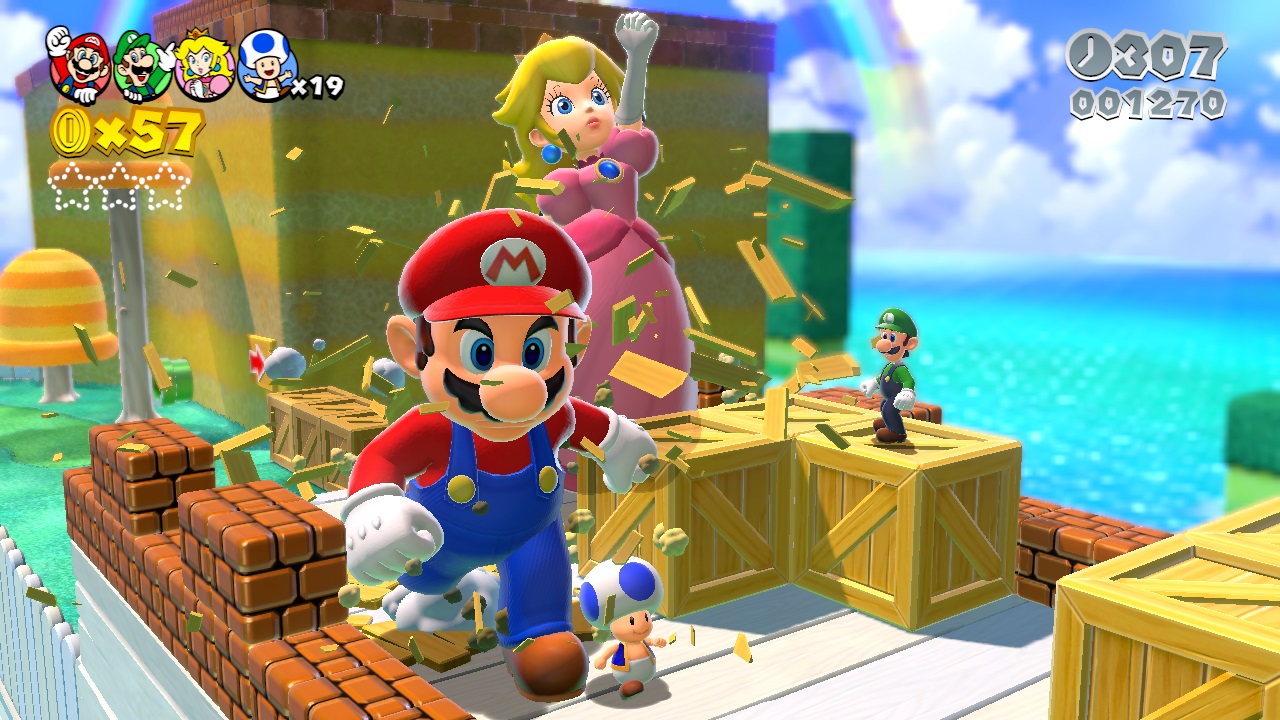
    One of the first things I have to get out of my system about the game is it’s absolutely stellar presentation. Seriously, who knew simplistic geometry and cute disney-esque designs could be so god damn gorgeous? Everything, from the grass waving in the wind, to the mud that you see underneath, is absolutely stunning. It’s also insane that in a time when most console games are struggling to reach 30fps, Super Mario 3D World never stutters or moves below 60FPS, helping to keep gameplay smooth, no matter how many players or enemies are on screen at any one time.

    sm3dw1

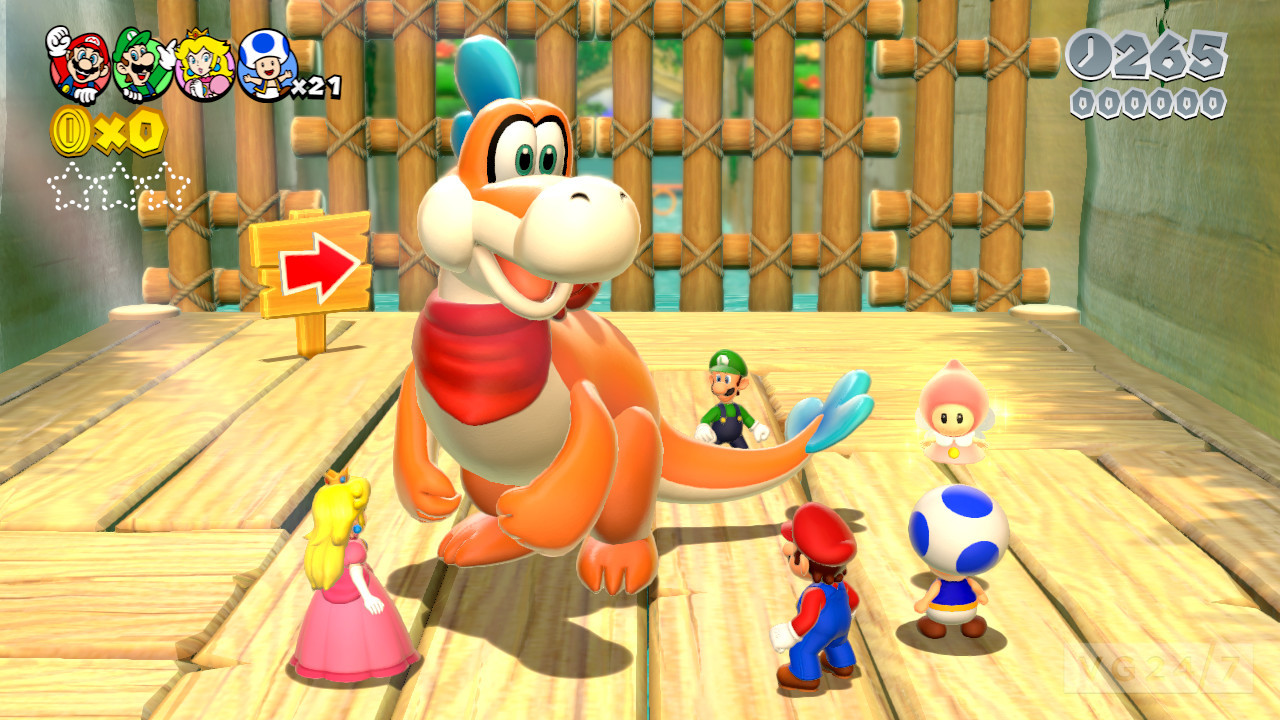
    The addition of multiplayer is a huge advantage over it’s predecessor on the 3DS. Being able to play the game with my other half ensured that I was finally able to incorporate her into my game time, ensuring she had a lot of fun whilst I got to play a game I wanted to review. Yes there were disagreements, it’s bound to happen in a game where the camera is trying to incorporate both players in the screen at any one time, but it was still enjoyable all the same.

    With the presentation and multiplayer out of the way, how does the gameplay hold up? Rather well actually. Mario and the team still jump in the ways they always have (with peach being hugely OP since she can hover whenever she likes!), but because of these mechanics being the same as they always have been, where does nintendo find the innovation? In the course design and power-ups. You see, rather than resting on their laurels, Nintendo came up with quite a few new power-ups to use throughout, from the new cat bell which turns Mario and co into cats that can climb walls (in all fairness, this power-up feels like Nintendo’s pandering to the internet culture, but it was still good to use all the same), to the new cherry power up (which spawns a new playable character on the screen) found throughout certain levels, each power-up felt great to use and helped in keeping each stage original, and giving new options by which to traverse the levels.

    super-mario-3d-world-2

    It’s thanks to the course designs that each level is so enjoyable to play and go back to. Everything’s doable without power-ups, but it’s the power-ups that will help you achieve 100% of collectibles within a level should you have them. For example, the vast majority of levels will allow you just to rush through, but should you wish to get a collectible green star (there are 3 of them in each level), you’ll need to climb a wall, which can only be done with a cat bell power-up. Most stages will give you these at the start, so it’s up to your own skill as to whether you can keep them until the end of the stage. It’s a fantastic system that ensures everyone feels encouraged to finish a level (no matter whether they’re tiny Mario or full upgraded), and helps to make sure those who are slightly more skilled (who keep the power-ups) get the satisfaction of beating a level without being hurt.

    There are drawbacks to the new camera angle approach in Super Mario 3D World, and it’s mainly present in multiplayer. You see, trying to keep multiple players on the screen at the same time can take a lot of effort on the developers side, so to compensate, they make the player who’s ahead and on the correct path the main, focused player, whilst also zooming out to show the other player. This approach works most of the time, but there were so many instances where I would have to turn into a “balloon” in order to get back to my other half on screen, even though I was getting a power-up or collectible. It’s frustrating at times, and can also cause you to miss-time your jumps, resulting in lives lost or getting damaged by simple creatures like goombas.

    Super-Mario-3D-World-7

    Overall, Super Mario 3D world is simply one of the best games I’ve played in recent memory. It’s simplistic control scheme and simply sublime graphics really help to show how Nintendo go to where it is through sheer polish alone, a rare sight in a world with buggy games and unpolished presentations. If you have a Wii U, the price tag of Super Mario 3D World may be steep, but it’s worth every penny.

    5/5