Tag: PS4 Pro

  • Weekly Gaming: Uncharted 4 (PS4 Pro)

    Weekly Gaming: Uncharted 4 (PS4 Pro)

    Unchartered 4 Review (PS4 Pro)

    As those of you may have seen from previous reviews, I like the Unchartered games, but always found them a bit hollow. In fact, it was the original Unchartered game that put me off the series for so long, with its mediocre presentation, lacking game design, and weird characterisation. A started to warm towards the series throughout playing 2 and 3, with both games not only pushing the limits of what was possible in the graphical department for such an old system, but also making the characters more likeable.

    So here we are at the fourth title in the series, and what have Naughty Dog managed to do? They’ve managed to learn from their previous titles, that’s what.

    You see, what I didn’t mention is that between 3 and 4, Naughty Dog released The Last of Us, a great game that I reviewed when it was released. It received critical acclaim, and rightly so, especially for the character interaction and building that they managed to do. Naughty Dog haven’t rested on their laurels, and with the help of the lead writer, creative director and programmer Neil Druckmann, have managed to create characters you can genuinely love, and hope do well. This isn’t to say Neil was the only developer who helped craft unchartered 4’s story, far from it, but he seems to have pushed the seriousness of gaming one step closer to Cinema and TV, making it a better medium as a consequence.

    Anyway! Back to square one before I go on a tirade about nonsense. How does Unchartered 4 play? Well, if you’ve played a previous entry in the series, then you’ve basically played Unchartered 4. Don’t get me wrong, theres a few new mechanics used throughout the campaign, such as the hook mechanic to swing from platform to platform, but overall nothing new can really be seen here. You go through the same old routine of – narrative > puzzle > platforming > kill lots of henchman > platforming that we all know and (maybe) love.

    This tried and tested formula may not be very revolutionary, but what’s different this time round is the previously mentioned character arks, especially with Nathan Drake himself. You see, from Unchartered 1 through 3 you never really knew anything about Nathan’s past – yes, he would occasionally say things about how he met sully, but outside of that you’d never know how he knew so much about history and had some great survival skills.

    Unchartered 4 manages to do a fantastic job of not only fleshing out Nathan Drake, but also his new, never before seen or mentioned brother, both of which have a few chapters that go back to their childhood in an orphanage, and even what they got up to as youngsters. This fleshing out at first feels a bit contrived, merely to teach you some new mechanics you may first think – but as the campaign progresses you start to get a real sense of brotherly love between the two siblings, and eventually, care about their wellbeing.

    Graphically, the game is stunning. Everything from the mocap on the main characters, to the detailed forests, and even the gorgeous ancient buildings all looks truly magnificent, so much so I was taking screenshots every few seconds. I swear I’ve said this before, but if only Naughty Dog wasn’t a PS4 exclusive developer – the things they could do on a platform as powerful as the PC could be truly breathtaking.

    What helps bring the graphically impressive world to life even more is the new open world driving sequences, which, whilst are new in the game design of Unchartered, are still fairly linear. You’re given a big area of a map to explore, and an objective to find something, so you proceed to drive around looking for clues that may help to reach your objective. These sections can be as long, and as short as you like, and certainly add something new to the traditional formula of Unchartered.

    The set pieces are just as extreme as ever, and push the physics simulation of the PS4 to the absolute max, with debris flying everywhere, as well as dynamic building falling as you progress, or even cityscapes being drawn in on the fly. My other half also found them incredible, being surprised that even with eh amount of detail on display, I was still controlling Nate throughout the entire scene as it was unfolding. If you liked previous Unchartered’s set pieces, you’re sure to love them here.

    There is unfortunately still the issue of ludonarritive dissonance – that is the fact that the story. puzzle solving and everything else seems to have no bearing on the actual shooting of enemies throughout the game. It’s like you’re playing two completely different games – no one ever mentions the fact they’ve just killed a bunch of men, and no one certainly mentions the blatantly stupid story moments when enemies just so happen to be in the ruins of a never before seen city. It’s all a bit immersion breaking, and certainly got annoying towards the end of the game when (spoilers ahead!) the group abandon the cave with treasure in despite the fact they could go back there at any time.

    Another issue I found was the combat. Whilst Unchartered 4 pushes you to be as stealthy as possible, I found it was easier (and faster) to just start shooting the first enemy as soon as possible. Being sneaky resulted in a lot of AI routine bugs, especially when they were within close proximity to each other, resulting in enemies walking to a cliff edge, back into a friend, and back again.

    So overall, I definitely enjoyed Unchartered 4 more so than the previous entries in the series. It still has some of the same issues that plagued the previous titles BUT it managed to add enough story moments, along with better character depth, to make me choke a little at the ending. It’s been a long ride, but one I’m glad I experienced, and dare I say it, you should too.

    4/5

  • Weekly Gaming: Sonic Mania (PS4 Pro)

    Weekly Gaming: Sonic Mania (PS4 Pro)

    Hey all!

    Welcome back to weekly gaming! This week, I review Sonic Mania, a game I’ve been waiting to be released for a long time. Having been raised on Sonic, Sonic Mania manages to hit all the right nostalgia notes, all whilst bring lots of new and refreshing ideas to the table.

    You can read my full review at the link below, but SPOILER ALERT: I like the game, a lot.

    http://www.vgchartz.com/article/269085/sonic-mania-ps4/

    Anyway, until next week!

    -Dan

  • Weekly Gaming: Get Even (PS4 Pro)

    Weekly Gaming: Get Even (PS4 Pro)

    Hey all!

    This week, I take a look at Bandai Namco’s new weird FPS horror game, Get Even. It was a strange game that tried to do too many different genres in my opinion, and never really mastered one. It’s ambitious, and genuinely worth a play, but man oh man does it not hit on any of the mars it attempts to.

    You can read my (heavily edited) opinion on the game below:

    http://www.vgchartz.com/article/268505/get-even-ps4/

    Until next week!

    -Dan

  • Weekly Gaming: Tekken 7 (PS4 Pro)

    Weekly Gaming: Tekken 7 (PS4 Pro)

    Hey all!

    So this week, I take a look at the latest of one of my favourite game franchises of all time: Tekken. Whilst the graphics are as gorgeous as ever, I certainly missed the old arcade mode with multiple random endings. Overall, I’m glad the game exists, but it definitely feels a bit of a hollow package considering the value of previous titles in the series.

    You can read my review below:

    http://www.vgchartz.com/article/268324/tekken-7-ps4/

    As always, I hope you enjoy the review, and until next week, have a good one!

    -Dan

  • Weekly Gaming: Virginia (PS4)

    Weekly Gaming: Virginia (PS4)

    Virginia (PS4)

    Those of you who’ve been reading this website for a while may know how much I adored Thirty Flights of Loving; the extremely short indie game that showed you can evoke drama, emotion and story from any game, even if it has no voice acting or dialogue.

    Virginia is one such game that was also heavily inspried by those weird and wonderful experiments all those years ago. Set in the town of Kingdom, Viriginia, you play as Anne Tarver, an FBI Special agent which is assigned a partner who is already working on a case of a missing teenager called Lucas.

    Throughout the course of the campaign you’ll be given control of Anne as you make your way from one location to another, seeing what unfolds before you. Since there’s no dialogue, it’s up to you to determine the intention of what is happening in each scene, making the story confusing, but extremely intriguing and engrossing. This constant guessing kept me on my toes throughout Virginia’s two hour playtime, so much so that even know, I’m guessing my interpretation of the story may actually be different than the developers originally intended.

    It has to be said, but the way in which your character is teleported throughout the world is genuinely stunning. Holding a piece of paper and examining it one moment in the office you’ll find the next you’re looking at the same page whilst now in a car to your next destination. The Scene transitions are sublime, so much so that at times you never notice.

    If anything, the abruptness to which you’re thrown around the story adds to it’s appeal. Tension and intrigue would be lost in making the player walk from point A to point B, so to speed it all up and getting rid of the mundane, Variable State have managed to make a refined and dramatic experience, one that keeps your entranced from the moment it begins to the end.

    To coincide with the amazing jumpcuts throughout, Variable State have managed to employ an absolutely amazing soundtrack, one which is so great that I’m listening to it now as I write this very review. It’s genuinely has the production values and acoustics of a Hollywood film, and is so integral to the story that the storybeats happen just as the music drops a beat, resulting in euphoric moments that push you to get more involved with the weird and wonderful world. Seriously, give the soundtrack a listen whilst you read the rest of my review; you will not be disappointed:

    Story-wise, Virginia is a mixed bag. Whilst my interpretation of the story may be wrong, and I enjoy that you have to interpret it in your own way, the constant shifting of scope can also be seen as a bad thing. Unlike Thirty Flights of Loving, where there was some ambiguity, but for the most part you could figure out what was happening, Virginia goes the opposite direction, and proceeds to make the main story so ambiguous that entire threads were created just to discuss what had actually happened.

    [Add something here]

    As an actual game, Virginia could actually be considered a “Walking Simulator”. Whilst some may consider that a detriment, I find it endearing, as all I wanted was to experience the story and little more. There are opportunities to walk about in some sections of the game, but due to the simplistic graphic employed throughout, I found no reason too. I mean, what’s the point in walking over to a desk full of books when there’s no actual writing on the books themselves – they’re merely a prop to the environment, and little more.

    Don’t take my “Simplistic Graphics” comment to mean that Virginia has bad graphics. Far from it. In fact, there are many times where the minimalist aesthetics work to its advantage, giving some spectacular scenes where I couldn’t press the screenshot button fast enough to show how beautiful the game is. Each character is suitably animated, to the point you can properly detect what emotion they’re meant to be portraying at that moment in time. The animations were so great and fluid that they actually helped to make the characters and world as a whole feel all the more believable, despite the minimalistic graphics seen.

    Virginia is, if anything, a testament to what can be done in the “Walking Simulator” genre. Given enough time, and talent, these games are able to make an audience feel, and think, so much more than a typical medium like Television. The fact that you’re actively engaging with the world and pushing the story along helps make you more aware of every little detail, stopping you from zoning out and missing elements of the story. I managed to pick the game up in the Sony sale, and for £3.49, you really cannot go wrong. If you like mysterious games with pleasing graphics, give Virginia a go; you won’t be disappointed.

    4/5

  • Weekly Gaming: The Witness (PS4 Pro)

    Weekly Gaming: The Witness (PS4 Pro)

    I’ve been wanting to play The Witness ever since Ryan Davis talked about it years ago. He, and Brad Shoemaker, managed to get a secret tour of Jonathan Blow’s studio years before the game even had a proper name. Everything the guys said about the game sounded right up my street – an entire island made up of little puzzles where they all interconnect with each other and expand on each others rules sounded amazing.

    Suffice to say, after 30+ hours in the game with my other half, The witness delivered on most, if not all promises that were made in the run up to the game’s release, and in interviews afterwards.

    So what is The Witness? Simply put, it’s a walking simulator whereby you walk around an island and solve line puzzles. If anything, that simplification may actually be doing something of a disservice to The Witness, because it’s so much more.

    You start off in a tunnel, where the only way your player can go is forward. From the very offset, The Witness is telling you that there’ll be no hand-holding in this adventure, with everything you need to know being conveyed using the world and the environment itself. This point is pushed home not just 5 seconds later, when you come across a door which has the first puzzle you need to solve on. Before you can begin the game properly, you need to press X on the first puzzle, which is impossible to fail. On this first board/screen, you’re presented with a simple line – at one end, a circle, at the other, the end of the line. Simply pressing X within the circle at the left begins a line to wherever you direct it – pressing X again once you’ve directed the line to the end solves the puzzle. Simple right?

    Well, whilst it starts off simple, this premise soon gets expanded upon no end, with other boards adding symbols or colours to represent new untold rules. These new rules will always be introduced in a nice, gentle manner; similar to the way the first ever puzzle was introduced. Once you start to get used to a new rule, the proceeding puzzles will push your knowledge of this new rule to the limit, even pushing you so far as to combine your knowledge of other puzzles too. This introduction -> expansion -> mastery loop is genuinely fantastic, and constantly makes you feel like a genius each time you master a new rule. There are times where a few guesses will successfully get you through a few puzzles, but these moments , if anything, help you to master a new rule even more – as you’re constantly looking at why your guesses succeeded, and what the difference is between new puzzles.

    I seem to have gotten ahead of myself a little – as I haven’t explained why you’re solving these puzzles. The genuine answer is intrigue. As per the core gameplay loop whereby nothing is explained and it’s up to you to figure out the meaning of the puzzles, the same happens on the island you play upon. As you explore and walk around the island finding new boards, you’ll notice little structures and untold stories – all of which are, as their names imply, completely untold. It’s up to you to decide, or interpret what happened on this island, and why all these boards exist.

    On top of this, there’s many hidden tapes to find throughout the island. When found and activated, the tapes go ahead and play a fantastic, and somewhat unrelated speech by a philosopher or scientist in the real world. Whilst I enjoyed finding this hidden tapes, my other half was certainly confused, and found their presence annoying, as she couldn’t make sense as to why they existed. For what it’s worth, whilst I agree they felt a little abstract, I enjoyed listening to these thought provoking statements whilst stretching my brains capacity in trying to figure out puzzle solutions.

    The island you explore is huge, and the amount of variety in the puzzles you find is insane! I was about to go into detail in how they all differentiate from each other, but I feel in knowing what to look out for would ruin the surprise and satisfaction you get from learning a puzzles rule by yourself. Don’t take these words lightly; The Witness will have you feeling like an idiot, and a genius, all at the same time.

    Graphically, The Witness is stunning. Minimalism is the theme here, but it’s not minimalism without detail. Everything on the island is bright and saturated to high heaven, with geometry standing out to make sure you notice subtle environment cues which could help solve puzzles. It’s not a stretch to say that any screenshot you take within The Witness is frame-able, with stunning views and amazing attention to detail even in every nook and cranny. All this stunning art on display becomes all the more vibrant on a PS4 Pro with a 4K HDR screen – so much so that when I tried to play the game again on PC I couldn’t get over how much of a difference the transition made.

    There is one cause for concern – the core of the game itself. Whilst I personally loved the theme of The Witness, and lavished every moment I spent figuring out puzzles or exploring, I can see why for some people this type of game would rub them up completely the wrong way. The lack of instructions, direction, or anything to propel you along any given path can be seen as a disadvantage to some gamers. Bear this in mind if you find “walking simulators” like Dear Esther a little too dull or non-linear.

    So should you go out and buy a copy of the Witness? Wholeheartedly yes. Even if it’s just to experiment with a puzzle game to see how far you can get,  The Witness pushes the limit of what it means to be a puzzle game, making you as a player feel simultaneously clever, and stupid, all at once. I didn’t finish every puzzle in the game, and certainly didn’t find all the island had to offer me, but I know for a fact I’ll keep coming back to The Witness, just to chip away at it time and time again.

    5/5

  • Weekly Gaming: Little Nightmares (PS4 Pro)

    Weekly Gaming: Little Nightmares (PS4 Pro)

    Hi all!

    This week I’m linking back to a game I played a few weeks ago; Little Nightmares. Whilst the game may be short, it’s certainly engrossing, and creepy, so should you want to spend 3-4 hours playing in a unique and weird world, give Little Nightmares a look; you won’t regret it.

    You can read my full impressions on the game by clicking the link below:

    http://www.vgchartz.com/article/268003/little-nightmares-ps4/

    Hope you have a great week, and until next time, stay classy.

    -Dan

  • Ratchet and Clank (PS4 Pro)

    Ratchet and Clank (PS4 Pro)

    I have a confession to make fellow readers: I never played the original Ratchet and Clank’s that came out for the PS2 many many years ago.

    Whilst that’s not a massive confession, it does have its reasons. Growing up me and my family were never playstation fans. We had the consoles, but we also had the gamecube and xbox, and as such, never sided with just one console’s exclusive. Given the plethora of different titles we could choose from on all consoles, we missed out on some exclusives from each respective platform.

    Regardless of this, having played through Ratchet and Clank on the PS4, I can safely say I’m annoyed I didn’t play this series of games when they were first released.

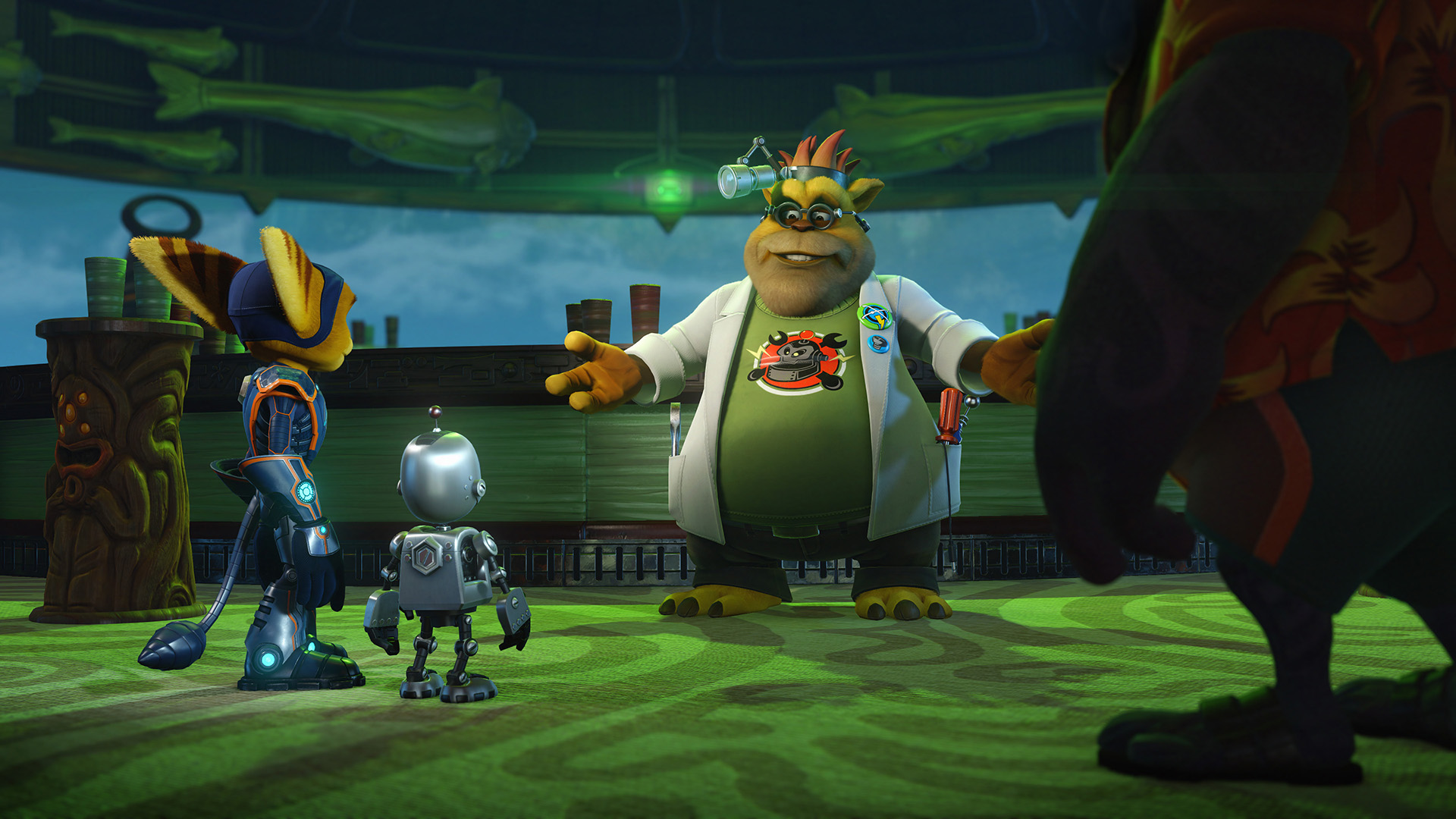
    Being a reboot, most elements are stripped out of the original series and brought into modern sensibilities. The graphics, for example, is absolutely stunning, with the PS4 Pro and 4K TV being an absolutely fantastic combination for playing the game. The story too has had some changes, with a quick google search showing me that whilst the plot is mostly the same, the characters and their key plot points are changed ever so slightly to align with the recently released Ratchet and Clank film.

    One of the first things that caught me off guard whilst playing the main campaign was how hooked I became whilst playing the story. I’m not usually into platformers, as I feel they can get repetitive and easy far too fast. Not so with Ratchet and Clank, where I was playing the game all day everyday until I eventually finished the campaign and started the “New Game +” mode, at around 13-14 hours. There’s just something about the RPG-lite gameplay of the game that lends itself well to also being a platformer, meaning that I kept re-visiting already completed planets just to make sure I got everything that was available, and finished every objective.

    The story is charming and all told from the point of view of Captain Quark, the once head of the Galactic Rangers, which is now in prison due to what happened throughout the course of the campaign. This method of story telling results in some rather humorous scenes, especially when Ratchet and Clank do something the captain wasn’t expecting, resulting in some fourth-wall breaking moments. There’s not really any character development to speak of, but when the gameplay is so addictive and fun to play, there’s no reason to want a better story.

    Playing through ratchet and Clank is equal parts third person shooter, third person platformer and beat-um up. You control Ratchet, who has clank on his back (most of the time) and proceed to jump around the environment defeating enemies either with your melee weapon (a crank) or your myriad of crazy and awesome weapons gained throughout the course of the campaign.

    This combination of gameplay is fantastic in action, and makes for a challenging and varied experience. I found myself dying quite often, even on medium difficulty, rethinking my strategy on how to take down a new crowd of enemies with different combinations of weapons or even new ways of attacking. Then there’s sections of levels which are entirely dedicated to platforming, meaning you’ll need to jump at the right time or find the right route in order to get a piece of treasure at the end. It’s fun, and always kept me on my toes, resulting in an enjoyable time throughout my playthrough.

    Each weapon you acquire is both entertaining to use, and also upgradable, resulting in many quirky and awesome side-effects. The pixelator for example is pretty nifty, and once fired, results in enemies becoming their old PS2 models whilst also being pixelated. The boogie ball was also fun and hilarious: shoot it into a field of enemies and laugh as they all stop fighting you to take part in dancing around the ball. It’s fun, and actually made me invest in my weapons a great deal, so much so that I ended up finding every collectible in the game in order to upgrade them.

    The collectables throughout the stages are fantastic, and help to keep you involved in the game. 28 Gold studs are hidden throughout the whole campaign, with each one unlocking new cheats, or even aesthetic changes to be used. These rewards for exploration may seem trivial, but when they help in speeding up or slowing down the game they become extremely useful. Then there’s the trading cards you can collect from hidden spots on maps or by killing so many of a certain enemy. Each set that’s collected give’s buffs in the game, for example giving me +100% damage when meleeing enemies, certainly a great buff I’m sure you’ll agree. It meant that everything to collect contributed to the enjoyment of the game, meaning nothing ever felt meaningless or without warrant. I know I certainly enjoyed it so much that I proceeded to collect everything Ratchet and Clank had to offer.

    The only thing that could be seen as a bad thing about Ratchet and Clank is the rate at which you obtain studs throughout the world. These studs are used as currency within each level, allowing you to buy ammunition, or even new weapons. Trouble was, studs come out of every enemy you defeat and every obstacle you destroy, meaning throughout the course of the game I had so many that I never had to worry.

    So overall, I’m glad Ratchet and Clank was remade. This story, as well as graphical fidelity, harkens back to a by-gone era, one where the point of a game was to have fun and nothing else. With the increased visual fidelity (thanks to the PS4 Pro) and updated gameplay, I can certainly say that Ratchet and Clank is one of the best PS4 exclusives I’ve played since it’s release, and one that you owe yourself to own should you have a PS4.

    5/5

    N.B. Ratchet and Clank is one of the first games I’ve played that’s truly a 4K HDR title, and my god does it shine. The colours, and aesthetics throughout are so slick and gorgeous that you could be forgiven for thinking you were watching a movie. 4K HDR games are really going to ensure artists’ work is shown how it was originally intended, making for an exciting and enticing future in Video games, especially for ones that don’t strive for realism, and have a art direction that takes advantage of every pixel on screen.