Tag: Steam

  • Weekly Gaming: The Mind’s Eclipse (PC)

    Weekly Gaming: The Mind’s Eclipse (PC)

    Hi all!

    This week, I look into the new game The Mind’s Eclipse – a sci-fi visual novel game by the new studio, Mind’s Eclipse Interactive.

    It has to be said that whilst some elements of the game were repetitive (e.g. the layout of the rooms), the rest of the game, such as it’s world buidling and plot, were stunning.

    You can read my full impressions on the game using the link below:

    http://www.vgchartz.com/article/272273/the-minds-eclipse-pc/

    Hope you have a great week!

    – Dan

  • Weekly Gaming: A good Snowman is Hard to Build (iOS)

    Weekly Gaming: A good Snowman is Hard to Build (iOS)

    Like clockwork, it’s another friday, so that means another game to review! This week I take a look at A Good Snowman is Hard to Build, a game I bought when it was on sale due to a snow day here in the UK. So without further ado, here’s my thoughts on the game.

    First up, AGSIHTB grabs your attention from the offset due to it’s absolutely charming design, and sweet animation. No matter how long you play the game, you’ll consistently be surprised at how cute the game is, especially given how few assets are on display here. Each snowman/woman you successfully create has its own unique look, leading you to believe they have their own personalities, despite them being technically inanimate objects. It’s charming, and down right amazing in your entire time with the game.

    So, I should probably at this point talk about the game’s core loop. So here’s to elevator pitch: AGSIHTB is a puzzle game where you must explore a maze, creating snowpeople as you go along. Each section of the maze will be a different shaped room, which restricts you in your ability to create the snowpeople, leading you to think of different ways to the solution. Each room usually starts off with 3 snowballs – roll a snowball over a patch of snow and it’ll create a slightly larger boulder. Roll once more and you’ll get the maximum size. You must pile 1 small, 1 medium, and 1 large snowball on top of each other to finish a room, which is a lot harder than it sounds.

    You see, medium sized snowballs CANNOT touch another piece of snow without becoming bigger, meaning you’re constantly watching and analysing rooms to see how you can make 1 large boulder, whilst avoiding snow to ensure the others don’t get any bigger. This complication can be irritating as hell at times, but the feeling of elation you get when solving a difficult room is exhilarating, enough to keep me playing throughout one day to the games completion.

    Outside of building snowpeople, there’s not much more to do around the environment. You can sit on benches, hug completed snowpeople, and look through telescopes to see the whole map, but other than that, you’re stuck with just solving puzzles.

    There’s not much to say in regards to the music – it’s cute, and is there, but otherwise, you’re more than welcome to play the game on silent on your mobile, or whilst listening to an audiobook. I personally played the game whilst watching youtube videos, which was perfect, as I was able to execute a guess at a puzzle, and whilst the person was animated in doing that action, I could then continue watching the TV.

    There’s no story to speak off – you wonder around, create snowpeople who each have names and different accessories, and finish the game once you’ve completed each puzzle. There’s more after you’ve completed it all, but I shan’t go into that as I don’t want to spoil the surprise.

    So overall, I know I haven’t written much, but that’s because AGSIHTB is to the point and genuinely lovely to play. Some would say the lack of anything else to do would be a detriment to the game, but I feel it made AGSIHTB all the more better for being a purely cute puzzle game. If you fancy a game on the go, and love puzzle games based on moving things around a given space, then A Good Snowman Is Hard to Build is the game for you.

    4/5

  • Doki Doki Literature Club (PC)

    Doki Doki Literature Club (PC)

    Warning: the following review contains plot spoilers for Doki Doki Literature Club. It’s recommended you play the game before reading this review.

    Given it’s the end of the year, and that I had to complete one more game to achieve another year of 52 games, I proceeded to look through steam for new games I could play that weren’t too long. That’s when I remembered Doki Doki Literature club, the quirky game from Team Salvato that the internet seems to be going crazy for. Looking it up, I couldn’t believe my luck: it was free! So I got on with downloading it asap and proceeded to play it one Sunday afternoon.

    First up, lets get this out of the way. Doki Doki Literature Club is a Visual Novel game whereby you play as a school kid who happens to find himself in a literature club with 4 very attractive girls. Each day you write a poem for them, and cater it to individual girls, for example, Yuri like’s dark, edgy words and themes, where as Natsuki (the more childish of the group) prefers cute and lovely things. Depending on the words you choose for the poems, each girl will fall ever closer to you, showing custom art pieces of the girls and you becoming quite intimate.

    So far, so typical waifu* game. But Where Doki Doki Literature Club changes is in its approach to bringing about a bigger narrative of these types of waifu games. You see, half way through the game, one of your best friends starts acting weird, writing poems that talk about getting someone out of their head. This all comes to a head when said best friend comes out as having depression, and proceeds to commit suicide one day later. Rather than live with these consequences in game, the game then rewinds, taking you back to the start of the game all with the exception of your best friend now being missing.

    N.B. Waifu games cater to single young men, presenting them with a bunch of ladies, of different personalities and body types for the purposes of making them grow attached to these fictional characters so that they buy products with said characters on/invest more time and money into the franchise.

    Play another week in the game and you’ll soon start to notice that the girls are acting up, to the point of wanting the player at all costs or even just acting weird. The character I was romancing, Yuri, even proceeded to start giving me poems which had her “scent” on, and even would have outbursts of how she would play with herself using the pen I dropped one day. Whilst this was all weird, I found it a fantastic narrative of how far gamers who like waifu’s are willing to take their relationships with their imaginary characters.

    To put it another way, Doki Doki literature club takes waifu games to their logical extreme, pushing the player to question what is right and wrong when it comes to games that create female characters purely to be maids to the main character. I mean, how long would you take being stared at in a cupboard before it no longer feels cute and affectionate, and instead is taken as the creepy and weird action it actually is? In putting the player in these circumstances, Doki Doki Literature Club manages to be both one of the best Waifu games on the market, whilst simultaneously showing how awful the games can be.

    The fact that the ending literally screams “this world and the women within it were made entirely for you!” pushes this point home even further, so much so that I’m unsure how anyone could conclude anything different from the game.

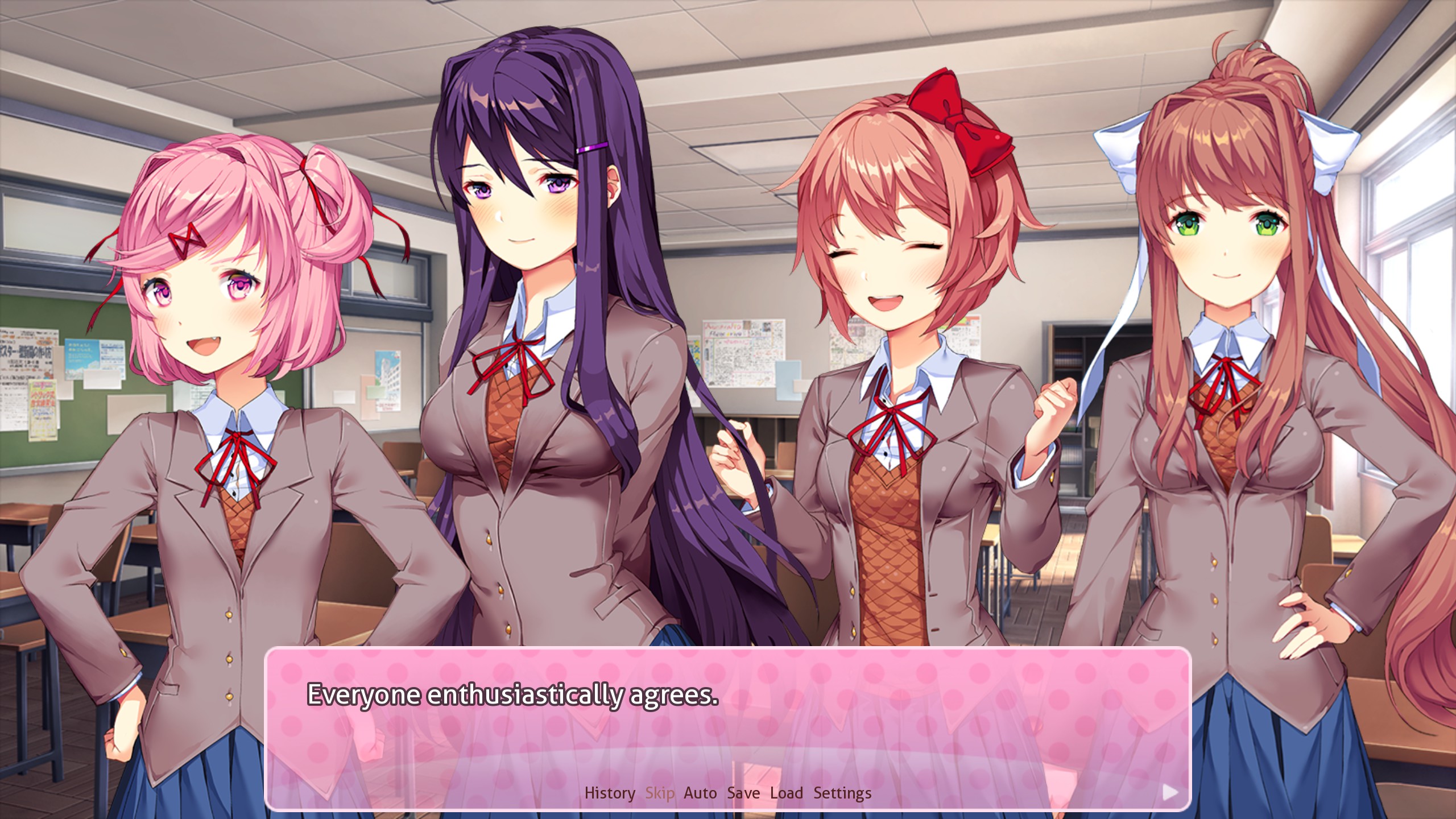
    Play even further, and you’ll eventually have Monika (pictured above) come out and specifically say that she’s been altering the game files to get closer to you, the player. Having to navigate to these files just to delete this crazy character was a fantastic touch, one that drove the point home even more about how this game, and world, was created just for you, to the point an “AI” would want to delete all competition to be with you.

    Hmmm… this is usually the point in the review where I talk about the game’s graphics and sound – and whilst the cute anime girls are certainly detailed and do the job, graphics is definitely low on the list of priorities for Doki Doki Literature Club. Being a narrative driven game the images on screen are merely there to communicate what girl is saying what to you, and whilst it’s all pretty, it’s not really the point of the game. Don’t get me wrong, there are points when the art and particle effects on display are fantastic, but overall, don’t go into Doki Doki Literature club expecting to push your PC to it’s limits.

    So all in all, as you may well be able to tell, I thoroughly enjoyed Doki Doki Literature Club. It’s a pleasant (read: enjoyable) game that really has you wanting to know more about the characters and the world they inhabit. I liked the overall tone of the game, and felt that the twists and turns the narrative took helped keep me interested when I started to get bored of interacting with the same people over the course of the week. Give Doki Doki a try, I promise you won’t be left disappointed.

    P.S. TEAM YURI FOR THE WIN

    4/5

  • Weekly Gaming: Sonic Forces (PC)

    Weekly Gaming: Sonic Forces (PC)

    Hey all!

    This week I take a look at a series I’ve long loved, the Sonic franchise! I would usually be excited about this, but I’m afraid there’s bad news: Sonic Forces is easily one of the worst games I’ve ever played. Graphics aside, the game has next to no redeeming features, with it’s controls easily being one of the worst I’ve ever experienced. It’s as if the animations/graphics were made by Hollywood studios, whilst the programming was left to a bunch of primary school children.

    If you want to read my full opinions on the matter, by all means click the link below:

    http://www.vgchartz.com/article/270151/sonic-forces-pc/

    Until next week, I hope you’re well, and I look forward to seeing you beautiful face once again!

    -Dan

  • Weekly Gaming: Jettomero (PC)

    Weekly Gaming: Jettomero (PC)

    Hey all,

    Apologies for this, but it appears I forgot to publish a review on the 20th of October, so this post is for that! Please find below my review for a game I haven’t talked about on my own website just yet: Jettomero.

    You can read the full review over at VGChartz.com below:

    http://www.vgchartz.com/article/269731/jettomero-hero-of-the-universe-pc/

    Thanks for coming back again! I’ll post another catch up for Friday the 3rd soon, with regular schedule commencing Friday the 10th 🙂

    Til next time!

    -Dan

  • Weekly Gaming: Songbringer (PC)

    Weekly Gaming: Songbringer (PC)

    Hey all,

    Bit late with this one (I apologise!) but for this week I’m linking to my review on Songbringer – a fantastic procedural dungeon crawler that really did remind me of the early days of Zelda. It had a few issues (more bug related), but otherwise I thoroughly enjoyed the game and am going to definitely go back to it in the future.

    You can read my full review at the link below:

    http://www.vgchartz.com/article/269312/songbringer-pc/

    Until next week!

    -Dan

  • Weekly Gaming: Submerged (PC)

    Weekly Gaming: Submerged (PC)

    It’s been a while since I’ve played an incomplete, rough indie game, and weirdly enough, I wasn’t actually going out of my way to do that. But that was the case with Submerged – a weirdly ambitious indie platformer that proceeded to push the boat (literally) in the graphics department, but also felt so rough that I ended up almost quitting the game. Lets take some time to disseminate why.

    Submerged has you playing as a teen who is looking to help her injured brother. The very start of the game makes you know this is a world unlike our own, as the whole world is “submerged” in water, with only the tops of skyscrapers being accessible for humans. Playing as the unnamed girl, you proceed to sail the sea hoping from one building to another finding collectibles and old medical equipment for your ill brother.

    With that context out the way, let’s talk about the good things Submerged brought to the table.

    Graphically, Submerged is both one of the prettiest indie games I’ve seen in a while, as well as the roughest. Some scenes took my breath away, especially the dynamic weather on display through your travels throughout the world. Having the absolutely stunning skies, sunsets and sunrises follow your main character as you explore the world was fantastic, and had me more often than not standing still and watching as the world passed me by.

    Another thing submerged done right was its UI, or to put it another way: its ability to say a lot without saying anything at all. There is very little text used throughout the game, with most story points, as well as objectives told through simple symbology or animations. I was surprised and excited at how much I was able to understand the world and it’s backstory based on nothing more than simple abstract cards that are collected throughout the game. It gave me true inspiration for my own games in the future, and is definitely a highlight of how well games can do when they try their best to portray elements to players of many different walks of life through simple human-understandable images.

    Collectibles was another strong point that kept me playing far longer than the game required just so I had everything the game had to offer. The world is vast, and as such, has many islands that hide collectibles throughout, as well as powerups for your boat within the

    On the rough side is the absolutely atrocity that is the textures, repeating of assets, and just simply flat world the developers at Uppercut Games have conjured up. Terribly detailed and bump mapped lion textures adorn every surface, with their intention meaning to bring more detail to the world, but instead detract from the beauty of the environmental effects. Textures were so flat and dull that even my girlfriend pointed it out, saying it looked terrible. Considering my other half usually doesn’t care about graphics, it shows how bad they really are.

    The animations too are lacklustre and provide no life to the characters you’re meant to care about. Every morning your female player discovers that she is increasingly getting more moldy, with green spores covering her arms – but I just don’t believe that she’s actually worried. Each day her animations for climbing are exactly the same, and just don’t give the feeling that she’s pushing through pain to save her brother.

    Then there’s the gameplay of getting to the main game objectives themselves. For one, your character cannot walk, jump, or in fact, do any of the things you would expect in a platformer. Instead, you simply walk up to a wall, continue to press forward and have your character traverse the environment like you would in Assassin’s Creed – all without any button prompts. It’s weird, but the lack of actual control of my character made the actual traversal of the world extremely boring – I simply felt like a bystander willing the character to their next inevitable position.

    It seems that in striving for simplicity, Submerged becomes all but mundane, making me bored when traversing environments, and requires so little input from the player that I was able to play a lot of the game one handed.

    The buildings you traverse weren’t exactly exciting either – there are multiple paths to take usually, with some resulting in dead ends, and others leading to collectibles. If anything I found the map design of the buildings the most frustrating part of Submerged: 5 minutes of slow traversal could result in nothing in you took the wrong path, with no way of getting back to the start of the building in any timely fashion, yet again resulting in more wasted time.

    Despite the rough edges, there is some charm to be had in Submerged. I may not believe it’s anywhere near as good as some of the reviews I recall reading when the game was first released, but it was still a nice way to kill some hours, and a great way to find collectibles across a whole map. By all means give the game a go if you like finding lots of collectibles, just be warned that the graphics, gameplay and even controls are a little rough, and as such, you should know about that before going in.

    3/5

  • Weekly Gaming: Refunct (PC)

    Weekly Gaming: Refunct (PC)

    I’ll tell you what, it’s been a while since I’ve gone out of my way to find an indie game. Given how much work I find myself doing these days, that’s a massive shame; it’s always good to see what’s on the market and what your fellow developers are up to. So with it being the Steam Summer sale, I saw one game that peaked my interest: Refunct.

    The minimalist trailer certainly done it justice, and showed off how simplistic the game truly is, so I’m sorry if this review is a little on the short side. Regardless of length, it’s 64p pricetag interested me so much, that I immediately downloaded the game and proceeded to play through all it had to offer.

    Refunct is a parkour platformer that has you jumping across many 3D cubes on water, both to turn them green and give them life, but to also press switches across the stage to make more of these blocks appear. It sounds simple, but that’s because it is. That sentence above is the game in its entirety, and it’s bloody beautiful.

    Jumping around the world feels natural and seamless, more so with an xbox controller plugged in. The controls are simple to learn; simply press RB to jump, and LB to slide, and you’re basically good to go! You’ll pick up new tricks as you progress towards revealing every single cube on the map, such as wall jumping and climbing, and everything just feels well thought out and right.

    It’s even more splendid that there’s no text or tutorials in Refunct – simply start running around and the platforms you need to make your way to will teach you all you need to know. It’s charming how damns simple the game is, and has even made me rethink how I approach game design – if you can have this much fun in something so simple, do I really need to be spending ages making systems users may never use?

    As you progress in pressing more switches, the platforms get harder to climb, with switches moving further and further away. Refunct has a progression so to speak, but one that doesn’t exclude anyone – the game is easily completable by anyone.

    When I say completable by anyone, I truly mean it: ensuring I went out of my way to collect everything the game had to offer (e.g. touch each cube, making sure the whole world was coloured in), I completed Refunct within 25 minutes. Some may complete it even faster, and news may take a little longer. Regardless of your skill level, Refunct is short, but certainly makes an impression in it’s limited time.

    Graphically, the game is pretty, and has a dynamic lighting system which blends between night and day, but at the end of the day, all you’re looking at is pretty cubes. It’s nice to look at, don’t get me wrong, but you are literally just looking at cubes, and anyone can make cubes look pretty, right?

    So what more is there to say? One negative that could be thrown its way is the lack of any story, as all you’re doing is running around cubes on the water. Why are the cubes there? Why are you pressing these switches? Whilst I personally feel the lack of story is that much of a big deal, it could have helped Refunct have more staying power with players, giving them a much more memorable experience with maybe a surprise ending rather than just not knowing when you actually finished.

    That’s definitely one negative in my opinion; the endgame. Once I’d coloured everything in and pressed every button, I proceeded to run around the map changing the colours of all the cubes for fun. Thinking this was a new mode, or a new section of the game I ran around the environment for 5-10 minutes, wondering if anything would happen. Pressing start eventually, I found that nope, I had 100% the game, meaning my wondering around was for nothing. The end of the game could have definitely been choreographed better, that’s for certain.

    So all in all, I thoroughly enjoyed Refunct. It may be simplistic, and short, but it certainly left an impression, and has made me think about how I create games myself. Should you have a spare half an hour, and want to enjoy yourself for that entire time, you can’t go wrong with Refunct.

    4/5

  • Weekly Gaming: Subsurface Circular (PC)

    Weekly Gaming: Subsurface Circular (PC)

    Hey all,

    This week, I’m looking at another Mike Bithell game. This one come out of nowhere, which in turn made me push back quite a few other reviews, but for good reason. It’s a short, narrative driven game which could be considered a text-adventure game. You play as a Tek (this world’s robots), who has to investigate and get to the bottom of why Tek’s are disappearing.

    Through sitting down and not moving at all, you interact with other Tek’s as they get on and off the subway cart you’re on. It’s a unique concept, and one I really enjoyed. If you want to read my full review, you can do so at the link below:

    http://www.vgchartz.com/article/269115/subsurface-circular-pc/

    Anyway! Until next week!

    -Dan

  • Weekly Gaming: Jotun (PC)

    Weekly Gaming: Jotun (PC)

    As with many of the games I review on this site, I’ve been meaning to play Jotun for a while. It always intrigued me on the Steam store, and even peaked my interest when I saw that the whole game was hand-drawn. Alas, many years after purchasing the game, I finally decided to sit down one afternoon and put the game through its paces. Join me as we investigate what kind of game Jotun is, and whether it has much past it’s hand drawn art style.

    First up, lets get the basics out of the way. Jotun is a top-down action/boss-rush game where you play as Thora – a female viking tribe-leader who was sent to her grave in an undignified manner. Upon coming to the afterlife, she wants to seek vengeance on her terrible death, and vows to impress the gods enough to be let into Valhalla. To do so, she must collect old runes guarded by all manner of puzzles and creatures, and proceed to use these runes to kill Jotuns – massive giants that stand in her way of Valhalla.

    Where Jotun stands out from other games in this tried and tested formula though is in those aforementioned graphics. From start to finish everything you see in Jotun is hand-drawn, with lovingly detailed environments and fluid animations all looking absolutely stellar throughout the main campaign. Jotuns animate with expressive styles, and even the environment stands out, especially when the camera pans out to show you the immense scale of the world Thora inhabits – a testament to how well the art stands up even when there’s loads of screen at once.

    It should be noted though that there are a few inconsistencies when it comes to the hand drawn art-style. For the most part, everything is lovingly detailed, but occasionally, multiple frames in an enemies attack pattern will have them looking like a 5 year olds drawing. This stands out far more than it should, especially considering how detailed and flawless the rest of the art on display is.


    Within the first hour of playing Jotun you’ll the core gameplay loop which you’ll need to participate in for the next 4 hours. Pop into a level (it’s up to you which ones you take on first – something I found to my detriment when getting slaughtered by overpowered foes early on), explore until you find power-ups, grab the rune, and proceed to go back to the hub world to take on the boss. It may sound repetitive, but was actually alright – should you get annoyed at a boss taking you down, just head off to another level and get more power-ups until you’re powered up enough to take them on again.   

    From the offset you realise how little control you actually have over Thora’s actions. Her basic attack (done by pressing X) is slow, and oh so weak. Her next attack, the strong attack, takes so long to wind up that it’s rare you’ll actually use it in a fight. Pressing B activates her powerups, and A allows Thora to do a dodge-roll (one which doesn’t make her invincible whilst rolling – like other games). For players familiar with action/boss rush games, you’ll note how limited this is, and how much of an issue it can be in later, harder battles.

    Thankfully, for the most part, each stage is fairly easy to beat, with most of them simply being massive areas to explore. Without many hazards, this can get a little boring, but there’s a reason each stage is like this: to flesh out the world Thora inhabits. Each stage is varied in art style, and all centred around a different god – some even let you see mythological creatures in the distance should you explore enough. Each time a new art-style would be presented I’d be stunned at the amount of attention to detail the developers put into it – especially given the variety on display. Who’d have thought a team was capable of showing all different seasons/elements, especially with the same great hand-drawn art style and animations. It’s fantastic to say the least.

    Hidden throughout each stage are powers for Thora herself. Some are simple, like an apple that extends you health meter, with others being full-on new abilities. These come in handy when taking on bosses, as Thora’s standard moves are either weak, or awfully slow. Each power earned is varied; one helps Thora’s speed, another fires an arrow, whilst another just heals her. They each serve their purpose, and in due time you’ll find you’ll rely on some powers more than others in boss fights – I know I relied far too heavily on the strength power-up, much to my own detriment when I ran out of uses for it.

    Even with all of these abilities on hand, some of the later bosses can certainly be difficult. I found myself getting to the last 2 bosses within 3 hours, but still took another hour/ hour and a half to actually beat the game.  This came as a surprise to me, and definitely got a bit irritating towards the end – the rest of the game was just so simple that this spike in difficultly felt unfair – a feeling you never want the player to experience when creating a game.

    If has to also be said the narration deployed throughout is simply sublime. Whenever Thora describes a myth or her own history to the player, she does so in her native tongue – a fantastic design decision which makes the stories of this world feel all the more authentic.

    Soundtrack wise, there isn’t much to talk about. I cannot for the life of me say I recall any of the music on offer in Jotun, and as such, can’t say you would either. The sound effects were alright, with some animals or Jotuns sounding ferocious, but overall you’re not here for the music.

    Overall, I’m glad I picked Jotun up and finally gave it a go. Whilst it can be a bit inconsistent in the art department, and the difficulty can spike at one point, I thoroughly enjoyed my time overall, and would recommend anyone who likes the look of the art to give it a go; you won’t be left disappointed.

    4/5

  • Weekly Gaming: Killer is Dead (PC)

    Weekly Gaming: Killer is Dead (PC)

    Growing up, I loved the concept of “weird”. I would love to describe myself as weird, and would consistently go out of my way to do weird things, both to differentiate myself in school, but also to see and feel different experiences. Being almost 30, I’ve toned down in that regard, but “weird” is the only word that comes to mind when I think of my time in Grasshopper Manufacture’s Killer is Dead.

    The game, boiled down to it’s core components, is a hack and slash interlaced with a dating simulator. You play as Mondo, an emo gentleman that has a robotic arm that no one takes notice of, and who is pretty agile with a sword. Mondo works for an execution firm (as weird as that may sound) and so takes on contracts to kill nuisances in the paranormal (and normal) world. The first mission, for example, is to explore a house reminiscent of Alice in Wonderland, complete with upside down stairs, rose gardens, and a blonde lady named Alice. By the end of the mission you’re taking on Spiders with human faces, and destroying all in your way, all to complete the contract.

    This weird state of affairs may seem odd at first, but you soon get used to it, mainly because no one else in the world gives a shit or thinks it’s normal. This weird and wonderful premise means that the developers were able to go crazy with some ideas, like having a palace on the moon which people can visit with no issues, or skeleton monsters which nick peoples ears to listen to music more easily. Once you get immersed in the weirdness, it’s strange how little it all phases you when new things come up, so much so that I’m even now, weeks after finishing the game, thinking about some of the moments I saw, and realising how awesome they truly were.

    Aestehtically, Killer is Dead’s Noiré vibe fits right at home with the paranormal and technical elements on display. I couldn’t help but get vibes of Devil May Cry, or even Cowboy Bebop throughout my whole time in the game. It felt, and looks incredible, even when some areas are so dark you find it hard to see enemies – aesthetics above all else as they say.

    So whilst it’s weird on the setting and aesthetics front, how does the gameplay hold up? Well, I for one love hack and slash games, with Killer is Dead easily being on of the most stylish, and enjoyable ones I’ve played in quite a few years. The usual controls work out fine here: press the X button to attack continuously, Y to break enemies guard, and B to dodge or deflect attacks coming at you. Dodge an attack at just the right time, and you’ll have the ability to slice and dice your opponent for quite a while – a god send in boss fights and brilliant for getting your combo up.

    What’s worth mentioning in this standard action affair is the absolute style pouring out of every action Mondo performs. Every movement to begin with is slow and melodic, making combo breaking all the more frustrating should it ever occur. But should you get into a rythme of dodging enemies attacks and dealing a huge amount of damage, Mondo proceeds to move around the stage in more exuberant and stylish ways, with him even going so far as to do flips and somersaults with each attack he performs. This style is stunning, and kept me well in awe even in the final moments of the game.

    Music wise, the game is absolutely stellar, with Killer is Dead’s soundtrack all feeding back to the Noiré feeling. During fights and the many, many cutscenes I couldn’t help but get engrossed in the gorgeous presentation and soundtrack that all made the world of Killer is Dead feel so real. The fact that the music manages to jump between mellow noiré and action tempo’s so quickly is also commendable, and had me engrossed all the way through. One things for certain, I’m going to be listening to this soundtrack for a long time to come.

    The romantic side quests are funny, and fairly entertaining, but do little to add to the game itself. My biggest annoyance with them was the fact that they were more buggy than the actual game, and as such, every time I participated in one the game froze so I had to restart the PC (couldn’t even get back to windows it crashed that hard). This may be because the romance missions are side-objectives and not actually essential to the game (so less care was given to bugs), it’s just annoying I wasn’t able to unlock every weapon (which are given as rewards for successful side quests) due to the annoying bugs present.

    Overall, I’m annoyed at myself for not having played Killer is Dead sooner. Everything about the game, from it’s characters, to it’s gorgeous environments, to even the weird ways in which the world finds new ways to surprise you, talked to me on an emotional level. Weird is certainly one word for Killer is Dead, but that’s what makes it unique, and as such, a true delight to experience.

    4/5

  • Weekly Gaming: Shovel Knight (PC)

    Weekly Gaming: Shovel Knight (PC)

    I know I know. I should’ve played and reviewed Shovel Knight many years ago. But in my defence, I always have a massive backlog of games to get through, and purchasing one that’s full price (most of the time) doesn’t warrant high on my list of things to do.

    So when Yacht Club Games announced that they would be breaking the original Shovel Knight up and instead putting all of it’s freely available DLC into separate versions, I decided to jump on it asap to make sure I got the best deal possible £6.89 (with my 10% humble store discount) was definitely more like what i was willing to spend, especially when I wasn’t sure if the game would live up to the lofty expectations the internet’s put upon it.

    Having completed the game, I can now, with confidence, say that Shovel Knight is by-far one of the best 2D retro games of recent memory, maybe even since the start of the indie revolution.

    So what makes it so good?

    You may find what i’m about to say hyperbolic, but it’s genuine.

    Everything.

    Everything about Shovel Knight is fantastic, and harkens back to a by-gone era that we all used to love. Now this isn’t to say that Shovel Knight has no flaw, far from it, but I’ll get the good stuff out of the way first and then say my little niggles later.

    Just like games of yester-year, Shovel Knight starts out with a lovely intro made up of scrolling images. Shovel Knight used to be a great adventurer with his best friend/lover Shield Knight, until one day the latter was killed by a terrible curse in a faraway castle. Having lost his other half, Shovel Knight spent many years just attending to the land with his shovel, all whilst the world around him befell to darkness thanks to a dark enchantress. This short but sweet introduction set up the game perfectly, and had me set and ready to go on an epic adventure.

    The first level, much like the rest of the game, helps you acclimatise to the controls Shovel Knight will have you employ. They’re relatively simply: A to jump, X to swing your Shovel, and a pressing down whilst jumping to perform a stabbing motion downwards. Each level will introduce new variants of the traditional platforming formula, but you’ll be rest assured that the developers will make sure you know how to approach each challenge without dying.

    For example, the first time you ever come across a new enemy type, it’ll always be in a big, open environment for you to get used to how the enemy moves. This is then made more difficult by where the enemies are placed within each level, pushing you to evolve as a player in order to overcome the new challenges. 

    This constant barrage of learn and evolve is the core of Shovel Knight, and never gets old even when you’re venturing into the final moments of the game. You’re constantly tested on your ability of mastering these short simple techniques, ensuring when you do overcome a hard area you’re ecstatic at the feeling of triumph.

    You travel from level to level using a top-down map, not too dissimilar to Super Mario Worlds level selection screen all those years ago. Whilst it’s just as lovely to look at as the rest of the game, the overworld is great for going back to previously visited locations with brand new items, or even going back to town’s where you can proceed to purchase power-ups and upgrades.

    And speaking of those power-ups and upgrades, Shovel Knight has plenty! Throughout each level you’re constantly gathering loot from chests and enemies, which can then be used to purchase bits and bobs in towns; these range from Health Upgrades, to magic upgrades, to even brand new abilities for your shovel or even new armour. These upgrades will incentivise you to be more careful in each level, as dying makes you lose some gold with the chance of getting it back (should you make it back to the same location once more).

    Then there’s the new weapons, which allow Shovel Knight to traverse the world in new and exciting ways. One weapon, for example, are some gloves, which use mana, but can easily be used by holding up whilst also passing X. The gloves are awesome for destroying blocks of stone, and, as long as the level allows it, bypassing a lot of enemies below as you destroy blocks across the top of the stage.

    Another exciting weapons which helped me out tremendously was the Propeller Dagger, a weapon that, as it’s title suggests, allows Shovel Knight to propel in any direction you like, effectively making him fly if you wish. It’s uses may seem limited at first, but as the game progresses and you come across harder platforms that have little wiggle room, it’ll definitely help you out.

    The overworld has one other distinct advantage that harkens back to a by-gone error: random encounters combined with random locations. As you navigate Shovel Knight all over the place, you’ll notice new characters pop up, moving across the map as you do. Should you bump into one of them, you’ll be taken into a fight with them, pushing your skills to new levels. These jolly bits of combat aren’t necessary (you can ignore the characters walking around the screen if you wish) but they help to flesh out the world and add some excitement to navigating the map.

    I don’t wish to be over-the-top here, buttttt the music played throughout is absolutely phenomenal! I couldn’t help but get hooked on each soundtrack I encountered, humming each tune well after the fact I had stopped playing for a while. I can see why there’s such a craze about Shovel Knights music across the net: it’s just genuinely that good. Listen to a sample of it below and seriously, tell me with a straight face it’s not good. You won’t be able to:

    So now we come onto my only grievance with the game (if you could call it that): the story. Whilst I loved the characters I met throughout, I couldn’t help but feel there was a lot more to each of them, so much so that the story doesn’t do a good enough job of fleshing them out. Maybe that’s actually a testament to how great the character design is throughout, but I just couldn’t help but feel that I wanted more.

    So, almost 3 years after it’s initial release, I’ve finally played Shovel Knight. Has it aged well? Most definitely. Next to The Legend of Zelda: Breath of the Wild it’s by far one of my favourite games I’ve played this year, and I look forward to digging into the DLC available. Shovel Knight is special: it takes what we loved most about games from yesteryear and distills it in such a way that the result still feels original. If you were to go back to the 90’s, and show kids Shovel Knight, they’d be just as impressed back then as we are today, a testament to how bloody good the game is. Yacht Club Games should be proud; they’ve made an absolutely stunning game.

    5/5

  • Weekly Gaming: THE VIDEOKID (PC)

    Weekly Gaming: THE VIDEOKID (PC)

    Hi all,

    This week I take a look at a new little indie game called THE VIDEOKID, a paperboy inspired game that managed the hook me for a few hours due to it’s extreme difficulty.

    You can read my full opinions on the game below:

    http://www.vgchartz.com/article/267372/the-videokid-pc/

    You can also watch my video review on the game below:

    Anyway, I hope you’re all well, and if you have any questions, by all means shout at me on Twitter, or comment below.

    -Dan

  • Weekly Gaming: Leaving Lyndow (PC)

    Weekly Gaming: Leaving Lyndow (PC)

    Hey all!

    So this week I’m linking back to a review I published a few weeks ago over at VGchartz.com.

    Leaving Lyndow is a fantastic little game that made me want to spend more time in the world, it’s a shame that it doesn’t last that long. Hey ho, Eastshade (the full game) will be out next year.

    You can read the review below:

    http://www.vgchartz.com/article/267322/leaving-lyndow-pc/

    But if you’re more inclined, watch my video review of the game!

    (link to video)

    Thanks for visiting, and I hope you have a lovely weekend!

    -Dan

  • Weekly Gaming: Call of Duty Infinite Warfare (PC)

    Weekly Gaming: Call of Duty Infinite Warfare (PC)

    Holy crap, who would have thought it. A Call of Duty game with a bloody great story? Colour me surprised. Last year I made a point to play each Black Ops game, and came out the other side feeling “meh” about what Geoff Gerstmann described as one of the best Call of Duty campaign’s in recent years. Infinite Warfare blows all that away by making characters that you care about, and backstory’s worth listening to, all whilst giving you the freedom to pick what missions you go on, and how you attack levels.

    As the name implies, Infinite Warfare is set in the far distant future, when humanity has developed faster than light travel and is able to colonise the whole solar system. No reason is ever given (or hinted at) as to why we haven’t expanded past our own solar system, but each of the planets and moons suffice for good, varied destinations. Mars, a settlement which has a population matching Earth, wants freedom from the oppression of Earth, with their own SDF (Settlement Defence Front) proceeding to start an all out war with Earth’s Army, the UNSA.

    The first thing I found odd about the campaign was how few inter-stellar warships the UNSA had on hand. After a parade which shows off all of the ships on earth, and after “half” of them are destroyed from an initial bombardment, Earth is left with just 4 ships. Maybe the team at infinity ward were going for more “realism”, feeding off modern times where there are a limited amount of battlecruisers roaming the seas at this very moment in time.

    Regardless of the jaunting amount of army vehicles, the graphical fidelity on display is absolutely astonishing, as usual I might add. Whilst I wasn’t a massive fan of Black Ops 3 last year, I consistently reiterated that it’s graphic’s were amazing. Infinite warfare takes those strong art assets and stretches them further, giving epic space battles, explosions, lasers, and even massive scopes of playable areas, with some ground fighting eventually taking flight to space itself. These massive expansive environments are full of detail, and whilst some areas may harken back to Doom or other space horror games, it’s not through the fault of infinity Ward’s trying; there just isn’t much you can do with a massive metal spaceship, eventually, all metal walls are going to look the same. 

    Graphics only go so far, and it’s the amazing characters that Infinite warfare has you fighting alongside that truly helps to elevate this campaign above the rest. You’ll be introduced to your ship and crew fairly quickly, and whilst it all feels a little too contrived to begin with, you soon start to like the back and forth between each crew member. Everyone has their own personality, and own background that shows itself in new and subtle ways. You can tell this crew knows each other, so nothing is laid out like typical games; it’s only through subtle cues that you notice two characters relationship to one another.

    *Note: Skip over the next paragraph if you don’t want spoilers*

    That’s only the start. Throughout the campaign your playable character (Captain Nick Reyes) is constantly struggling with the decisions he has to make, wanting to never lose a friend of colleague. Towards the end of the campaign most of your characters will unfortunately pass away, due to the extremity of this war and your characters decisions, but it’s with each sacrifice that you realise each character has more personality than any age that came before, with each of their losses feeling genuine and true. It hits home even harder when the credits role, and you get to listen in to each characters death letters to their loved ones or the captain himself. This sentimentality caught me off guard, so much so I felt choked up, bringing fantastic personalities to all characters, no matter how big small their role was in the campaign. I mean, the game was able to make me care about a robot companion for christ sake, if that doesn’t show you how detailed and well thought out the cast are I don’t know what will!

    It cannot be understated how well Infinity Ward nailed the story then.

    Gameplay wise it’s the standard Call of Duty affair albeit with some space battles thrown in and a “hub” world whereby you can choose to do as many (or as few) side missions as you’d like. This freedom is welcome, as some players would like to just run through each main mission, not caring about the side objectives of taking down key SDF members, or rescuing resources needed for Earth. Space battle settings are vast and varied, with multiple obstacles to avoid whilst shooting ahead of enemies to damage and kill them. These sections, whilst varied, can be tough, especially should you forget to fire your flares at the right time to avoid homing rockets. I found myself having to revisit these missions multiple times due to silly deaths on my part.

    Weapon variety is certainly pushed up a notch, especially given the fact infinite warfare is set in the future. You can choose from normal bullet based weapons, energy based ones, and special weapons, all of which have different advantages against different enemies. The Energy based weapons for example will kill a normal human foe, but will take it’s time to do so, where as the same weapons will take down a robot fairly quickly. Before each mission you’ll need to choose your weapons, with the game usually picking the best recommended one for you beforehand, so it shouldn’t be too hard to pick the right weapon for the task at hand.

    Overall, I thoroughly enjoyed my time with Infinite Warfare. Managing to complete the game within 3 days, I constantly wanted to come back to it, even when I was away. There are the typical Call of duty tropes sprinkled throughout, for example never ending enemies in some sequences, but otherwise the game’s campaign manages to do something it’s never done before: making you care. Previous games may have had an end of the world scenario taking place, but not once did you feel it was real or that anything would happen should you failed. Infinite warfare managed to make me care about my actions, pushing me on not only to see the conclusion of the game, but to also see more of the crew that I fought alongside. I know Infinite Warfare hasn’t sold well, but if you can pick it up for cheap, do so; it’s certainly something special, and deserves to be played.

    4/5