A few updates about my game. I’m currently in talks with a fantastic artist who I’ve met at a few conventions now for a really good soundtrack. I should have more details soon, but either way I’m extremely excited.
This week I’ll be reconfiguring the collision detection system, as it seems I have a few bugs to work out (like the fact the cube moves BEFORE the collision detection system says it can or not). I’ll be cracking on with that all weekend, so hopefully by this time next week my game should finally feel how it will in the end.
I’m also hoping within the next two weeks to make a tutorial level for the first time you ever play the game, so look for this the next time you boot it up.
And that about does it for updates for now. To everyone who reads this stuff, thank you for your support, it’s greatly appreciated.
The art style of Luftrausers is fantastic. Just a glance of the logo conjures up WW2 aesthetics.
I bought Luftrausers months ago for my Playstation Vita in a sale, as it always intrigued me after having played it at the Eurogamer Expo last year. I don’t usually get on with Bullet Hell games, as my precision isn’t as good as it should be, but Lufrausers intrigued me due to its accessibility and stylish graphics. Needless to say, I’m glad I bought it, as Luftrausers is one of the best small games I’ve played in a while. Some may have their fill of the game within a few minutes, but I’ve played this little game for well over 8 hours, and don’t feel like stopping anytime soon.
The game starts out with a tiny cinematic giving a little context on the situation of Luftrausers (and by tiny, I really do mean tiny, its like 5 seconds long). Basically, crazy scientists have managed to create some ultimate ships that can regenerate health if they don’t fire their weapons. You then start your first of many flights in Luftrausers, launching from a submarine every time.
Customising your aircraft is a big part of Luftrausers, with each part you choose having a major effect on the way a life will play out.
Controls are simple enough to learn, but extremely hard to master. There’s the up button/direction, which propels you forward in the direction you’re facing, left and right rotates your ship, and finally the X button fires your weapon in the direction you’re facing. That’s it. Extremely simple to learn, but with the amount of bullets and enemies coming at you it’ll take you a lifetime to master.
There aren’t many enemies to learn about, and chances are,w within 3-4 playthroughs you’ll have met every enemy in the whole game. There are two types of enemies trying to get you which consist of both sea and air vehicles. Each class of vehicle has many variants, from small enemies like pawn planes that literally just follow you around and fire occasionally, to huge bosses that will take up the whole sky or sea firing so many bullets you cannot move without getting hit. Each enemy has different attack methods and movement, meaning some are easier to kill than others.
Being a bullet hell game, you’ll be glad to know that this is actually a fairly calm moment in most games, with the true challenge coming when bosses start to appear.
One of the things that sets luftrausers apart from other bullet hell games is your ability to regenerate your health whenever you’re not firing. Your health is represented by a white cloud that surrounds your plane the more you get hit. Score is completely based around a multiplier that will go up based on how many enemies you kill. If you go a while without killing anything, your multiplier will disappear, meaning you’re constantly in a risk/reward situation, where the longer you continue to fire you’ll probably kill more enemies, but in doing so you won’t heal.
Your ship can be customised in a variety of ways before launch each time you die, with a plethora of body types, gun types and engine types to choose from. Each plane part is unique, and will allow you to do a variety of things, from taking no damage underwater, to simple things like being able to turn faster. It’ll take some trial and error to see what combination of weapons and body parts you prefer, but that’s part of the fun. One of my favourite combinations was a gun that fired 5 bullets at once, a body that took no damage when colliding with enemies (fantastic for killing enemies in the sea that are hard to fire at), and an engine that allowed my plane to go underwater and above the clouds without taking any damage. It does have the disadvantage of only being able to take two bullets of damage before dying, but it’s one of the easiest ways to kill multiple enemies.
Easily one of the most annoying bosses, and the one you’ll come across the most is the battleship. This monstrosity has plenty of health, meaning they’re one of the hardest enemies in the game.
The soundtrack to the game is absolutely fantastic, with tunes fitting perfectly with the 1940’s style and aesthetic of the game. I found myself humming the tunes whilst playing other games, or even just walking down the road. It’ll definitely be a soundtrack that I’ll recommend for years to come, and one that I glad I experienced whilst playing through the game time and time again.
As I said at the beginning of this review, Luftrausers is easily on of the best mini-games I’ve played in a long time, keeping me coming back for more and more every time I boot my Playstation Vita up. What it may lack in content, Luftrausers certainly makes up for in polish and replayability.
Bioshock Infinite was one of my favourite games of last year, given its fantastic story and fairly unique setting. Ken Levine is a genius when it comes to setting up these lavish cities, where your imagination becomes a reality, and so it was a welcome piece of news that the first true piece of DLC for Infinite would take place in Rapture, a place we all find so dear considering how much Bioshock imprinted on gaming culture forever. The problem is, as much as rapture is so loved, Infinite opened the doors to the Bioshock potentially going anywhere, much like assassins creed 1 opened the door for the series to go to any culture in history and stake its mark, Infinite was full of potential, so its a shame that they decided to squander this potential by returning to an already visited location.
Just to make sure you know where you are, Burial at Sea pushes all the things you knew and loved about Rapture right in your face when you first start it up.
The game starts out with you taking control of Booker Dewitt, a man you’re already accustomed to by now, in your office of investigations, sleeping the night away. A lady decides to wake you up, and upon seeing her face, you realise this is Elizabeth, the girl you spent the entire main game with. She asks you to take up her job of finding a little girl called emily who is supposedly dead, and will show you the way to find her. This start part is similar to the start of infinite in that it introduces you to the world of rapture before all of the chaos and disaster of the first game, meaning you get to see how people once lived in this beautiful metropolis under the sea. This is good for slowly easing you into the world, but you soon start to feel disconnected from the world being shown, as people around you speak once, then never speak again, repeating the same animations over and over. It all feels jarring, and pulls you out of an otherwise great and immerseful world.
Before long, you start getting into some action sequences, with plasmids and gunplay taking centre stage. Gone are the columbians that are out to get you for being the chosen one that takes the lamb, which are all now replaced with splicers. These splicers aren’t like the original splicers of Bioshock, and instead are still human, albeit with some mental difficulties. Plasmids play a role in the combat, but I found the little time you play the DLC meant you couldn’t upgrade the plasmids to their full potential, meaning most of the time I relied on the guns of rapture to get me through, due to their ability to instant kill enemies with a headshot, and the plethora of ammo enemies drop after they meet their demise.
Plasmids make a return to the series, but this time you don’t get as much of a variety than the original Infinite or Bioshock. This could be because of the length of the game, or due to the fact the developers are running out of ideas.
Through some weird coincidence, the sky crane, a staple from Infinite that was unique and not seen in rapture before, is now in rapture, with its use limited and rare. I found myself never using it in combat situations like I did in the main campaign, and it felt like it was there more for window dressing or a way to melee kill enemies than an actual gameplay mechanic.
It’s hard to go into too much detail in regards to the story of the DLC without giving out massive spoilers about not only the main campaign, but also this piece of DLC itself. The story has its usual twists and turns, with booker getting to one location with Elizabeth, only to need a new plasmid or item in order to continue forward. All I can say on the story side without spoiling anything is that I definitely enjoyed it. I found that it had enough plot twists, along with enough audio boxes to find to give proper depth to this new reason for being back in Rapture, something I didn’t feel the DLC would be able to do.
The DLC is beautiful, both graphically and artistically. I was stopping once every few moments in the beginning of the game to take as many screenshots as possible, as the amount of detail in every scene is staggering. Light rays gleam around figures beautifully, objects around the world are fantastically furnished that you wish you could actually reach out and grab them for their authentic 60’s look; the world of rapture has never felt more alive than in this.
Some familiar faces make an appearance upon your return to Rapture. Some of you may recognise this character from the original, others may find this confusing.
The music was catchy, and constantly in the background, meaning you had a permanent reminder as to what decade you were meant to be fighting in. Having no internet at the moment means that I can’t find out whether the music was authentically taken from that error, or whether it was all made originally for this game; either way, it’s all a beauty to behold.
I suppose I could sum up my time in rapture for the first part of DLC as enticing. The DLC gives enough story beats and justification for its own existence, but I still can’t help but think that it wasn’t needed at all. The DLC comes off another timeline from the game we played through in Bioshock Infinite, and although that can be seen as a good thing, I found myself wishing Bioshocks DLC would have gone to another place, with a new sprawling metropolis to discover all over again. Rapture is a place we’ve explored in every game in the series so far, nothing about it is new apart from the people within it, and they just aren’t that interesting when the game tries to justify the DLC’s existence through people you don’t really care about.
Beautiful and abstract art make Monument Valley an absolute joy to behold.
Having recently switched from a iPhone to an android device with a lovely 5.2inch screen, I wanted a game to push those pixels and play out and about. I didn’t have to go far to find a game that intrigued, with bytwo’s Monument Valley being a featured app in the Google Play store. At the cheap price of £2.49, I decided to take the plunge, I mean, from the looks of the game alone it was worth giving the developer £2.49 of my hard earned cash.
The game starts you off like many tropes in video games these days by giving you no context about the environment you’re dropped into. This may be because it allows you the player to explore and realise the world as you progress, engrossing you more into the story and the world itself.
The levels have many platforms like this, with multiple floors being accessible by manipulating the geometry and the world to your will.Story pieces are told through these encounters with the fairy lady. She’ll show you the past and the future so you have more context as to what’s happening in the world.
You play as a white girl that must explore a seemingly puzzle like world made up of different geometry to get to the bottom of where you are, and why the world looks like it does. Throughout the story you’ll come across other characters, mainly black crows, that block your progress and try to hamper your progression through the narrative. Finally, you’ll come across the main form of narration in the game, a white fairy like person who’ll give a tiny glimpse of the past or future once every few levels to give you a little more context.
The game is controlled merely by tapping the screen where you’d like the white girl to move. As you navigate across the stages, you’ll need to use the geometry of the world against itself to get higher and higher on platforms. Take for example, the Penrose Triangle, an object that shouldn’t exist, but when you look at it from the right angle, you can become higher or lower that you were before, even though looking at the illusion, you’re on the same level. Monument Valley is completely comprised of this trickery, which both makes you as a player feel intelligent, but also allows you to praise the amount of thought and effort that must have gone into creating the game.
Eventually, the game starts introducing more core mechanics, like the ability to control a totem poll independently of your character, and additional parts of the level which can be moved into place for your progression. None of the puzzles are especially hard, in fact, I didn’t feel challenged once and was able to briskly get through the game within an hour, but you know what? I savoured every moment.
Each level was beautiful and mesmerising, pushing me on to see as much as the game had to offer. Each level, filled with its unique and splendid geometry made me stop for a few minutes just to marvel at the level design of this game. It’s a fantastic showcase, one that I hugely recommend any person, whether they’re into games or not, to see.
There isn’t much more to the game, except that the story eventually is concluded, albeit with the little pieces of information you’re given, you kind of make your own conclusion to what could happen next. You play Monument Valley purely for the visual spectacular, one which bytwo studios should be hugely proud of creating.
Playing Monument valley was like being transported into one of those old abstract paintings, the ones where it messes with your head and your perception. Everything about the game twists your mind in weird an wonderful ways, and whilst not being too difficult to play or complete, it feels like an accomplishment to experience this truly breathtaking game.
This week, I take a look at Tropico 5 for PC, a game series I’ve always been interested in, but never taken the plunge into. To read this weeks review, click the link below, where I’ve done it on behalf of GamrReview.com:
Once again, I’ve managed to write a review for gamrReview.com. This week, it’s on the indie game Concursion that I saw back at EGX rezzed back in March. The review can be found below:
As I said last week, I’ve been making a few reviews over at GamrReview.com, so this weeks latest is Among the Sleep, which I Kickstarted a while ago. The game was alright, but failed to capitalise on such a unique and brilliant concept due to it’s length and depth.
So for the previous two weeks I was actually on holiday travelling the length of my little country: the UK. Unfortunately, this left me little time to work on anything at all, so coming off of holiday I was able to work on getting through Transistor for the PC. The review has been edited, and is currently up over at GamrReview.com, so if you fancy taking a look, click the link below:
I’ll be doing this for the following weeks as I have quite a few games that I need to review for that site, from Among the Sleep, to Tropico 5. Rest assured that I’ll be back to my usual Friday, 10am posts before long, but for now, I’ll have to consolidate my reviews over there.
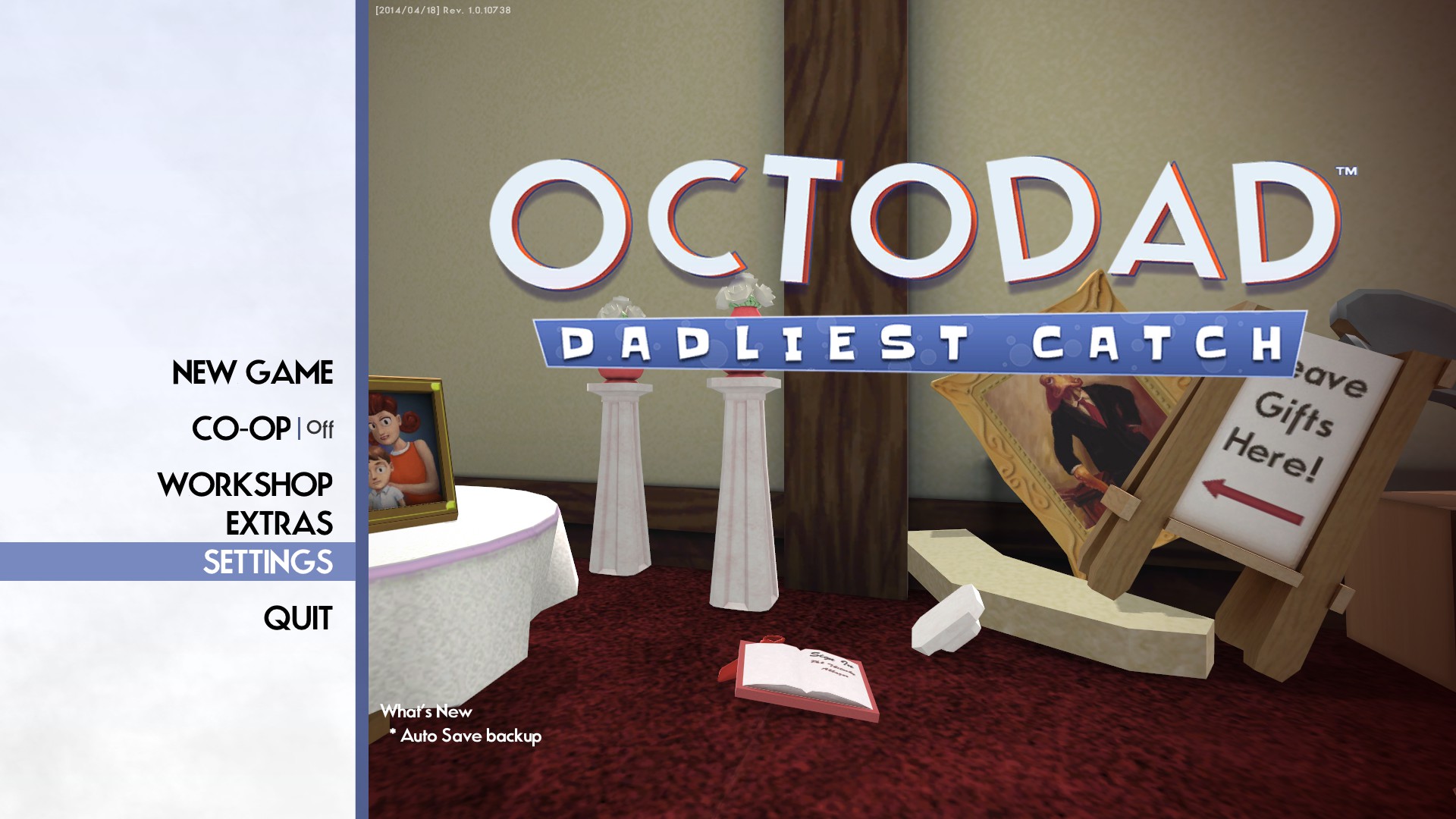
Considering its indie origins, Octodad certainly looks the part, with highly polished graphics and menus looking like they’re straight from a AAA game developer studio.
When Octodad was announced and shown off around the time of the PS4 announcements, I couldn’t have been more excited at the chance to play it. Here was a platform holder like Sony, bowing their head to an indie studio, and making way for a company that wouldn’t have been given the time of day 5 years ago. The Game looked goofy, fun, and all around a brilliantly unique game that I couldn’t wait to play for all of its ideals. Octodad was unfortunately delayed for the PS4, and as I haven’t got around to buying a PS4 just yet (my PC is more powerful than both the PS4 and Xbox One, and there just hasn’t been unique games yet) I decided to get the game on my PC. Did Octodad live up to my huge expectations? or was I just living a dream as to whats possible with indie development?
Octodad is a game based around seemingly ordinary things we do thorughout our lives, as Octodad tries to fool everyone around him into believing he’s another human, just like us.
You start the game of Octodad out at a church about to attend a wedding ceremony. The game messes with the joke of Octodad being an octopus in disguise from the offset, throwing little quips about people not noticing he’s one straight away before you even control him. From here, its your job to find your suit and embark on an epic quest of controlling Octodads four limbs to pursue getting to your wedding reasonably presentable. The control mechanics are the core of this game, with Octodad being rather hard to manoeuvre reasonably well. You control his right and left arm with the left and right analogue stick respectively, pressing the RB button to pick things up and pressing it again to put things down. To walk, you press and hold one of the triggers on your controller in order to raise a leg, the longer you hold the trigger down, the higher it goes. Whilst you hold the trigger down, you then use the analogue sticks to control in which direction the leg should point or move. Combining all these actions allows you to manoeuvre Octodad around the world, but you have to be careful, everyone is always watching you, meaning if you make too many mistakes or are too clumsy in how you move Octodad around, you’ll suffer for it when people start to notice you’re not human.
Throughout the course of Octodad, you’ll be repeating similar events to the start, with levels designed to push your controls of Octodads limbs to the limits. There will be levels where you have to do household chores, and other levels where you’ll just have to take your family out to the shopping market. The everyday scenarios with this crazy character adds a sense of.. surrealism to the game that I haven’t felt before in others. Who would have thought scanning items through a checkout would be so much fun when it’s considered a chore in everyday life. I suppose you could say that Octodad gets your preconceived notions of boring things in real life and flips them on their head with the introduction of one strange main character.
You’d think making a pot of coffee would be pretty easy in a game all about participating in everyday chores, but you’d be wrong. Ocotodad is a nightmare to control (a seeming fit to an octopus impersonating a human), with this chore alone taking up to 5 minutes just to grab the right objects and put them in the right place.
The games chore stages couldn’t last forever though, with Octodad starting quite blissful, but turning into a fully pledged story before long. To make sure there’s a narrative, Young Horses have made a arch nemesis to Octodad: a chef. The chefs out to expose Octodad to his family and the world, and he won’t give you an easy ride in his mission to do so. This central theme pops up in places, and adds some urgency to an otherwise slow and weirdly paced game. You’ll be shopping in the supermarket with your family, when all of a sudden the chef appears and you have to run for your life, ensuring you’re not caught, otherwise you’ll need to repeat the sequence all over again.
The game starts to change its pace half way through with this introduction of the main antagonist, meaning that the fickle controls are no longer fun and hilarious to use, but are instead annoying and frustrating at times. The final boss encounter for example involved walking across a lot of small beams, which I admit that I spent easily 15 minutes repeating over and over. I understand the developers need for a narrative to ensure that players didn’t feel like they were skimping out, but this narrative with its ups and downs and changes in pace deterred from Octodads core principal: funny controls in mundane situations. Using a badly controlled octopus to sneak past guards or walk across thin obstacles isn’t fun when the mechanics are just not there to support it.
You’ll be surprised to learn that there is at least 1 part in the game where you actually get to play as Octodad’s true self, in a fishing section that doesn’t require much action on your part and is more akin to a quicktime event than an actual playable section. Still, it was a nice scene to watch unfold.
The humour is great to begin with, but will soon become a little dry after a while, with both the narrative becoming a little more serious in tone, and the jokes becoming stale as time goes on. In this sense, its a good thing Octodad doesn’t overstay its welcome. Coming in at almost 2 hours long (I managed to finish it in 109 minutes), it’s easily one of the quickest games I’ve played in recent memory. This may or may not bother you (I know some people take a game time= value decision), but when it’s on sale in the humble store, I still think its great value for a truly original idea for a game.
I’m glad Octodad exists. I feel it shows how far our industry has come, where a random game with very random mechanics and a very strange plot can get the backing of a huge publisher like Sony. It also stands as an accumulation of how creative developers can be, allowing them to come up with an idea, and sticking to it through thick and thin. Whilst the game of Octodad itself didn’t set my world on fire, the fact that this game exists at all still excites me even after completing it and having my fill. I truly commend Young Horses for this game, and look forward to their future endeavours.
It can’t be denied, despite unpossibles simple style, it’s also extremely pretty. The skybox is beautiful, and allows for you to enjoy the style of the level you play.
Given the nature of the game I’m currently developing, I decided it was time to delve into the mobile app market to see what competition is in the market, and what innovative/original ideas were out there. Whilst browsing, I came across a nifty little app that I liked the trailer of called Unpossible, an obstacle avoider game, similar to my own, which had a unique sound track and slightly different course structure in that you’re on a never ending tube that generates obstacles on the outside. Usually, tubing games stick you on the inside, so this definitely made the game stick out for me.
Levels start out easy, with obstacles being fairly easy to pass, but the difficulty soon ramps up, with obstacles coming at you faster than you can move to avoid them.
The game starts you off on a tube where you’re constantly moving forwards, throwing obstacles at you which you need to avoid by strafing left and right around the tube. You’re stuck to the outside, so you don’t have much room to navigate, but it’s enough to keep the game tight in gameplay whilst also being loose in controls. You can choose to strafe by either touching either side of the screen, or by rotating the device to the side you’d like to move. I personally went for the touch controls as I felt they gave me more precision when navigating between lots of obstacles.
The levels begin easy, with big pilons sticking out of the tube allowing 90% of the tube to avoid them, but they soon get faster, and the obstacles start grouping together, meaning that it becomes harder and harder to avoid them all. The difficulty I could say is inconsistent, with early levels being so easy you breeze through it and get scores of 2 minutes and over, with the second level ramping up the difficulty to the point I could rarely reach 30 seconds. This isn’t a detraction from the game, and if anything, adds to its addictive behaviour, but can become infuriating for many players looking to beat their friends on the scoreboards.
Although the levels may be hard, they can start to become a bit predictable, allowing you to know the patterns and how to avoid them. I was eventually able to get high scores on each level, but it takes a lot of trial and error.
The game consists of 3 levels, and 3 daily levels, meaning the game doesn’t offer much in terms of content. Where it makes up for this though is its replay-ability, ensuring players replay levels time and time again until they finally beat their last score. It’s not as addictive as say… Super Hexagon, as there are times that you feel cheated like it was impossible for you to avoid something no matter what you done, but the game still allows you to become hooked to some extent to constantly strive for a better score.
For £1.49, I certainly learnt a lot about my current competition on the market, and it makes me want to improve myself and my work for my upcoming game Twixel, with my game needing to be polished to Unpossibles level of detail. For £1.49, you really can’t go wrong with this addictive little game, and I must warn you: the soundtracks absolutely fantastic.
Coming from the makers of World of Warcraft, you’ll be surprised to find that a lot of the art is original and different in style to the main game, with a lot of the artwork for the cards done by guest contributors.
Given my love of Magic: The Gathering, I was surprised I didn’t happen upon Hearthstone sooner. The Free to Play World of Warcraft card game seems to be an exact replica of Magic, but at the same time adds its own uniqueness to the formula. With its recent release on the iPad, I decided to give the game a go, firstly for the amount podcasts have been talking about it, and secondly as its free and I needed an excuse to use my iPad.
The game starts out by slowly introducing you to the games mechanics via some tutorial matches which will make you actively partake in the game before setting off and versing other players. Here, you’ll learn that every turn you take gives you 1 more mana than the last which you can use to summon minions or cast spells. The objective of the match is to dwindle the enemy players health down to 0 from its starting strength of 30. You can use your minions attacking power to attack the enemy player, or the individual minions the enemy summons. After a few matches, you’ll learn that you can use some cards to summon powers for your player themselves, such as weapons that allow them to attack, and after a few more fights you’ll finally learn about your own heroes ability, which always costs 2 mana and differs depending on the character you choose to play as.
Hearthstone, like many card games, is just as much about luck as it is skill. I may have lucky matches like the one above, but then I’ll have plenty of terrible ones where I’ll lose 5 times in a row. It’s all about the luck of the cards unfortunately, no matter how hard you try.
The games mechanics don’t take long to learn, but its the cards themselves you’ll have to master, as building a desk here is just as important as it is in Magic. Your decks are allowed to hold 30 cards in total, with only 2 duplicates in any given deck, meaning that you can’t rely on one amazing card for the whole game. The desk builder does contain a nifty companion, that will ask you to pick from one of three cards at a time, ensuring you have a decent amount of cheap cards and expensive ones for the long game.
Cards are earned whilst you build your chosen character up to level 10, and after that its a case of buying card packs or forging individual cards using the deck builder. In the case of purchasing card packs, Blizzard have done a good job of making sure you get good value in your purchases, with an individual pack costing 100 coins (the in game currency earn by winning games or completing challenges), and other packs costing the following: 2 packs £1.99, 7 packs: £7.99, 15 packs: £13.99 and 40 packs costing £34.99. Each pack comes with 5 random cards, which, considering how much game you get for nothing up front, and how generous the cards are at the start of the game, I see a lot of people purchasing these packs in the hope of getting great cards they could use in their next deck build. The crafting mechanic I mentioned requires destroying your cards to create “dust”, which is then used to create a fresh new card. You can pick from any card that exists at the moment from within the game, which offers a fantastic amount of flexibility for a game like this, but it comes with a cost: destroying cards for dust gives half as much dust as it requires to build a card, meaning you’ll need to destroy a lot to get the cards you want.
Building decks in Hearthstone could never be easier, with a guide to help you pick the best deck possible. You can still manually make your deck from scratch if you’re feeling adventurous, but the deck builder does a good enough job.
Games play out rather predictably at the start of every match, with both players not able to do much with the tiny amount of mana they both have. Thing start to ramp up soon, with different opponents using different, unique cards to really turn your world upside down when battling one another. I’ve had infuriating games where my only hope is set on a strong minion with, just for the opposing player to steal it away thanks to their unique card I’ve never seen before. I’ll then have games where I manage to deal 27 damage in one fel swoop, meaning the other player never stood a chance. I suppose like other card games, it all comes down to the luck of the draw, and how and when you play certain cards, because not everything is left to chance.
I’m enjoying my time with Hearthstone, and its needless to say that I will continue to play the game well throughout the next few years as a nice time sink. It’s a brilliant game to play for an hour or whilst on lunch, or not doing much else, and somehow, whether you win or lose, you always feel like you’re bettering yourself as a player, which is always empowering when it comes to gaming. For a Free to Play game, you really cannot go wrong with picking Hearthstone up and giving it a chance. I give this recommendation with a warning though: you may get as addicted to the game as me with time.
Following on from the success of Rayman Origins, Legends takes all the characters you knew and loved and makes them polygonal based rather than sprite based. This new venture in graphics adds a lovely shine and polish to an otherwise basic graphics engine.
Having loved Rayman Origins for its fantastic platforming, I couldn’t wait to get a hold of the latest game in the series, Rayman Legends. Screenshots and trailers made me even more jealous of the games Wii U exclusivity, until one day Ubisoft announced that they would be releasing the game on all platforms simultaneously across all systems. I decided to purchase the game on PS Vita, for the sheer sake of portability and for having a game to play on the system.
The game starts out with Rayman and his pals asleep in the forest, whilst the world is being taken over and destroyed by a bunch of dragons and pirates. A green ‘fly’ comes to the rescue by waking Rayman and co, and telling them the world needs saving. The first levels sets you up and gets you used to the basics of the mechanics all over again (being able to sprint, jump, punch etc.), but a twist occurs when you can’t proceed any further in the level, and must touch the screen in order to continue.
The Touch screen elements in Rayman Legends certainly adds some originality to the platforming genre, but this isn’t why we buy a Rayman game, which means it detracts from its core value rather than adding value to an otherwise familiar genre.
This is where the game gets strange and I wasn’t sure about my purchase. When touching the screen, you take control of murphy (the green fly from earlier), and set upon helping the king teensy navigate the rest of the level. In these stages (of which there are many), you use the many abilities of the Vita to help the king teensy through the stage, buy swatting pests flames, slicing ropes of obstacles, and rotating the device to change the shape and layout of the level. This all sounds fine in theory, and finally makes good use of the PS Vitas different sensors and touch screens, but its the actual character that sticks out and is annoying. The king teensy is AI controlled, meaning he’ll walk through the level just like you would if you controlled him. Where the annoyances come in are obstacles or trying to find hidden secrets, as the king teensy can make the wrong move, killing himself and starting the stage again, or ignoring the fact you’ve opened a new door, missing the secrets you’ve uncovered. These sections were my least favourite of the whole game, taking away from the fantastic level design and glorious platforming the Rayman games usually encapsulate so well.
There are around 48 new levels to play in Rayman Legends, with another 40 from the original game, making for a lot of content to play through. Each level has between 3 and 10 teensies to find and rescue, making for 700 tenses in total to help rescue. I can’t say how long I’ve played the game so far, but it must been in the 10’s of hours, and not single digits, as there’s just so much to do and collect. The new levels are interesting and stylishly done, but with half of them being the murphy levels, I became bored and annoyed at how they were designed. Whenever I got around to unlocking a new world I’d go out of my way to avoid the murphy challenges, so that I could have fun on the normal levels instead. The inclusion of the original Origins levels was nice, but it feels like a bit of a gimic to make the game bigger with relatively little work. The levels haven’t changed except there’s more teensies to collect than before, making them boring and tedious if you’re like me and played the original game many times with friends and family.
The levels that don’t incorporate murphy are hectic and fast, requiring perfect coordination and timing to pull of fantastic stunts that make you feel great as a player. Add that to the hidden tweensies that are spread throughout the level, and you have a brilliant combination of sheer excellence.
One new mechanic Ubisoft have added for Legends is the ability to store and collect lums that you collect in each level. These lums are accumulated, and can be used to unlock new playable characters, from knight Rayman, to jungle Rayman, it allows you to progress through just playing the game. Everything seems to be revolved around these lums though, with scratch cards being unlocked in levels that can give you more lums, unlocking classic levels from origins, or unlocking creatures that you keep hidden away so that they slowly give you lums on different days of the week.
Ubisoft have also added a new online mode, where you can compete in daily and weekly challenges in order to prove your might against other players across the world. These levels consist of small challenges, like collecting 250 lums as fast as possible, or reach 200metres asap, to which you’ll be rewarded with a small number of lums depending on where you’ve placed in the world wide rankings for that particular challenge. It’s certainly one way to get players involved everyday, with the levels being small enough that you could play for 5-10 minutes a day, just to maintain a score on the world rankings.
Rayman Legends was a weird mixed bag of experiments and tried and tested fantastic gameplay. You can tell, especially with the Murphy sequences, that the game was designed from the ground up with the Wii U gamepad in mind, but those controls only work with multiple people playing. I found myself being the bystander, watching as the AI got to have all the fun navigating the levels. The collection of lums and online scoreboards also felt like a new experiment as a way to ensure players kept coming back for more, even after finishing the main campaign and side levels like the original Origins ones. I suppose what I’m trying to say is: Rayman Legends feels contrived. I enjoyed my time I’ve spent with the game, but cannot for the life of me understand why Ubisoft took some fantastic platforming, and replaced it with such a boring mechanic like touch screen controls and accelerometer controls. By all means play Rayman Legends, you may enjoy some levels, but be warned, you may not enjoy the other half.
The pixel graphics make OlliOlli stand out, with each kick flip or olli rendered in glorious detail. The game emits a retro feel, but with modern frame rates and stability, making for a truly unique feel.
I’ve been reading up on OlliOlli since I first saw an announcement a while back on engadget. It seemed like an interesting concept, one which I even toyed with whilst at university (my idea was to play the game on a touch screen and use one finger swiping down the screen and the other up to mimic the motion of an ollie). My game however, never came to fruition, and here we have OlliOlli on the market as a fantastically intricate skateboarding platformer.
The game centres around controlling your character as he makes his way across each small level, trying to amass as many points as possible along the way. You control the character by pressing the X button to push, and olli/do a trick by moving the analogue stick in a specific direction. The hard part comes in landing your trick, by which I mean you have to press the X button again at the precise moment that you touch the floor, ensuring you score the maximum points possible for the set of tricks you just performed.
Eventually, rails start making there way into levels, testing your ability to grind to accumulate points as well. You land a grind by pressing a direction on your analogue stick just before you touch the rail. The grinding can then be combined with air tricks like Kickflips or Heelflips to increase your score significantly. The whole mechanic of performing tricks pushes you to try and try again until you finally press all the key presses at the perfect times, ensuring your score gets onto the scoreboard or finishes one of the other addictive parts of the game: Challenges.
The change in scenery is a welcome feature, with each new level bringing with it a new set of unique obstacles to avoid. Russia, for example, has a lot of snow that you cannot land on and much Olli over in order to continue the level, which can make for some very annoying and hard moments.
Yep, each level has its own set of challenges, with some being as small as getting a specific score in a combo, or others entailing landing specific tricks in certain areas. Regardless of what challenge you attempt, you’re sure to bail many times before you finally manage to achieve the specific goal you’re working towards. Once you’ve completed the 5 challenges on one level, a “Pro” level will open up, based on the same act you just completed. This Pro level encompasses harder and more varied gameplay, meaning that players will be tested in order to succeed.
On the main menu of OlliOlli you’ll find a daily grind button. Pressing this allows you to compete with other OlliOlli players across the world by competing on one new stage daily. This option is certainly interesting for those of you who are competitive at games, but may not sit well with others looking for more variety in the game.
The soundtrack of OlliOlli is absolutely sublime. I genuinely would put the game on just to listen to its chilled out beats whilst I went about my day doing other, non-gaming activities. There’s some mellow club music in the mix, along with some dubstep tunes, which makes the task of repeating levels over and over all the more enjoyable. Each music track is repeatable for around 10 minutes, so you could sink hours into OlliOlli without realising.
Pressing the X button at different times will result in less score, with not pressing it at all causing you to bail and restart the level. The game pushes you to become as accurate and as timely as possible, without compromising your enjoyment of the game.
The one thing I’ll say against OlliOlli is the lack of variety in its gameplay. For example, each level usually just consists of grinding from one surface to another, without ruining your run. A new game mode where players could just roll whilst practicing tricks wouldn’t have gone amiss, but as it stands, if you’re not good a fan of the campaign/main challenges, you might as well stop, as there isn’t too much more to see.
I’ve enjoyed my time with OlliOlli, and it looks set to become a game that I keep coming back to time and time again due to its addictive and short nature. For those of you looking for a challenge, you’ll love what OlliOlli has to offer, but for those of you who dislike repetitive gameplay and are looking for variety in your games (Read: FPS’s with a story), you won’t find much value in OlliOlli. It’s currently on sale for £2.55 from Sony, so grab it while you can at such a fantastic price for a lot of value, I know I’m glad I did.
Being the second title in the Typing franchise, The Typing of The Dead Overkill goes all out on being as crazy and sexist as possible, all for the chance to get a little laugh out of the player.
As a Kid, I used to beg my dad to go on his PC and play some of the games I watched him play. I recall loving the look of The Typing of the Dead as it was a game that I remembered from arcades at the seaside, and wanted to revel in this myself. Being only 13/14 at the time, I wasn’t very good at typing, and had to look at my keyboard every time a new word appeared on the screen so I could find the appropriate keys and press them. I was terrible, but it was still fun to play the game that I played in the arcades, albeit with a different control method. Does the new, “improved” Typing of the Dead live up to my expectations from yesteryear? Read on my friends.
Being that the original Typing of the Dead was just a rehash of The House of the Dead 2 with typing elements instead of a light gun, The Typing of the Dead Overkill does the exact same trick as it’s precursor, going so far as to include the original shooter as well. Being that I didn’t own a Wii, I wasn’t able to play the original, so all the gags, humour and characters seem completely original to me. The game starts you out by introducing you to the protagonists of the game: Agent G and Detective Isaac Washington. Its through these two characters eyes (and others along the way) that you’ll see a crazy world where mutants (they make sure to remind you that they aren’t zombies, and are in fact mutants) are roaming free, killing and devouring all that stand in their way. Agent G and Washington’s only hope is to find the serum to cure this outbreak, which it seems is in the hands of Papa Caesar, the crazy old man that started this outbreak.
Levels are varied, and the words you have to type to kill zombies are ludicrously sensitive, with some words being close to the knuckle in respect to your current situation. The screenshot above is a bad example, but you wouldn’t be surprised to find words like “Personal Space” on a zombie whilst it’s in your face.
Levels are played by just shooting the mutants by typing in the text that appears below them. The game is a rail-shooter, which means you don’t control the movement on the player, you merely watch as you’re taken on a tour throughout a level and shoot zombies as fast and as accurate as possible. Being that the whole game centres around this one core mechanic, the developers have managed to push it further than I’d have thought, with each word being sensitive to the surroundings or current predicament occurring. It makes for some witty chuckles as you progress through stages, and allows you to have a laugh whilst doing something that most people would find tiring and boring on a day to day basis. You finish each level with a boss fight, which consist of typing faster than usual, or typing the correct words that are coming at you. Bosses are varied enough to keep the stages entertaining, with fantastic design that makes you appreciate how much effort went into creating detailed, original mutants without being too grotesque.
There are many collectibles to be found throughout each stage, ensuring you keep your eyes on the screen at all times whilst typing the mutants words. The whole game kind of pushes you into learning how to touch type, for the sheer reason that you’ll die if you don’t. There just isn’t enough time between seeing a word or letter on the screen and looking down at your keyboard to type it. This could be seen as a weird attempt to teach children and others how to touch-type whilst having fun, but maybe I’m just stretching the premise a bit too far.
With most of the bosses being gigantic and near impossible to miss, The Typing of the dead makes it so that you don’t have to dodge, so long as you manage to type the words fast enough on the screen.
The typing mechanic isn’t the only point on the spec sheet to keep you playing though, with The whole game featuring a 3 hour campaign that tells the story of Agent G and Isaac Washington hunting down the cure to the mutant outbreak, and putting a stop to the evil Papa Caesar that’s managed to destroy so many lives. The story is brilliantly funny, with the game taking the Mick out of it’s own ridiculousness every two seconds, a sense of irony isn’t amiss here. Certain groups of the gaming community may not like the jokes that are told, as they are used as the butt end of the joke, thankfully these jokes are rare and uncommon. You may at times take control of other protagonists, but these are only side missions, as the main story is all based around the problems Agent G and Washington find themselves in.
Being a rehash of the Wii Overkill game isn’t a detriment to the typings success, as many players like myself have played the original. If you enjoyed the original Typing of the Dead released in 2001, you’ll enjoy whats on offer here. With more touch typing goodies at your finger-tips, Typing of the Dead: Overkill both challenges you and entertains you at the same time. Needless to say, I thoroughly enjoyed my time with Overkill, and may go back again in the future to improve my typing skills.
Titanfall has had critical appeal and reception since its reveal at E3 last year, but does this fanfare have merit, or is it a gust in the wind?
Given the amount of hype TitanFall has received since its debut at E3 last year, I had to give the game a go on release day to see what all the fuss was about. Without thinking, I slammed £25 into the Origin edition from CDKeys.com and preloaded it onto my machine days before launch. With a download size of 50GB, and a host of games sites going crazy for its imminent release, I hoped the money was worth it. After 42 hours of game time later, I suppose I can say that I have a few opinions on the game, and whether you should purchase it or not.
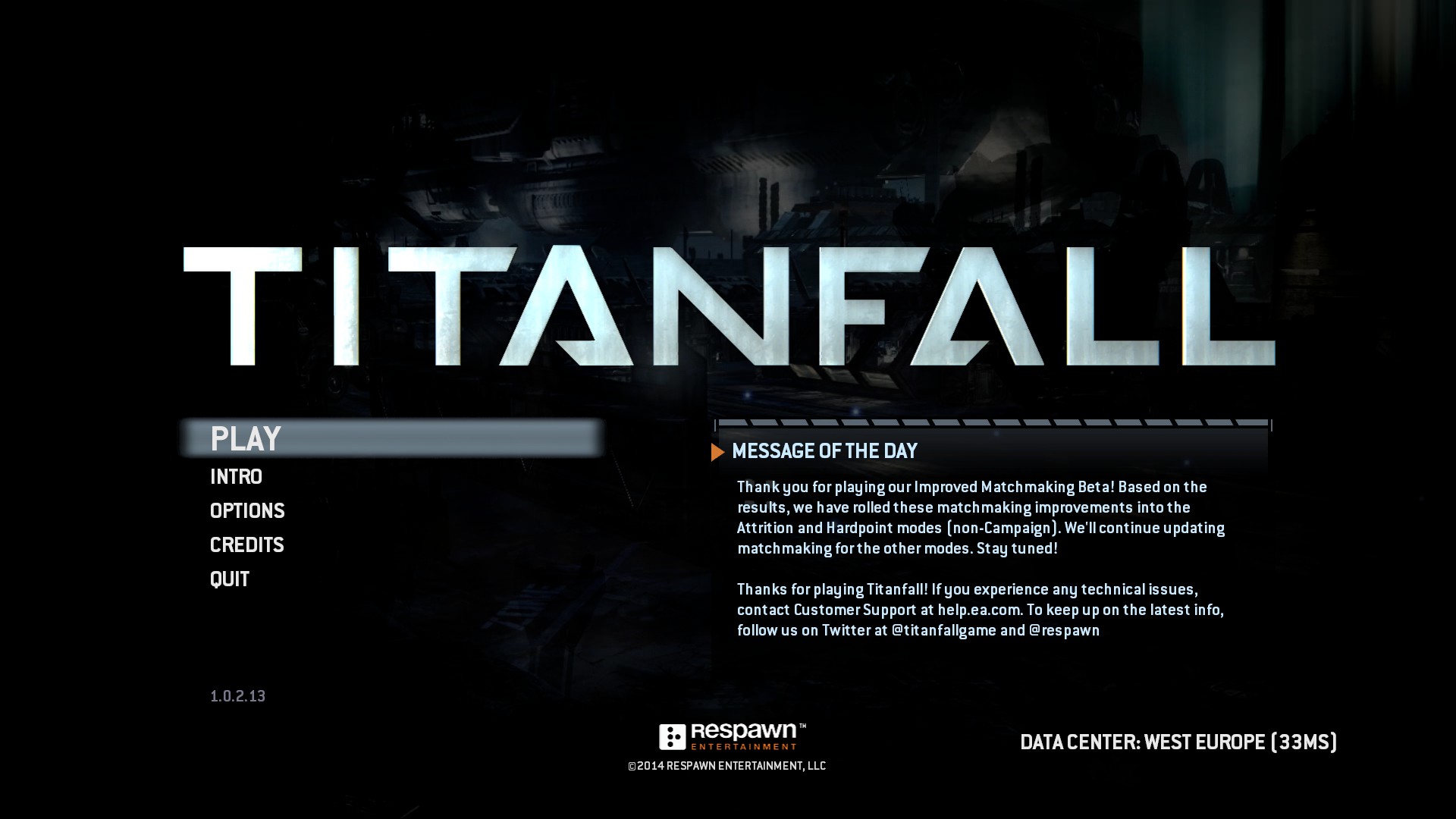
First up: TitanFall is a multiplayer only game, and although it comes with a campaign mode, it’s little, if anything worth mentioning. Upon starting Titanfall, you’re greeted with a main menu which has very few options. Pressing start brings you to another menu asking whether you want to start campaign, or start classic. Whichever option you choose makes little difference; one takes you to a multiplayer game with 30 seconds of audio logs and 15 seconds of pre-scripted animations before a match, the other just takes you straight into the match. The campaign is abysmal, with each stage concluding in a victory or defeat regardless of what you’ve done in the actual match, meaning you play no part in the world at large. Unfortunately, the campaign needs to be played in order to unlock the meagre 3 types of titans you can play as, meaning this is the only necessity in the game. For a full priced game (currently £45 on Xbox One), this is some of the worst value in the industry, but that’s relative to whether you spend time on multiplayer or not.
All maps are of similar size, with plenty of walls to run across and places to hide. Streets are always wide enough for Titans to navigate, with each level offering plenty of opportunities for pilots and Titans alike.
The matches themselves are what you’re here for, with the control scheme and game mechanics working in perfect harmony to create a fun and dynamic multiplayer experience. The matches play out similar each round, with teams starting on opposite ends of the map and meeting in the middle for a firefight. After about a minute or so, Titans start falling from the sky as players have earned the right to manoeuvre them. These hulking machines of metal, tower over enemy players, allowing you free reign of any robots or npc’s you may happen upon. Encountering other titans mixes the typical combat up, with titans taking a bigger beating than any normal solider would, and having special abilities like missiles that lock onto enemies or forcefields that repel enemy fire. The dynamism comes into play around the time a few titans have been killed and most players are back on foot, as it gives a new element to the combat: pilot v titan action. Titans are terribly overpowered, but to make up for this, pilots run and manoeuvre faster than a titan can keep up, ensuring a balance is maintained. Pilots also have the ability to double jump and wall run, giving a parkour feel to an otherwise static shooter. It can be said that you won’t die the same way twice, which certainly speaks volumes to TitanFalls ability to mix up the way a match plays out.
Throughout these matches you’ll meet NPC’s that are generated and controlled by the server, meaning none of the AI is being processed by your local machine. It means you can have hundreds of characters on the screen at any given time, making the stages a lot more epic in scope and scale, with the exception that the AI aren’t intelligent and don’t substitute for real players. They’ll group up together, have lower health, and generally don’t do too much damage to you, making them great cannon fodder for your kill streaks. There are times that I feel the AI were put in the game to fill the gap that the lack of real players couldn’t fill. With it’s small match size (12 players total, 6 V 6) the AI may have been a necessity to overcome the sheer size of the maps with a limited amount of players, ensuring you’re always coming across something to kill. On the other hand, they feel intentionally dumb and satisfying to kill, meaning coming across a drop pod of them brings glea with the amount of kills you’ll now be able to accomplish. Whether the AI were put in to make the maps feel epic, or whether they were put in as a game mechanic is down to you, but regardless on how you feel about the AI drones, they’re here to stay, so you had might as well slaughter them either way.
One new mechanic that has been added to TitanFalls gameplay is its addition of burn cards. Burn cards a temporary buffs to your character throughout one life. These buffs range from the mundane (like being able to hear an enemy near you) to the extraordinary (like summoning a titan when the game first starts). You can hold three of these cards in each match, which both ensures players aren’t too overpowered, and makes you reserve card uses until the opportune moment.
Your pilot and titan class can have a big effect on how you play each match, with each weapon starting off basic until you use it more. Each weapon also has challenges associated with it, meaning you’ll want to alternate between weapons to get the most XP in matches.
After each round, you’ll earn your XP, and level up, unlocking more weapons and titan abilities to progress up to the almighty level 50, a level so famed that you need to trade it in ASAP to get a new badge next to your name. That’s it. That’s everything your playtime has got you: a badge. Your second time through will also earn you more XP in each game (1.1x more for 1st regen, 1.2x more in 2nd etc.), but all this does again is give you another badge that looks slightly different. It’s a shame that the game doesn’t offer anything in terms of extra story or narrative for your achievement, but from the makers of Call of Duty, did you expect more?
Thankfully, I’m a competitive person, so this is all right up my street. I want to be the best of all my friends. I want annihilate them, so I continue to play. But for those of you who aren’t into this and are looking for a game to tackle new subjects or have a deeper meaning and better you as a person, TitanFall isn’t going to do any of this, and is instead a refinement of a old and stagnated genre of games.
So for those of you who never touch the multiplayer part of a game, TitanFall probably holds little to no value for you. But, if you’re the type of person that revels in the multiplayer sections of Call of Duty, and buy it exclusively for that alone, you’ll have the time of your life. The lack of a proper story makes the game feel like half of a game, and even the half that’s included feels devoid of content with only 3 titans and 15 maps, and 6 game modes to choose from. One day this may be resolved, but given numbers alone, TitanFall doesn’t offer much in terms of value. Where the value comes is in the dynamism and replayability, with my time invested already clocking in at 42 hours, it doesn’t look like this is going to end anytime soon.