For this weeks Weekly Gaming, I take a look at EA/Respawn Entertainment’s Titanfall 2. Whilst I don’t want to spoil the review too much, I should say that the game is absolutely sublime, and it’s a bloody shame that it hasn’t sold well at all.
Given that the game come out back in 2013, I’ve been meaning to get my hands on EA’s latest and greatest for a while now, but given the amount of negative press the game received upon it’s release I decided to postpone it’s purchase until things quietened down. Given that the game was 35 on disk at Amazon recently, I decided to take the plunge, after my initial impressions of the game when it was free were timid, £5 seemed like the perfect price. I wasn’t too impressed with the original Battlefield 3 many years ago, so how has time aged this product?
Well for starters, graphically, not a whole bunch. The game looks absolutely stunning at times, with the main characters detailed to such a degree that you can see the individual fibres in their hats and clothing. But this is all trickery, because for the vast majority of time you don’t see this at all, and instead see simple geometry for cars, or less detailed actors. Even the lighting is trickery, with most lighting sources on ultra not actually making shadows in the world and instead making cheap lens flare effects like you’d see in a Michael Bay film. Needless to say, I was intrigued by the graphics, but wasn’t stunned, something I was surprised by considering how many outlets use Battlefield 4 as a template for next-gen graphics.
The skybox on this level is astounding, really bringing depth to the stage. The only thing I’ll say against this level is the simple metal corridors which you go through time and time again.
The story was astonishingly terrible, with horrendous characters that made me sick to the bone and annoyed that I couldn’t team kill. I’m pretty sure Irish, the black gentleman of the group, was meant to have the common decency, with more humanity than the others, but I couldn’t stop hating him. He was disrespectful, annoying, and constantly got the group in trouble. In fact, if it wasn’t for Irish, the vast majority of the problems wouldn’t have existed for your trio.
Battlefield 4 could be called Battlefield Bad Company 3 for all the antics the group gets up to, with dam’s being exploded, planes crashing and boats collapsing, the group just seem to always find themselves in unlikely situations that ordinary people would die from. With Bad Company it was funny, with the dynamic of the group being happy go-lucky to the point I liked the company of characters assembled. Battlefield 4 on the other hand grated on me, constantly making me want to skip all cut-scenes which made out everything as the end of the world. The story and characters were seriously that lame that I wanted to shout at the screen: “I JUST WANT TO SHOOT PEOPLE AND BLOW STUFF UP DAMNIT!”
The campaign had it’s ups and downs, and could be considered ok if it was released 10 years ago, but by todays standards it just comes off as terribly short and damn right mediocre. The Russians have devised a plan to kill a Chinese official that is essential in maintaining peace and stability in the region, and in doing so, would cause another world war. The americans, and in turn Recker (the character you play as), have managed to save the gentleman, all without anyone knowing, starting china’s acceleration in bringing down all of the american Navi that happens to be by China. The plot comes to an end with the Chinese boarding your boat, managing to find the missing VIP, and bringing an end to the war between China and America.
I’m sure you’ve seen this scene many, many times, but it doesn’t stop the scene from having lovely awe-inspiring feel about it.
This lavish over the top story ensures the crew of tombstone (of which you are a part of), manage to travel through snowy mountains, stormy seas, and normal desert-y locations, all trying to show off the frostbite engine underneath. It all comes off as unfeasible, and melodramatic, with some areas of the game being just impossible to pass due to the team taking on huge tanks and millions of squad members.
It’s in the multiplayer that Battlefield 4 comes into its own, with huge arenas allowing you the freedom to tackle any enemy however you’d like, be it getting into a car with some squadmates, to gunning it alone with some C4 to take down enemy vehicles across the map. What little I played of the multiplayer was enjoyable, but I could help but feel left out due to all of the DLC which has been released since the game is 18 months old now.
So, being as this is just a quick review of the game and not a comprehensive one by any means, is Battlefield 4 a worthy game to be played by anyone with a next gen console or high-end PC? In my opinion, hells no. The story and game as a whole is just one huge convoluted mess, ensuring time and time again I wished I wasn’t playing. It may look pretty at times, with most textures being very detailed, but at other times the game just looks like a mess, with flat geometry across maps and terrible AI all making my experience with the game beyond a joke. Avoid like the plague unless you really REALLY want to show off your new gaming machine to friends and family.
I still remember the great days of Peggle, when I was introduced to it in my first year of uni. We all huddled around a friends laptop, competing between for hours laughing and cringing at insane luck and skillshots. Peggle was fantastic, so much so that I managed to get my whole family and a lot of friends hooked on it upon my return to Banbury. I downloaded the game on 5 different platforms, with it still to this day being the only game on my iPod video, a huge achievement for any game I might add (seriously, that device was NOT made for playing games).
When I heard that Peggle was finally getting a sequel, I was overwhelmed, until I read that it was going to be exclusive to Xbox One that is. It sucked, here was a game I would have willingly given EA/Popcap the full amount they were asking, and they put it out on the worst platform available this generation. Needless to say, I waited, until eventually I caved in, got an Xbox One, and picked up Peggle 2 in the Christmas sale for £3.99. Was the wait worth it? For the most part yes, but for most players Peggle 2 is not a guaranteed buy.
I enjoy playing as Jeffrey, but not because of his special ability like many of you would think. Jeffrey ‘s animations at the left of the screen involving the goats are fantastic, bringing me to tears at times.
Not much has changed in terms of the mechanics of Peggle 2 from Peggle, with you merely having to fire a ball at a bunch of pegs on the stage, clearing all the orange ones whilst trying to score as high of a score as possible. Green pegs still activate characters abilities, and purple pegs still cause a point bonus. Stages are familiar to Peggle, with some outrightly copy+pasted into 2 without a second thought, making you wonder what took the game so long to produce. So far not so good.
Where Peggle 2 does innovate and deviate though is in it’s characters and their abilities, which my oh my are they different and unique enough to experiment with and have fun all over again. First up on the new characters list is Jeffrey the troll, a mighty beast at the left side of the screen who’s special ability grants the player a huge boulder as a ball, smashing through anything it touches. This may sound similar to the dragon in the previous game, but differentiates hugely in the way that this boulder “stops” at the first peg it hits and plummets down, not carrying on it’s trajectory you planned originally.
Finishing a level with Extreme Fever is certainly more entertaining than the original, with the animations at the side making me chuckle with their cute and humorous gags.
Next up is Berg the Yeti, a character that makes the whole stage slippy, causing pegs you hit to glide along and hit/activate other pegs on the stage. Nifty on stages with lots of pegs, but not great on stages with straight blue pegs due to their inability to move. Gnorman the robot is next, with his power granting the player a electric ball that activates pegs around whatever peg was hit, possibly one of the best abilities in the game by far. Gnorman is easily my go to character for most stages, ensuring I can hit as many pegs as possible during my green ability turns.
Finally, there’s Luna, a zombie skeleton that has the ability to turn return all pegs back to the stage, whilst making all blue pegs on the stage completely invisible, highlighting only the orange pegs. Your balls are then able to travel freely to the orange pegs, whilst simultaneously destroying any blues in it’s path. It sounds like a strange power at first, but once you complete Luna’s trail, which has you using her ability on the final orange on the stage, you can see it’s potential: I managed to get 750k points easily using this powerup.
Weirdly, if I was now writing about the original Peggle, I’d continue listing the characters available to play with in Peggle 2. Problem is, that is all of them. 5 Characters in a sequel compared to 10 in the original is insane. Most products/sequels in the world work off the basis that you must offer your customer more than what you gave them before, to show them what they’re missing and give them better value. Not in EA’s wonderland. You can add another 2 characters to these measley few, but ones the squirrel from Peggle 1, whose ability is the multiball powerup, and the others a butterfly that gives you 5 points boost pegs to hit on the stage. Both of these characters are DLC, and each costs £1.59, which although isn’t an expensive proposition, is certainly annoying considering they could have been included in the base game in the first place.
Luna’s powerup is easily one of the most inventive of the bunch, with it not having an ideal time to be used, it can be used in a variety of situations. It’s gotten me out of many tight spots before, but should you leave it until the end of the level you’ll be in heaven when it comes to the scoring.
So what is available in terms of stages? Well this is where EA/Popcap have been cleaver, with 10 normal stages available per character, 10 trial stages per character and finally 20 stages for the master levels, making a total of 120. The normal stages are made even more replayable with 3 optional objectives to be done on each level, ensuring players come back for more even after completion of the main story. There’s a lot to be done it can be said then, but I’m not sure if I really will complete all side objectives. The stages just weren’t as memorable as Peggle’s; I’d be hard pressed to really remember any should you ask me, making for a boring experience throughout most of the campaign. Trial stages lighten things up a bit, giving you very strict instructions on how to beat said trial, whilst also pushing you to your limits in regards to characters abilities. They’re nifty, but short lived due to how few of them there actually are.
Given the limited about of content EA and Popcap have actually pushed into Peggle 2, is it worth your hard earned cash? Get it in a sale and I’d say yes, Peggle 2 can provide hours of entertainment at a great price with countless hours of replayability thanks to it’s trials and optional objectives. Get it at full price? Nope, don’t give EA or Popcap the benefit of paying more for a game that technically contains less. Most players are bound to find something they like in Peggle 2, but given the limited scope of content here, it’s harder than ever before to find that perfect character/stage combination, a frustrating endeavour for any player.
This week I took a look at The Sims 4 by EA, the latest in their long line of Sims sequels. I had mixed feelings about it, and even disliked a lot of the changes that had been made, but read the review to find out my true feelings.
As for Twixel, this week I’ve been working on a new touch method for iOS and Android, and have been implementing a new credits screen. I’m also hoping to have a trailer and poster ready for next weeks Eurogamer, considering it would have been a year since I attended it last. I’ll be writing up quite a few articles for Eurogamer next week, so look out over at GamrReview.com to see everything I write.
Titanfall has had critical appeal and reception since its reveal at E3 last year, but does this fanfare have merit, or is it a gust in the wind?
Given the amount of hype TitanFall has received since its debut at E3 last year, I had to give the game a go on release day to see what all the fuss was about. Without thinking, I slammed £25 into the Origin edition from CDKeys.com and preloaded it onto my machine days before launch. With a download size of 50GB, and a host of games sites going crazy for its imminent release, I hoped the money was worth it. After 42 hours of game time later, I suppose I can say that I have a few opinions on the game, and whether you should purchase it or not.
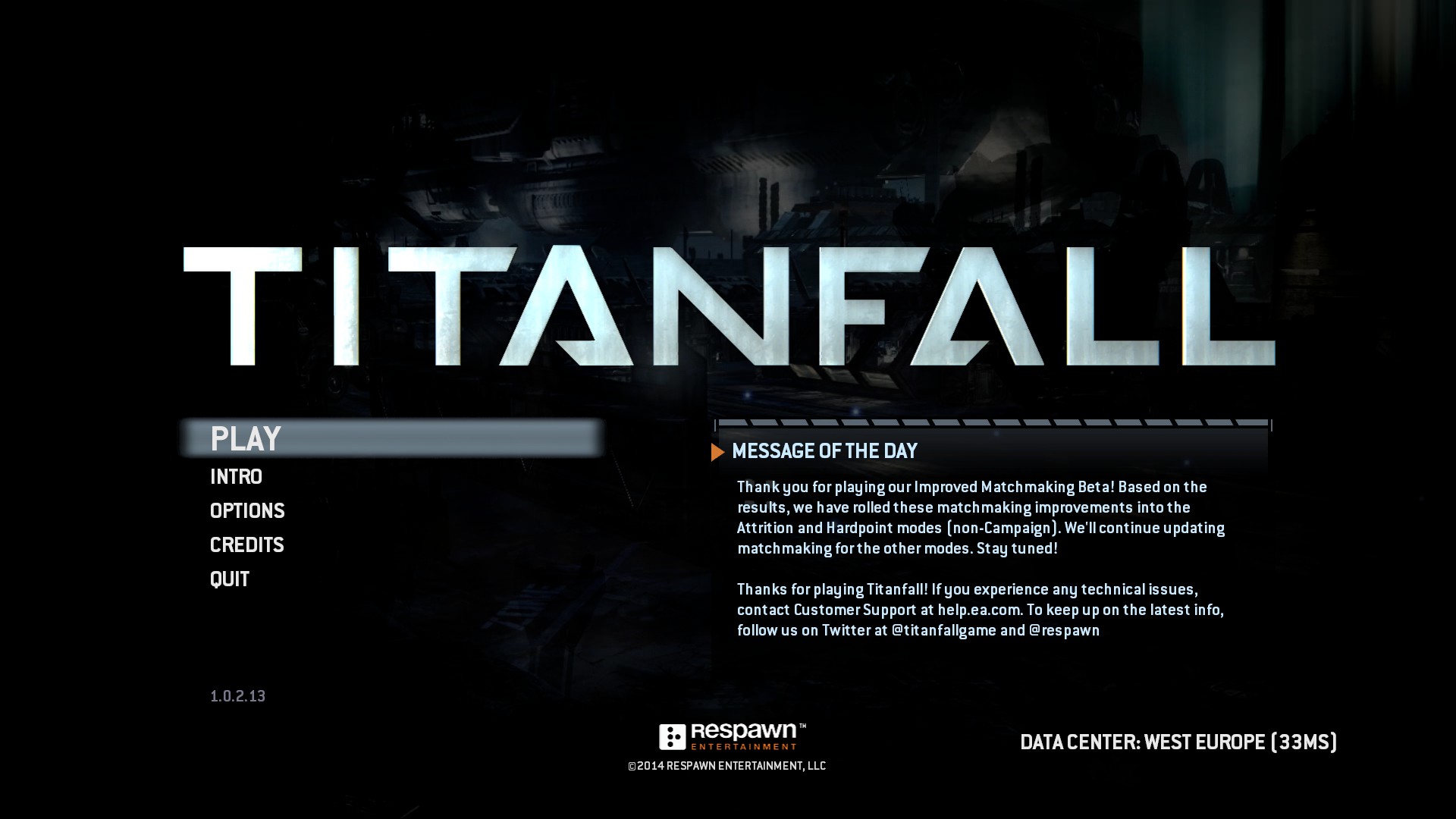
First up: TitanFall is a multiplayer only game, and although it comes with a campaign mode, it’s little, if anything worth mentioning. Upon starting Titanfall, you’re greeted with a main menu which has very few options. Pressing start brings you to another menu asking whether you want to start campaign, or start classic. Whichever option you choose makes little difference; one takes you to a multiplayer game with 30 seconds of audio logs and 15 seconds of pre-scripted animations before a match, the other just takes you straight into the match. The campaign is abysmal, with each stage concluding in a victory or defeat regardless of what you’ve done in the actual match, meaning you play no part in the world at large. Unfortunately, the campaign needs to be played in order to unlock the meagre 3 types of titans you can play as, meaning this is the only necessity in the game. For a full priced game (currently £45 on Xbox One), this is some of the worst value in the industry, but that’s relative to whether you spend time on multiplayer or not.
All maps are of similar size, with plenty of walls to run across and places to hide. Streets are always wide enough for Titans to navigate, with each level offering plenty of opportunities for pilots and Titans alike.
The matches themselves are what you’re here for, with the control scheme and game mechanics working in perfect harmony to create a fun and dynamic multiplayer experience. The matches play out similar each round, with teams starting on opposite ends of the map and meeting in the middle for a firefight. After about a minute or so, Titans start falling from the sky as players have earned the right to manoeuvre them. These hulking machines of metal, tower over enemy players, allowing you free reign of any robots or npc’s you may happen upon. Encountering other titans mixes the typical combat up, with titans taking a bigger beating than any normal solider would, and having special abilities like missiles that lock onto enemies or forcefields that repel enemy fire. The dynamism comes into play around the time a few titans have been killed and most players are back on foot, as it gives a new element to the combat: pilot v titan action. Titans are terribly overpowered, but to make up for this, pilots run and manoeuvre faster than a titan can keep up, ensuring a balance is maintained. Pilots also have the ability to double jump and wall run, giving a parkour feel to an otherwise static shooter. It can be said that you won’t die the same way twice, which certainly speaks volumes to TitanFalls ability to mix up the way a match plays out.
Throughout these matches you’ll meet NPC’s that are generated and controlled by the server, meaning none of the AI is being processed by your local machine. It means you can have hundreds of characters on the screen at any given time, making the stages a lot more epic in scope and scale, with the exception that the AI aren’t intelligent and don’t substitute for real players. They’ll group up together, have lower health, and generally don’t do too much damage to you, making them great cannon fodder for your kill streaks. There are times that I feel the AI were put in the game to fill the gap that the lack of real players couldn’t fill. With it’s small match size (12 players total, 6 V 6) the AI may have been a necessity to overcome the sheer size of the maps with a limited amount of players, ensuring you’re always coming across something to kill. On the other hand, they feel intentionally dumb and satisfying to kill, meaning coming across a drop pod of them brings glea with the amount of kills you’ll now be able to accomplish. Whether the AI were put in to make the maps feel epic, or whether they were put in as a game mechanic is down to you, but regardless on how you feel about the AI drones, they’re here to stay, so you had might as well slaughter them either way.
One new mechanic that has been added to TitanFalls gameplay is its addition of burn cards. Burn cards a temporary buffs to your character throughout one life. These buffs range from the mundane (like being able to hear an enemy near you) to the extraordinary (like summoning a titan when the game first starts). You can hold three of these cards in each match, which both ensures players aren’t too overpowered, and makes you reserve card uses until the opportune moment.
Your pilot and titan class can have a big effect on how you play each match, with each weapon starting off basic until you use it more. Each weapon also has challenges associated with it, meaning you’ll want to alternate between weapons to get the most XP in matches.
After each round, you’ll earn your XP, and level up, unlocking more weapons and titan abilities to progress up to the almighty level 50, a level so famed that you need to trade it in ASAP to get a new badge next to your name. That’s it. That’s everything your playtime has got you: a badge. Your second time through will also earn you more XP in each game (1.1x more for 1st regen, 1.2x more in 2nd etc.), but all this does again is give you another badge that looks slightly different. It’s a shame that the game doesn’t offer anything in terms of extra story or narrative for your achievement, but from the makers of Call of Duty, did you expect more?
Thankfully, I’m a competitive person, so this is all right up my street. I want to be the best of all my friends. I want annihilate them, so I continue to play. But for those of you who aren’t into this and are looking for a game to tackle new subjects or have a deeper meaning and better you as a person, TitanFall isn’t going to do any of this, and is instead a refinement of a old and stagnated genre of games.
So for those of you who never touch the multiplayer part of a game, TitanFall probably holds little to no value for you. But, if you’re the type of person that revels in the multiplayer sections of Call of Duty, and buy it exclusively for that alone, you’ll have the time of your life. The lack of a proper story makes the game feel like half of a game, and even the half that’s included feels devoid of content with only 3 titans and 15 maps, and 6 game modes to choose from. One day this may be resolved, but given numbers alone, TitanFall doesn’t offer much in terms of value. Where the value comes is in the dynamism and replayability, with my time invested already clocking in at 42 hours, it doesn’t look like this is going to end anytime soon.
Graphics are easily one of the standout features of Crysis 2, with characters and lighting taking the centre stage for a otherwise unoriginal First Person Shooter.
Crysis was the brilliant successor to Far Cry, a game that was original and ground breaking for its time. Giving you the ability to approach any mission how you liked, Fay Cry set a trend that the games industry would follow for quite some time, Crysis took the torch and continued this trend to new heights. Crysis 2 was only the natural successor that took this torch to a new audience: the console gamer.
In order to cater to this new gamer, the Crytek team had to dramatically change a lot of what made Crysis, Crysis. It was a shame, but a necessary evil to cater to this new market of customers, so the nano suit was revised to make for quick and easy allocation of powers, and the graphics were scaled down to compensate for the console’s lack of power. Don’t get me wrong, Crysis 2 is still a pretty game, but for such a generational shift in engine, there’s not much to show for it.
Although Tessalation and High Textures were added at a later date, they were a welcome addition for PC Gamers, with scenes lie this being a common occurrence whilst progressing through Crysis’ world of New York.
The level design is easily one of the biggest changes the series has seen. In Crysis and Far Cry, the island was so wide and open that you could approach any objective as you saw fit. I would occassionally hide in the bushes a mile away from the danger, slowly throwing rocks or nearby animals (chickens, turtles etc.) to get guards attention to slowly make their way over to me. It was fun, exciting, and allowed me to play the game at my own pace, doing what I wanted to do. Crysis 2 on the other hands feels like a linear experience, no different to a game like Doom. Your huge, free roaming island has been traded for a small, dense urban environment, with the game directing you where you should go and where you shouldn’t with arbitrary dead ends similar to what’s found in a Naughty Dog game. Cars will conveniently be destroyed and piled up blocking one way down a street, or an alien tentacle will be conveniently protruding from a wall blocking access to a door. It’s all very frustrating if you’ve played the original games, and even more irritating when the developers shouted about the game being all about choices. You are indeed allowed to choose how you approach a combat situation, but only within the confines of a small space between buildings, something that feels very contrived and not very open.
Landscape does change from boring old buildings eventually, with alien technology everywhere. It makes for a dynamic environment, something that evolves and changes the further you progress.
The enemies of Crysis 2 are very unoriginal, varying from human soldiers that patrol around and shoot you, to aliens that patrol around and shoot you. It’s a shame considering the first game had aliens as these weird hovering mammoths that could kill you quite fast, and running was usually your best option. Instead, we now have aliens that act and behave like the human AI in the game, which makes for some boring combat scenarios instead of the potentially exciting ones they could have been. The only variance you do get is in a giant hulking tank of a alien, which requires a lot of firepower to take down, but even that isn’t original in today’s market. I found that you could never take it head on, so your best tactic was to turn invisible, run to cover, and wait until it patrols again before bombarding it with rocket launcher ammo.
As mentioned earlier, the Nano suit has had a overhaul. In the past, you’d have to click your mouse’ scroll wheel in to bring up a radial menu which you then pointed in the direction of the type of power you wanted your suit to use. There were 4 options to choose from: Armor, Strength, Speed or Cloak. Activating speed for example would allow you to walk faster, crawl faster, and sprint extreme distances in a short amount of time. Crysis 2 does away with these powers up front, and instead only activates them when you go to perform a certain action. The Speed example I just gave is only activated when you sprint, and cannot be activated normally. This new way of working takes the control away from the player, meaning you’re left with an experience where more likely than not you’re only activating your armor ability due to the amount of enemies shooting at you all at once.
This is the only enemy in the game that changes gameplay in any meaningful way. He’s so huge and bulky that you really have to change up your tactics, as you really can’t take him head on.
A lot of spectacle was made of Cryteks employment of famous comic book novelists, saying that the story of Crysis 2 would be the next generation of story telling, and a new way to experience plot within a game. I can’t help but feel these were all marketing lies told to get people to buy the game, because the stories undergoes the same arcs as any other FPS out there. Nothing amazing leaps out of you in terms of the plot, with the only plot piece worth mentioning being the fact humans are contracting a disease that turns them to goo for the aliens to use, I can’t help but think Crytek have failed on the story aspect as well.
In the end, Crysis 2 turned out to follow the pack of generic FPS’s, when it could have been so much more and diverged. If you don’t think whilst playing games and just want some action on your screen with pretty visuals, Crysis 2 is right up your street. But if you’re looking for something different in the games industry, something that truly lets you feel emotion and gives you choice, then Crysis 2 isn’t for you.
From the get go, PvZ 2 wants you to make a new profile, and instantly suggests you connect to Facebook. You’re given no additional features for connecting, EA just wants your information.
Plants vs Zombies 2: It’s about time, is the sequel to the hit franchise, Plants Vs zombies, a game that came out of nowhere but left a lot of gamers, casual and hardcore alike, wanting more. PvZ 2 has already changed in big ways compared to its predecessor, being a iOS exclusive for the foreseeable future, and changing the way the game is bought, and in turn, played. Is this sequel a fantastic instalment in Pop caps ambition to become the best casual developer out there? Or have they over-reached their mark?
The premise of PvZ 2 is simple: Zombies continue to bombard your house, wanting to eat brains, but the main antagonist this time is Dave, the crazy shop merchant from last time. Dave just ate the best taco he’s ever eaten, and instead of making another, decides it’s easier to travel back in time to eat the exact same taco again. It sets up for a variance of different locales and different enemies to keep users entertained, and allows for some creative freedom from the artists. If you’ve ever played PvZ or any tower defence game for that matter, than you’ll know exactly how to play PvZ 2. You collect sun which randomly appears or is generated by sunflowers, and use this sun to create a defensive line to your house, using different plants to maximum efficiency depending on the zombies that are attacking. Each round is different, so you should think about the best combination of plants to take on the given zombies in any scenario, sometimes, I’d find myself in a awkward situation, thinking I’d found the perfect combination from an earlier level, just to be screwed over when a new type of zombie comes along which destroys my plans.
New enemies certainly add a new level of difficulty to the game, and give variety to an otherwise familiar game.
Sooner rather than later, the game gives you access to plant food: a new perk that allows a single plant that is fed this wonderful item extreme abilities; place it on a sunflower, and you’ll get 150-200 sun instantly, place it on a pea-shooter, and it’ll become a machine gun of a plant, easily able to take down a menacing line of enemies. Plant food is readily available throughout a level, being given to the player quite generously through killing green zombies, and given that it feels like cheat, it makes sure that you have some risk/reward scenarios where you’re not sure when or where to use your plant food. Another new set of perks are the three gestures in the bottom right corner: pinch, swipe and touch. Each perk allows the player to kill zombies on the screen using a different gesture, the pinch one is cheapest, but you have to pinch each individual zombies head to kill them. All these gestures come at the expense of your hard earned cash: a rare commodity in this game, and a asset you can buy from the store using real world money at any time. I’ve found that I haven’t needed to spend real world money yet, but repeating levels is certainly getting harder, and eventually, I will need to use those coins I’ve so desperately held on to.
For a casual game, PvZ 2 certainly pushes you to experiment at the risk of failing; sometimes you’re lucky and can screw up your placements but still pass a level, other times PvZ 2 will punish you for even a second of missed opportunity to spend your sun. It’s a unforgiving system, and one that adds to peoples frustration and can be seen as a cash grab by EA to make you buy more perks in the level. Now some people may see this as a attempt to get you fishing into your wallets for cash to buy short term perks, which can be used during a mission, and I can’t blame people for thinking that way, but it is just randomness. I’ve done levels multiple times, sometimes I do it no problem using the resources I have, other times I genuinely do need to use the perks otherwise I wouldn’t stand a chance in hell. Overall, it’s a nice balance, Popcap have managed to balance the difficulty to make it hard enough for hardcore players, whilst also being difficult enough to push pennies out of casual folks.
The store is where you really see why PvZ 2 is a free to play game. Next to everything has been monetized, from the gameplay itself, through to the locking of doors that hold power-ups, or even some amazing plants from the original. It’s a shame that EA see’s us consumers as cash cows, and treat us as such.
Worlds are varied, and Popcap looks set to release more as the months go on. As of writing, there’s only 3 worlds available: Egypt, Pirate and Wild West, with the future land locked until a later date. They give a nice variety to an otherwise stationary game, and push your strategy to it’s limits, constantly pushing you back on your arse if you don’t mix things up at all. Take, for example, the Wild West world, where train tracks are put on the levels with a cart, so you can only plant one plant on that row (with the added advantage of moving it up and down), If you place one lone pea-shooter in one of these in the start, then you’re pretty screwed for the rest of the level. One frustration most players will find is the constant grinding needed in order to get from one world to the next. This all starts when you think you’ve finished a world by getting to the end, but no no no, this wouldn’t be a F2P game if it were that easy. Instead, once you reach the end, stars appear under every level you’ve already finished, allowing you to go back to previously finished levels and do challenges on them in order to achieve enough stars to progress onto the next world. It’s an annoying system, one which really makes a player grind just to see a glimpse of the rest of the game. Putting barriers up like this is a common trope of the F2P model, it stops the players progress to tempt them into paying to continue, something which in my opinion, shouldn’t exist at it stops a players immersion.
Special plants or abilities are hidden behind walls that require keys. These keys are appear from killing zombies within levels and are dropped at random, but with all things in PvZ 2, you can pay to get rid of these doors and have access to the prizes behind them!
Pros:
It’s free
Graphics and animations are as smooth as ever
Just as charming as the original
Cons:
Constant hindrances to your progression makes for a frustrating experience
“Pay to Win” model really doesn’t suit a Plants vs Zombies game
It’s hard to come up with too many disadvantages for PvZ 2, it’s a bloody good game in it’s own right, from graphics to gameplay, it’s as good as the first, and even better in some places. Where the game falls short though is the constant hindrances to remind you that you should and could pay for everything in the game. If EA/Popcap had just made this another £15 game for every platform and maybe added the tropes for iPhone, it’d have been a lot better received, but alas, selling a game like this takes the soul out of PvZ, which once that’s gone, what does PvZ have left? Nothing but a shell of its former glory.
Dead Space 2 gave me a mixed bag of emotions from start to finish. I loved the first game, playing through it twice to get all the achievements, and even loving the fiction to the point of downloading both downloadable games, as well as watching both of the animated films. I felt the church of unitology was a perfect reflection of the christian church of today, and the fiction behind humans having to destroy planets for resources a great view of what may one day happen.
So as you can imagine I was looking forward to putting Dead Space 2 in finally and pushing on with Isaacs story, turns out my excitement would turn to disappointment. Now don’t get me wrong, Dead Space 2 isn’t a bad game by any means, it’s just a game that shows the first signs of EA getting their grubby little paws into a fairly original concept and washing it down into something they can sell more of.
Dead Space 1 would have so many tense moments where you were constantly on edge wondering when the next creature would come along. Sometimes that moment would never come, but it still didn’t stop me from anticipating a scare at every turn, and sometimes it’s the anticipation that’s scarier than the scare itself.
Dead Space 2 on the other hand just felt like jump scare after jump scare. “Monster Cabinets” (holes that monsters come out of, where there is no conceivable way in which the monster could have stayed in that hole for months on end.) are a plenty in this game, and come very fast and hard. You rarely get a chance to sit down and think. And that’s the problem; with scary games, it’s your own mind that’s your enemy, not the actual monster on the screen. It’s your paranoia that something could happen that makes you scared. It’s the isolation, the sense of frailty that makes you more scared. And that’s where I feel Dead Space 2 let me down. It concentrated too much on the image of horror, rather than the thought.
Pros:
Great Graphics
Gameplay has definitely improved
Isaacs personality definitely adds to the game/story
Cons:
Creatures lack originality since first game
Lack of atmosphere
Overall I would gladly say that anyone who was a fan of the first should definitely play this one, if not just for the continuation of the story. I enjoyed it, but wouldn’t play it again.