Category: Weekly Gaming/Media

  • Weekly Gaming: Furi (PS4)

    Weekly Gaming: Furi (PS4)

    Hi all!

    So this week I review Furi, The Game Bakers epic boss-rush game that’s a staggering success by my standards. The game both infuriated me and delighted me, and I have to give it a massive thumbs up, especially for those of you who fancy a challenging game.

    As always for my articles that are published over at VGChartz.com, you can find the full review here:

    http://www.vgchartz.com/article/264984/furi-ps4/

    As always, thanks for visiting, and until next week, have a good ‘un!

    -Dan

  • Weekly Gaming: The Walking Dead Michonne Episode 2: Give No Shelter

    Weekly Gaming: The Walking Dead Michonne Episode 2: Give No Shelter

    Hi all!

    So this week, I’ve decided to post an (old) review for Telltale games’ The Walking Dead spin-off series, Michonne. Given that I was rather tepid about the first outing of the game (which can be read here), I didn’t have much hope for the second episode. Lo and behold, my pessimistic side won out, with the game being massively underwhelming compared to other Telltale ventures.

    If you want to give the review a read, you can click on the link below:

    http://www.vgchartz.com/articles/adminnew/?task=edit&story=263776

    As always, thanks for visiting, and will see you next week!

    -Dan

  • Weekly Gaming: Splatoon (Wii U)

    Weekly Gaming: Splatoon (Wii U)

    splatoon_updates

    Having seen the amount of commotion traditional games media was lavishing upon Splatoon, I decided to finally jump in head first and see what the fuss was about first hand. Finding the game for sale at £18 (which is rare! Splatoon hasn’t really had any price drops since it’s release), I brought it straight away without hesitation. Here’s my impressions.

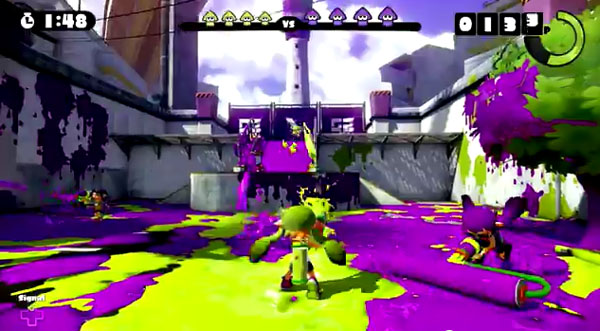
    Splatoon, Nintendos first ever foray into the Third Person Shooter Multiplayer genre, see’s you play as a squid-kid, a hybrid kind of creature that looks like a kid majority of the time, but can also turn into a squid at will. Being a Squid-kid comes with it’s benefits: you’re able to spray your own ink all over the stage, and use it to traverse to places you wouldn’t normally be able venture to. This mechanic is very reminiscent of Super Mario Sunshine for the Gamecube, where Mario had to spray FLUD (his water backpack) to get rid of toxic paint spread throughout the stage. The similarities stop there though, as Splatoon is a whole different kettle of fish.

    From the offset Splatoon makes it known that this is an online multiplayer game first and foremost with its news system. Each day it tells you what levels are available to play in social playlists, and in ranked. But before I got into any of the multiplayer, I decided to give the campaign a go.

    Splatoon_Wii_U_gameplay_screenshot

    First up, I played the entirety of the single player campaign. This mode allows you to get accustomed to the Splatoon controls (I’ll talk about those later; suffice to say, they take some getting used to), whilst also telling a story about the squid-kids versus the octopuses. Each stage has a unique gimmick to it, some will require you to fill up sponges with your own ink, increasing their size and making for some difficult platforming sections, with others having a boss system where you must avoid his attacks throughout the level, only to defeat the baddie at the end. The stages are varied and nice, and not once did I feel like the game was too repetitive, which, over the course of the 5 hour campaign, can only be a good thing. For all your troubles, you’re rewarded with some outfits to use in the online portion of the game (which is the main draw of Splatoon). Whilst this wasn’t much of a pay-off narratively speaking, the campaign doesn’t really set up much of a story in the first place; you’re trying to rescue a massive cuttlefish (electrical fishes basically) that’s been stollen by octopuses.

    Between choosing the campaign and the multiplayer, you have a hub world to interact with, allowing you to customise your character, as well as explore and take on extra challenges thanks to the games Amiibo support. Whilst I wasn’t a big fan of the amino challenges, they at least offered extra value in a game that hasn’t really dropped in price since launch. The shopping district in this hub area was a bit annoying though: everything’s level capped, meaning you need to make sure you play the multiplayer quite a bit before you can even interact with a bunch of shopkeepers. In theory this is a good idea: play the multiplayer more to get more loot! it left me disheartened, especially after I had just spent 5 hours playing the campaign. If anything, both multiplayer and campaign should have contributed to the same points system, allowing for single-player users to still feel like they’ve achieved something after so many hours playing the game.

    WiiU_Splatoon_02_mediaplayer_large

    Now before I get onto the core purpose of Splatoon (it’s multiplayer), a quick word about it’s controls. The game defaults with motion controls, meaning you need to move the gamepad up and down in order to look around. As soon as the option was available, I turned this mode off. It’s hard enough looking at a screen and concentrating on where to aim, let alone having to add another layer of complexity to the game by moving the controller up and down. As for the control scheme itself, I found that Splatoon is not accurate at all. You don’t get the precision that you normally would from a third person shooter, which takes some getting used to at first, but after a while, realise that it’s actually ok. You see, since the core purpose of the game is more to spray your ink as far as possible (covering as much of the map as possible), accuracy is mute. Yes, there are times you’ll come across another player and will need to precisely shoot at them, but these moments are few and far between, meaning the inaccuracy is fine for shooting and glooping the stage.

    Now onto the core of the game: Multiplayer, where all your skills are put to the test in multiple modes; ranked and social. For starters, you’re not able to join ranked matches until you’re level 10; a trait that’ll take at least 2-3 hours to attain. Whilst this was annoying, there’s a good reason for this restriction: the social playlist will teach you the core mechanics of the multiplayer mode. Every game mode is short (3-5 minutes in length) and as multiple game modes. For the vast majority of the time, you’ll be playing the “turf wars” game mode: a mode that requires each 4 player team to ink as much of the stage as possible. whilst that sounds boring in theory, it’s fantastic to actually experience, and gives every player of every ability the chance to have a great time. I loved being on the front line in this mode, taking on other players and getting rid of their ink in the middle of the level, but I could just as easily enjoy staying at the back of the level and making sure as much of the stage is covered as possible. It’s this flexibility that gives the game so much charm and replayability; everyone is contributing to the final score. Unlike most other shooters where you have to be good at killing others in order to contribute to the overall score, Splatoon makes it so that everyone on a team feels valued. It’s a fantastic feeling, and one which I can now see why so many editors and writers put it in their game of the year lists.

    WiiU_Splatoon_323_MultiPlayer_SplatZones_Warehouse01

    All in all, Splatoon is a marvel of multiplayer shooters. It stands alone in being quite unique and original; where so many other developers in the industry are trying to copy the leader (COD), Splatoon stands as a testament to what can be done when you think outside of the box. If you can find the game for cheap like I did (and of course be one of the 10 million people that own a Wii U), then buy Splatoon. You won’t be disappointed.

    p.s. If you do buy the game (or already have it) give me a shout, I’d love to give you a game!

    4/5

  • Weekly Gaming: Grand Theft Auto 5 (PC)

    Weekly Gaming: Grand Theft Auto 5 (PC)

    2015-09-06_00006

    Its strange to write this review on GTA V, as it feels like the end of something I’m quite fond of. It’s like those last goodbyes to friends and family when you’re going away to uni, or moving out for the first time, it’s unpleasant, but warming to know you have someone still there. GTA V is so big, so dynamic, and so damn good in almost all respects, I’m sad to have finished it’s campaign and will have to move on to another game.

    You see, GTA V made me miss America. I started this blog in 2013, the year I also spent 3 months in the great US of A with my then girlfriend. It’s hard to explain what everyday life in america feels like; I mean, granted, most of the time it’s exactly like life in Britain and I’m sure many other places, but it feels different. There were so many times that I would be driving down a motorway or walking down the sidewalk in GTA V that I felt like I was back in California. Everything from the lighting, to the amount of detail in textures, to even the grimness of living in Los Santos harked back to my time in Hollywood. It’s so rare for a game to do this; to relate to me on a deep fundamental level as to make me feel like I’m elsewhere, but GTA V manages to pull it off spectacularly.

    2015-09-06_00005

    I’m finding it hard to decide whether the story of GTA V was good, or just ok. Don’t get me wrong, throughout the entire campaign there’s fantastic writing, and each of the characters have brilliant personalities, but what really let the story down as a whole was its pacing and extreme use of new characters. You’re introduced to so many new people throughout the course of the game that it gets hard knowing when ones will make a reappearance, and who’s the true bad guy at the top. There’s also inconsistencies: why the hell do players have to spend 30 missions (from half way through the game until the end) following these bad buys plans only to kill them all right at the end with no consequences? It makes no sense, especially with how often the crew explain what they want to do to these bad people, narratively speaking (considering the group kill everyone else that gets in their way), they should’ve killed them sooner rather than later.

    20160324183136_1

    The world of Los Santos within GTA V is absolutely stunning, especially on PC. It’s actually odd to say that, because a lot of the graphics on show here sometimes look like they’re straight from the PS2 era of consoles; we still have flat geometry when it comes to hills, and still have pictures in shop windows to give the impression the world has depth, which does at times detract from the games aesthetics somewhat. The amount of polish on show though is insane. Sun-rays and shadows gloriously adorn the world as you drive, with an orange haze (a signature of LA in real life) being ever present as you make your way across the extremely large world. texture detail and resolution is staggering here too, as roads aren’t just one texture, but a multitude of little crevices here and there where it’s been fixed in the past with new tarmac. These little nuggets of graphical prowess is where the graphics truly help to make the world feel like a real lived in place, unlike other games where the world is completely pristine. I suppose it’s like they always say: the devil is in the detail.

    As for the gameplay, well Rockstar truly outdone themselves here. Much was touted about the games shooting mechanics, as they were taken straight from Max Payne 3, a game which has some of the most fluid and lovely third person shooter controls on the market. Here, they’re just as good as ever, with the added benefit of each member of the team having a unique ability which is activated by pressing in the left and right analogue stick at the same time. For Michael, he gets the ability to slow down time (brilliant for heists where you need to kill people quickly and efficiently), Franklin has the ability to slow down time whilst driving (allowing for faster turns and tiny adjustments to your vehicles direction) and for trevor the ability to withstand a multitude of damage but also to give that back. There was one problem about these abilities: they’re so damn good and useful that to not have them at times felt like losing a limb. You still have walls to stand up against (and I have to say, the animation for moving around is absolutely astonishing) but you’ll most likely find each of the characters abilities the best thing about the gameplay.

    2015-10-08_00002

    Heists are a massive feature throughout GTA V’s storyline, and there’s a reason the press talked about them non-stop up until the games release: they’re pretty damn awesome. First, you need to do a few missions where you’ll be grabbing all the necessary gear to perform this heist. Next up is the heist itself, which usually incorporates a few missions worth of length into one long drawn out objective. Drawn out was probably the wrong word to use there, as it makes it sound like the heists are boring; they’re not. Each one mixes things up constantly, and rewards or punishes you based on your decisions before the heist, and in real-time. A choice of driver for the mission could play out to bite you in the bottom when they lose their nerve later on, or on the other end of the spectrum, your choice could be so good you go by unnoticed by cops as the heist plays out.  In making you have to react to these decisions in real-time, the heists feel like a genuine evolution of the GTA  formula throughout the years, with this incarnation giving the player real agency rather than just being an innocent bystander to the structural underlying of the code going on.

    2015-09-13_00002

    As I said at the start of this review, I’m going to miss playing and exploring GTA V. The game itself is seriously a love letter to gaming; a potential of what all games can aspire to achieve (when enough money and time is thrown at something). It perfectly encapsulates America in ways I wouldn’t have thought a medium possibly could of, right down from the nitty gritty details of pavement, to how looking at the great sign of “Vinewood” feels. I’m glad I spent so much time in Los Santos, and with 50 million other people playing the game, I’m sure they feel exactly the same way.

    5/5


  • Weekly Gaming: CounterSpy (PS4)

    Weekly Gaming: CounterSpy (PS4)

    Being in the mode for some stealth games is rare for me, but it does happen, occasionally. The last time I played a stealth game was Mike Bethel’s Volume, and even that didn’t really quench my thirst for the stealthiness. This week I was browsing through my PS4, to see what games I could maybe complete in the spare afternoon I had, and happened across Counterspy in my library. I gave it a quick download and decided to get on with playing it.

    CS_PS4_016.0

    Right out of the gate Counterspy warns you that it’s randomly generated, so not all players experiences are going to be the same. Nice, I thought to myself, this should make for an adventurous play through. So off I set on being a stealthy spy.

    The game takes place at the height of a nuclear war between the soviet state and the imperialists (USA). Both states are wanting to make nuclear bombs to explode into the moon, causing it’s orbit to shift in such a way that it would destroy all life on Earth. You’re a spy who works for COUNTER, an organisation that has tasked itself with making sure this never happens by collecting plans for the nuclear weapons, and in turn, their launch codes and flight telemetry.

    counterspy-3

    Because you don’t work for either side, you’re able to pick and choose which state you spy on to get these plans. Each state has a “Defcon” level, which goes up should you ever be seen in missions or should people phone in help. Think of this level as lives, and it makes a whole lot more sense. Being able to pick which state you spied on between missions was great, and added a layer of tact to an otherwise boring stage selection screen.

    The Defcon level isn’t the only thing you’ll be looking out for when choosing which missions to go on, as each state will have different collectibles to unlock. The imperialists usually have loads of weapon blueprints to collect, with the soviets having lots of formula blueprints. Once enough blueprints have been collected in each area, you can unlock new weapons to use between missions, and new formula’s (think of the formula’s as perks).

    So, enough about the interface and the meta game of picking where to play, how does the gameplay itself actually hold up?

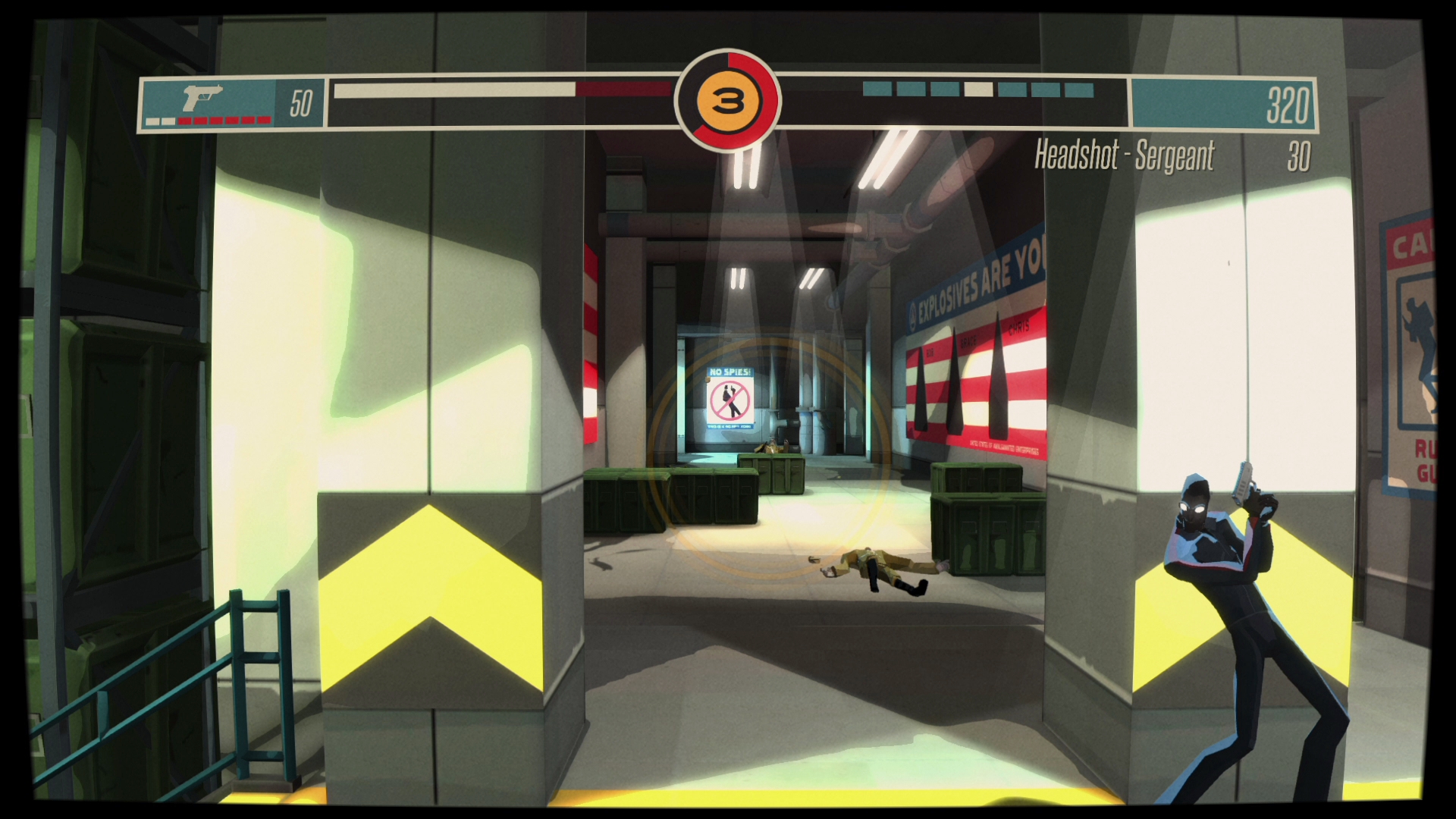
    Well for one, for a game that bills itself as a stealth game, I didn’t find it all that stealthy. Yes, you can sneak up on guards and knock them out stealthily, and yes, you can get around security cameras by sneaking past their vision cones, but for the most part, Counterspy pushes you into violence at every turn. There are so many occasions where you’ll have a room full of enemies and the only way past is to shoot them all. There were times that I was able to shoot the enemies in a nice order so that not one was alarmed at the others falling, but due to the AI’s walking patterns, these stealth kills are few and far between.
    2631458-2014081911271510

    Each level is adorned with multiple layers, which is a good thing for a 2D platformer. being able to get behind a guard by passing above or below him is always great fun, and helps to keep a stealth game interesting like a puzzle. The problem is these moments rarely occur within Counterspy, due to it’s very random nature. There are just so many rooms where the only way forward is through 3 guards all facing each other, with no way above or below them, meaning starting a firefight is your only option.

    It’s in options that the game truly falls apart. Whilst you have quite a few options about what level to select and what weapons you’ll be taking into a level, you have next to no options when in the levels proper. Stealth is all about options: “should I stay where I am and wait for the enemy to come to me? Or should I shoot the explosive, wait for the carnage, and then pick the guards off one by one?” Options like these were plentiful in Volume, but are lacking in Counterspy, where I felt that I constantly had to take cover and shoot my way through almost every section in the game.

    I tried being stealthy as much as possible, even going so far as to get myself killed should I have been spotted time and time again, but the game just still corners you into action. There are sections of levels that are no longer 2D, and instead have depth to them with lots of enemies patrolling in the background. These sections are nigh on impossible to get past unless you kill all the enemies; not something a spy would necessarily do when they’re trying to be quiet.

    Regardless of the gameplay (and lack of stealth) at least the weapons are varied and help to keep you in stealth mode for as long as possible. I found myself using the silenced shotgun and silenced pistol as much as possible, otherwise guards nearby would be alerted by my arrival. When all else fails and there was an all out firefight, I’d use my hypnotising gun to hypnotise a guard in fighting for me; a brilliant tactic for running away from a firefight without having to deal with he rest of the guards.
    counterspy-screen-01-us-17jun14

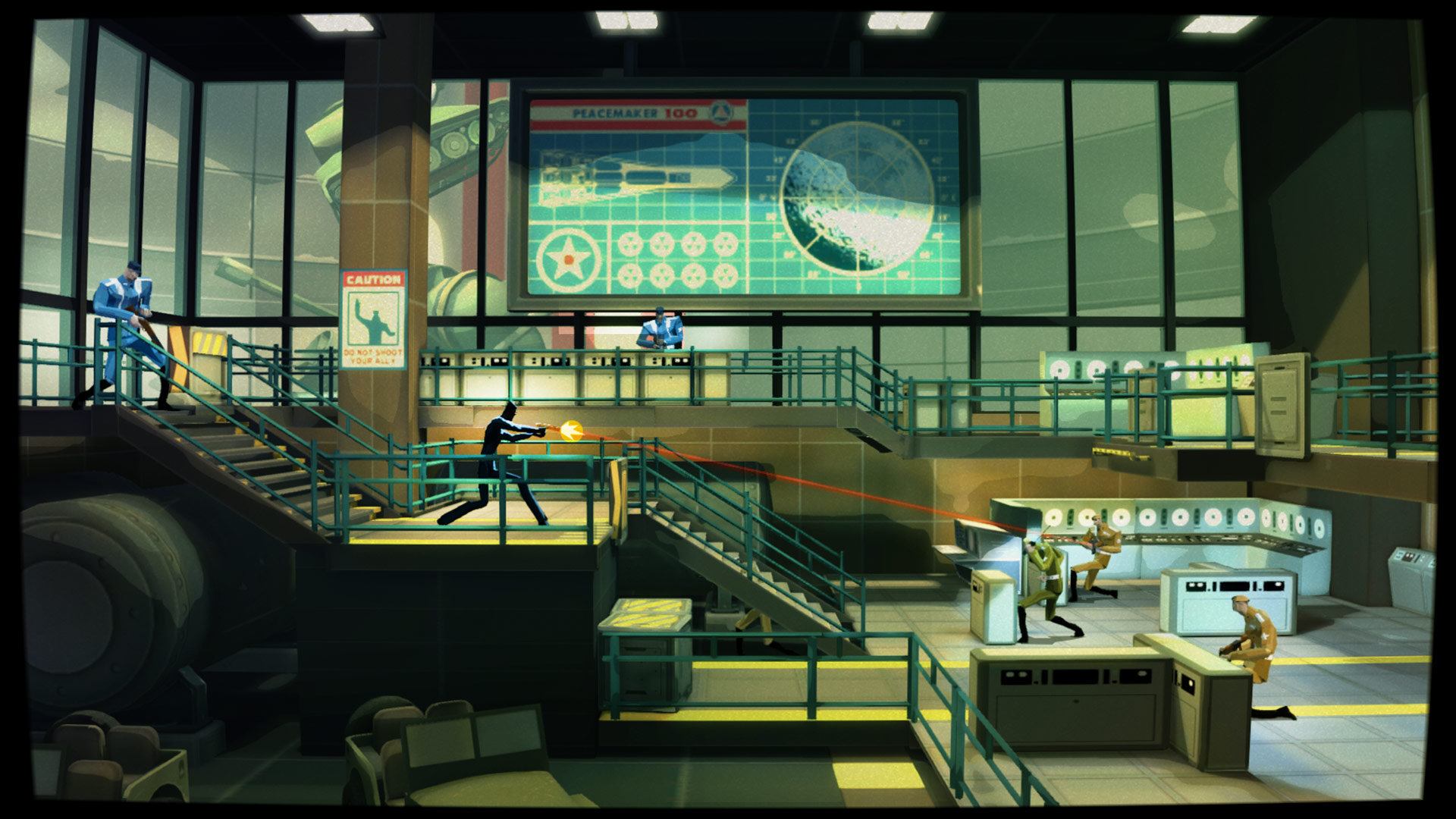
    The aesthetics are generally lovely to look at, with soviet and imperialist posters scattered throughout areas both being funny, and great in achieving a cold war-era feel. Soviet missions will take place in hard concrete rooms with great towering statues adorning most rooms, whilst the Imperialist rooms are generally more metallic and useful. This contrast between both states is fantastic, and really helps to give the game a charming look and feel throughout.

    After 2 and a half hours of fighting, I finally come to the stories conclusion, and whilst it wasn’t a great ending, I still enjoyed my time with the game. As a stealth game, I feel Counterspy is a failure; it’s own random levels push you out of stealth rather than encouraging it. But as a polished product that manages to make you smirk and smile at it’s aesthetics, Counterspy is enjoyable. Give it a go if you already own it, and if you don’t, download the game on Android; it’s cheaper, and you’re bound to find more than 2 hours of enjoyment out of the game.

    3/5

  • Weekly Gaming: Downwell (PC)

    Weekly Gaming: Downwell (PC)

    If I had to describe Downwell with as few words as possible, I’d have to say the following: The Binding of Isaac but as a platformer. Those words don’t come lightly, as I absolutely adore The Binding of isaac; a game that has easily taken hundreds of hours of my productive life away. So what about Downwell makes me sing its praises so loudly? Mainly everything about this addictive little shooter/platformer/rogue-like/endless runner has something to be fascinated by.

    animated2-feb

    As may have been ascertained from my last paragraph, it’s hard to clump Downwell into one genre. It’s an endless runner with levels, it’s also a shooter, as well as a rogue like, and finally, it’s also a platformer. All these elements fit strangely well together, mainly due to the simplicity of the game, and the fact you only need to know 3 button presses.

    Left, right and A. That’s everything you’ll need to traverse the bottomless pit that is Downwell. The A button isn’t only for jumping from platform to platform, but also for shooting your weapon whilst falling or in the air. It’s stunningly simplistic, but hard to master, and makes for every jump in the pit just as exciting as the last time. what also helps is the controls’ accuracy; we’re talking Super Meat Boy levels of twitching-ness here, which certainly helps to bring the blame of deaths and hits onto yourself. Not once in my time with Downwell did I ever feel like the game was ripping me off; if I take a hit of damage or die, that’s my own fault, not the games.

    7b1cbe2604c4881ff0c1102bfe97520cfe5f0e3d

    The rogue-like nature of the game also works in its favour, ensuring that everytime you die you’re bound to come back. The short, repetitive levels never feel overused, and with each new stage and new enemy that is spawned the difficulty increases, helping you to truly always feel challenged, but never outgunned.

    To help with the rogue-like feel of the game are power-ups given between each stage. These power-ups can range from the trivial (like extra gems from enemy deaths), to the extreme (every rock exploded produces shrapnel that’s fired upwards at enemies). Along with the power-ups between levels, you have the chance to purchase new ones at a shop which randomly generates throughout stages. Using gems collected by killing enemies, you’re able to buy ammo upgrades, or health, ensuring you’re constantly well stocked and ready to face the well again. Regardless of how lucky you are on a run, you never feel cheated. Each power-up, no matter how trivial, at least serves some purpose, and helps to make the game feel more engaging as a consequence.

    Downwell-PC-3

    Enemies throughout the stages are also varied enough to make sure you’re always kept on your feet whilst progressing downwards. Skeletons and jellyfish may not seem threatening whilst alone, but should you avoid some and let them accumulate with others on the screen, you’re bound to get into trouble. It means that not only are you trying to manage your risk throughout every section of the map, you’re also trying to get to the bottom of the screen as fast as possible should you miss an enemy, as you may be able to deal with threats below you, but you can never deal with something above (not unless you’re a mentalist that’s able to trick enemies into somehow going below you).

    The platforming if anything is a hindrance to playing Downwell: landing on a platform breaks the flow of immersion you get by scaling the games levels. The only time they’re somewhat useful would be when they lead to timefree zones; areas that have hidden power-ups within and allow you to pause the world outside the timeframe bubble temporarily, which is a good chance to get back to your senses and progress again.

    Whilst the game may not be much to look at, it’s certainly stylized fantastically, and really gives the vibe of an old/retro game. If it wasn’t for the smooth and consistently fascinating animations anyone would genuinely think the game was released 30 years ago. The music too isn’t too great, but when you’re concentrating so hard on the gameplay at hand, it’s good to have no distractions.

    Given Downwells cheap asking price (£1.99 full price, £0.99 at time of writing) you can hardly go wrong with this absolutely mechanically smooth game. I had friends telling me how good the game was, and I should have listened to them sooner: Downwell is an absolute joy, and completely deserving of your hard earned cash. Upon playing the game for a few hours I went and purchased two more copies for a couple of my brothers, just so I had someone to talk to about my experiences and theirs. If you loved The Binding of Isaac, and are looking for a quick fix, you can’t go wrong with Dwonwell.

    5/5
  • Weekly Gaming: Super Time Force Ultra (Xbox One)

    Weekly Gaming: Super Time Force Ultra (Xbox One)

    Having both Games with Gold and Playstation Plus is a genuine nightmare should you make sure to get each of their games monthly. That’s (at the minimum) 9 games every month constantly added to my overwhelming collection, and thats ignoring my PC collection where I also subscribe to Humble Monthly, and buy multiple Humble Bundles as and when they’re released. Why do I bring this up? Well, as a consequence of so many games being stockpiled, great games manage to slip through my hands, meaning that although I got them for free months, even years ago, I never get around to playing them.

    Super Time Force Ultra just so happens to be one of those great games that slipped through. I recall playing just the tutorial when I first got my Xbox One almost 2 years ago now, and whilst I wasn’t necessarily hooked on the game in that short time, I was still intrigued. This week, I decided to give it a go, after hearing many players online say that they completed the game in around 4-5 hours. I had an afternoon spare after programming and cleaning, so why the hell not?

    SuperTimeForce_Screenshot

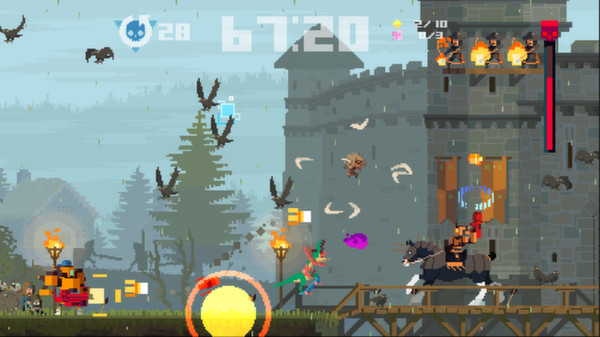
    The game starts off with the tutorial which instantly shows off all the games mechanics, some things are trivial, like the fact each character has different weapons/abilities, butt some things are extreme. Take for example the games core mechanic of rewinding time: this ability allows any character to press the B button to instantly start a rewinding mechanic. Wherever you choose, you can spawn a new character anywhere where the main character was, allowing for multiple shots on an enemy, or putting people in the paths of collectibles.

    This Time Out feature is the highlight of the whole game, and an ability that will take the whole game to master. When I first started playing Super Time Force Ultra I felt overwhelmed: the amount of bullets and enemies on screen can be astronomical at times, and the timer certainly doesn’t help to alleviate any stress you may have. Once you get used to the Time Out feature (which is limited to a generous 30 uses), you start to realise how easy the game is, but also how well each level has been designed to take advantage of these multiple characters on screen at any one time.

    It’s actually genius how a mechanic that brought me great stress at the beginning soon evolved into one of the most enjoyable parts of the game by far: I would genuinely hang around stages and waste time just to see if I could kill more enemies/get more loot whilst using as many time outs as possible.

    ss_27a8e2e8e1d3058896b20527190343658c0f1f1d.600x338

    As was said before, each character has their own abilities and weapons, allowing you to mix and match multiple characters until your hearts content or you’ve defeated a boss how you would like to. Pressing X once on the controller will fire a simple attack, with holding it down and charging it released the character in questions special attack. I’ll be honest, the vast majority of the game I never used the standard attack: it’s just too hard having to constantly press one button when you can hold it down for a more powerful attack.

    The story is somewhat funny, and involves a professor that has discovered time travel, and his future self, who has assembled a Super Time Force to make time adhere to what he wants it to (making the world more awesome as he says himself). Sergeant Repeatski (as he’s known – fantastic pun, if I may add), sets you and your team out to all manner of random and crazy points in time: one minute you’re fighting dinosaurs, the next you’re in a computer, and eventually you’ll even be ascending to heaven whilst fighting angels. It’s a ludicrous idea, but one that I thoroughly enjoyed; from start to finish I was wondering how the game was going to top it’s own humour. Suffice to say, it succeeded in making me chuckle quite regularly.

    The levels are well played out and offer enough variety that no two scenes ever feel alike. You’re constantly having to think on your feet, which is fantastic when you have so much leeway in how many time outs you have should you accidentally die. Each time-out on a stage feels refreshingly new, with enemies dying ahead of you (from your previous attempts) and secrets found that otherwise wouldn’t have been.

    STF_198X

    The boss fights are also absolutely fantastic, and take advantage of the time-out mechanic even more, making you repeat your fight against the boss over and over again until you get it perfectly using a combination of skill (from dodging the bosses attacks and placing your previous time-outs in the correct position) and firepower. I found the strategy of “place as many machine gunners around the stage as possible” a perfectly acceptable method that managed to get the job done consistently.

    There’s plenty of reasons to keep coming back to levels well after you’ve finished them too. Glorbs (the games collectible which also gives you more time-outs) are hidden throughout levels, both within enemies and breakable objects. When you kill an enemy or break and object they came flying out in a semi-random direction, and should they touch the floor they’re useless. This breaking mechanic ties in well with the Time-out abilitiy, as it means you’re constantly replaying levels not only to build up enough firepower to kill enemies, but also collect Glorbs as they’re ejected.

    It’s hard to nitpick anything bad about the game. I mean, after a while you could say the pacing and difficulty gets easy, but then the studio’s fixed this with their new ULTRA mode, where you need to save each time-out version of yourself otherwise you start a level again. If I really had to say a bad thing about the game, it would be that the basic three characters have plenty enough firepower and abilities to never use anyone else throughout the rest of the game. Yes, I messed with other characters; Cleo for example has an awesome boomerang ability which essential makes her untouchable, but for the most part I relied on my shooter, sniper, and shield.

    As I said at the start of this review, it’s annoying owning so many games! Yes yes, I know, that’s a proper #firstworldproblem right there, but as more and more indie developers saturate the market with fantastic games, it’s going to be hard for everyone to play the standout achievements like Super Time Force. It genuinely is a mental platformer, one that takes you to your limits both in stress, but also enjoyment. If you find that you have Super Time Force in your library, give it a go, you will not be disappointed.

    5/5

  • Weekly Gaming: Doom (PC)

    Weekly Gaming: Doom (PC)

    Hey all!

    So this week I’m looking at ID’s latest take on Doom on the awesome platform that is the PC. It’s hard to put into words how much I genuinely love this game, and how I lost an entire weekend to the game when I really didn’t expect much.

    So without further ado, go read my full review at the link below!

    http://www.vgchartz.com/article/264338/doom-pc/

    For those of you who are interested, I felt that this review was so different to the original draft I posted that tomorrow I’ll be posted an editorial on the edits that happen to a review before it’s posted over at VGchartz.com. It’s gonna be a long article, but I hope it’s worth it to many of you out there that would like to see the difference.

    Until tomorrow!

    -Dan

  • Weekly Gaming: Tembo The Badass Elephant (Xbox One)

    Weekly Gaming: Tembo The Badass Elephant (Xbox One)

    I know I know, it’s weird hearing that Game Freak made a game that isn’t Pokemon, but here we are with Tembo The Badass Elephant. After having just spent 6 and a half hours 100% the game, I have to say, what a weird confusing experience it’s been. If this review seems a bit all over the place, then I apologise, but Tembo The Badass Elephant has unfortunately frazzled my brain.

    vlcsnap-2016-03-13-19h17m18s107

    The game starts out easy enough, with the graphics being somewhat charming, and with the story being funny and nowhere near serious in any way. A group called “phantom” has invaded a peanut shaped land, and is holding all civilians hostage. The lands general, in need or urgent help against these bad people, calls in someone he used to work with whilst he was in the jungle.

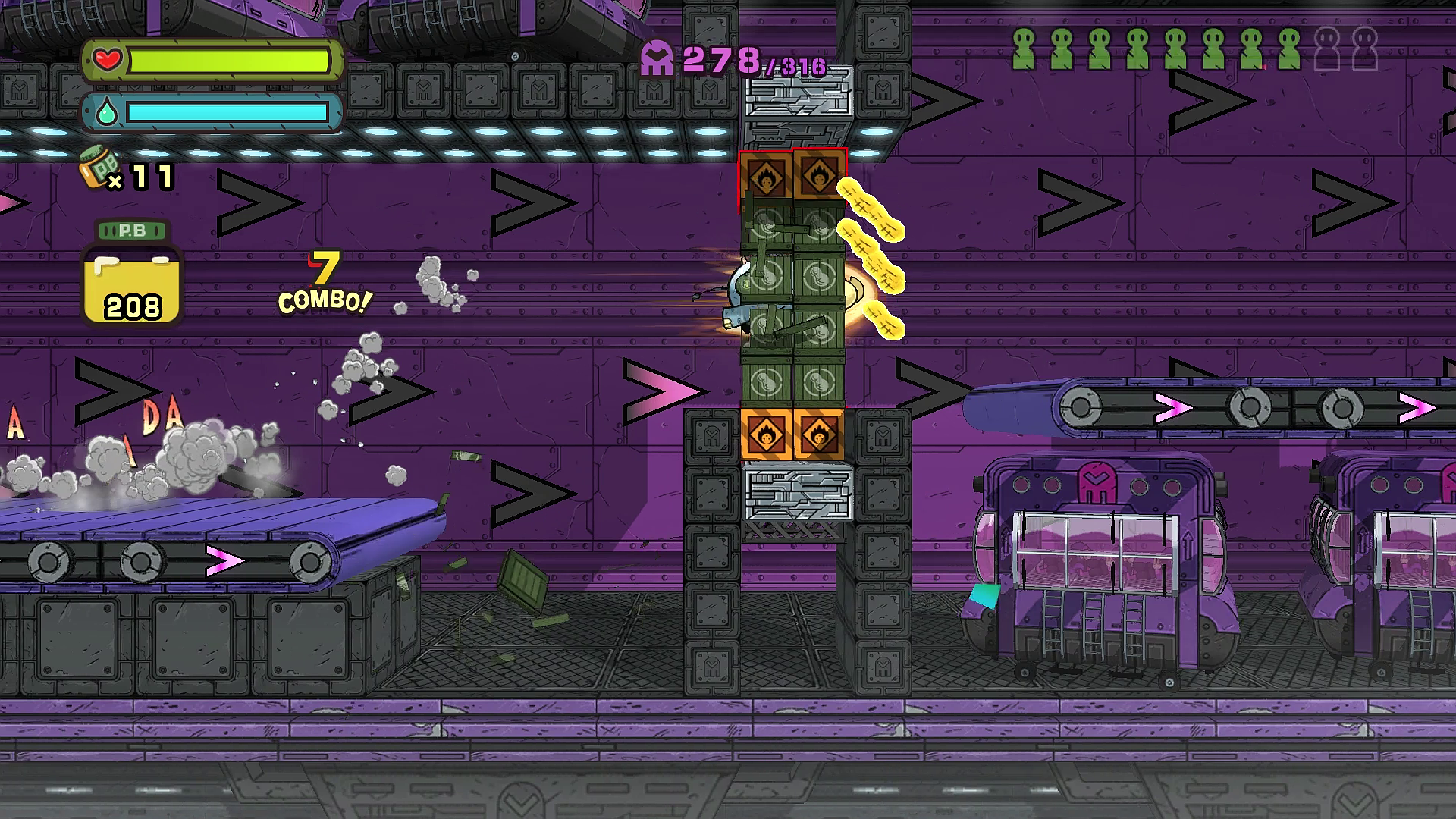
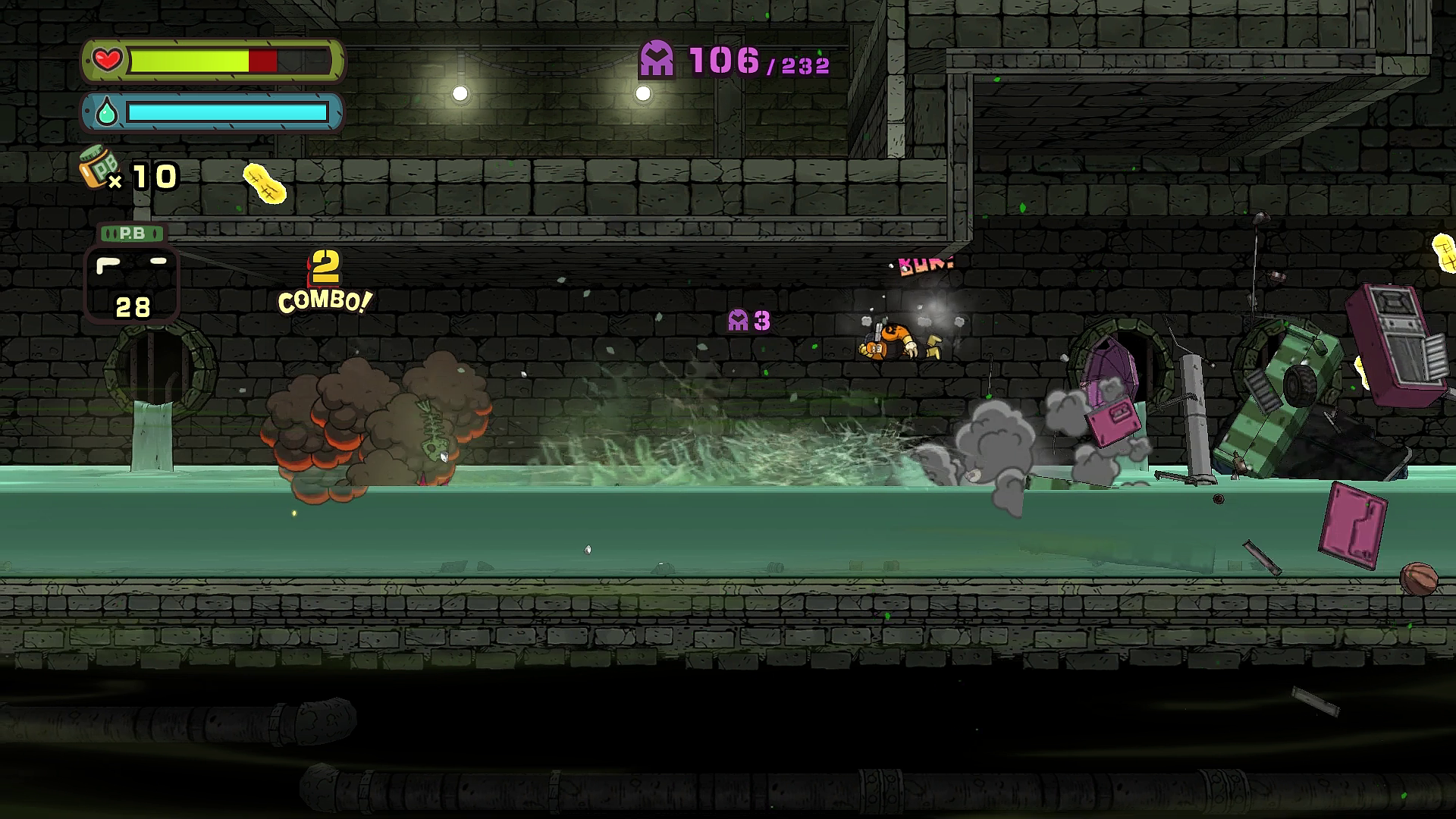
    In comes Tembo, and with this huge elephant, a whole new way of playing platformer games. Due to Tembo’s size the platforming mechanics have had to be reworked. You don’t need to worry about many walls or enemies, as Tembo will just triple through them with relative ease. So with the core mechanics changing in this way, how does Game Freak manage to make a challenging and compelling game? Through variety and collecting.

    vlcsnap-2016-03-13-19h17m03s215

    Whilst core enemies are of no concern, Game Freak have made a variety of different enemy types, all of which are easy to deal with A mano a mano, but the second these enemies start grouping together you’ve got a fight on your hands. Take for example the flamethrower grunt; his attack is straightforward and easy to see through: simply wait for him to recharge his flame, and rush into him. Seems simple enough, but when you start putting this very same flamethrower man alongside robots that glide, and bomb throwing grunts, you start having a very challenging time.

    That’s not to say Tembo isn’t without his own array of arsenal. Using his hulking size, you’re able to sprint through enemies, slide, uppercut and finally spin dash at them (the last move is similar to sonic; jump and press x to lunge towards enemies as a ball). These attacks are all the arsenal you’ll need against both terrain and enemies, but use them wisely: i found myself dying far too many times because I was trigger happy and would press the X button before touching the ground, leading me to spin to my death.

    vlcsnap-2016-03-13-19h17m42s93

    Along with Tembo’s abilities for movement is his ability to use water from his trunk to put out fires. Whilst this mechanic is shown off at the start of the game as a brilliant way to differentiate it from other platformers, I found it was rarely needed throughout the campaigns 17 levels. Wherever there was fire, there was a way round it.

    The collecting part of Tembo is what got me so hooked on the game, and kept me coming back to levels time and time again. There’s two collectibles on each stage: 10 civilians to collect, and kill every enemy within a stage. The two kind of go hand in hand; each time you collect a civilian, you’ll have 10 phantom points added to the total number of enemies you’ve killed, meaning you’ll need to get everything a level has to offer if you want to get all the medals.

    vlcsnap-2016-03-13-19h18m09s101

    There are boss fights throughout, and I found them actually rather challenging compared to most levels. Sure, the first boss fight can be done easily, but every subsequent one took me at least half an hour; a brilliant sign of their difficulty in putting your knowledge on how to control Tembo to the test. I found the final boss especially frustrating, mainly due to the lack of checkpoints throughout his many stages; a true testament to testing the abilities you’ve mastered.

    The stages were aesthetically pleasing for the most part, but ignorable all the same; for the vast majority of the game you don’t really notice what colour the ground is, or whether you’re in a city or forest; all that matters is killing every enemy, and charging through, making sure to look out for breakable walls or collectible civilians.

    vlcsnap-2016-03-13-19h21m26s24

    If there was any gripes I could have about the game, it would be in how temperamental the controls were; the spinning dash sonic move could just have easily have been remapped to the Y or B button to make sure players didn’t accidentally press it whilst in a pickle (Like I did far too often).

    With the game currently on sale as I write this, is Tembo the Badass Elephant as Badass as Game Freak like to think? Yes, albeit be prepared to get frustrated throughout, as you’re in for a challenging difficulty curve throughout the game’s 6 hour campaign. Platforming fans who enjoy collecting should really enjoy Tembo, but if you’re put off by collecting and don’t like fickle controls, it might be worth looking elsewhere.

    4/5

  • Weekly Gaming: Q.U.B.E Directors Cut (Xbox One)

    Weekly Gaming: Q.U.B.E Directors Cut (Xbox One)

    It’s been a while since I last played a puzzle game for the hell of it. I ended up playing 1010! just for the competition of beating my friends, but otherwise, I haven’t exactly gone out of my way to challenge my mind. After having a productive week in regards to games development and work relating things, I decided to dedicate my entire Saturday night to playing and completing a game. So, sitting in front of my Xbox One, I decided to look back through the many games I’ve purchased and never played, and happened across Q.U.B.E, by Toxic games.

    vlcsnap-2016-03-13-00h48m46s32

    I’ve seen the game multiple times in the last few years, but always dismissed it as “just another portal ripoff” before going about my day. It wasn’t until the Develop conference in Brighton that I finally started paying attention to the game when I met Dan Da Rocha. Having spoken to him and then going off and watching some trailers, I decided I would buy the game, and one day (time pertaining) would give it a play. Suffice to say, I’m glad I did.

    The game starts out like a typical indie game: you’ve lost your memory, and are in a strange simplistic (aetsthically speaking) place. You walk along and start getting voices radioed to you: apparently you’re in a space station which is close to earth and have been tasked with destroying this alien station for the benefit of all mankind. Walking on, you find a room which makes you go into sectors, with the first sector teaching you the basics of the game; namely cube manipulation.

    vlcsnap-2016-03-13-00h49m11s39

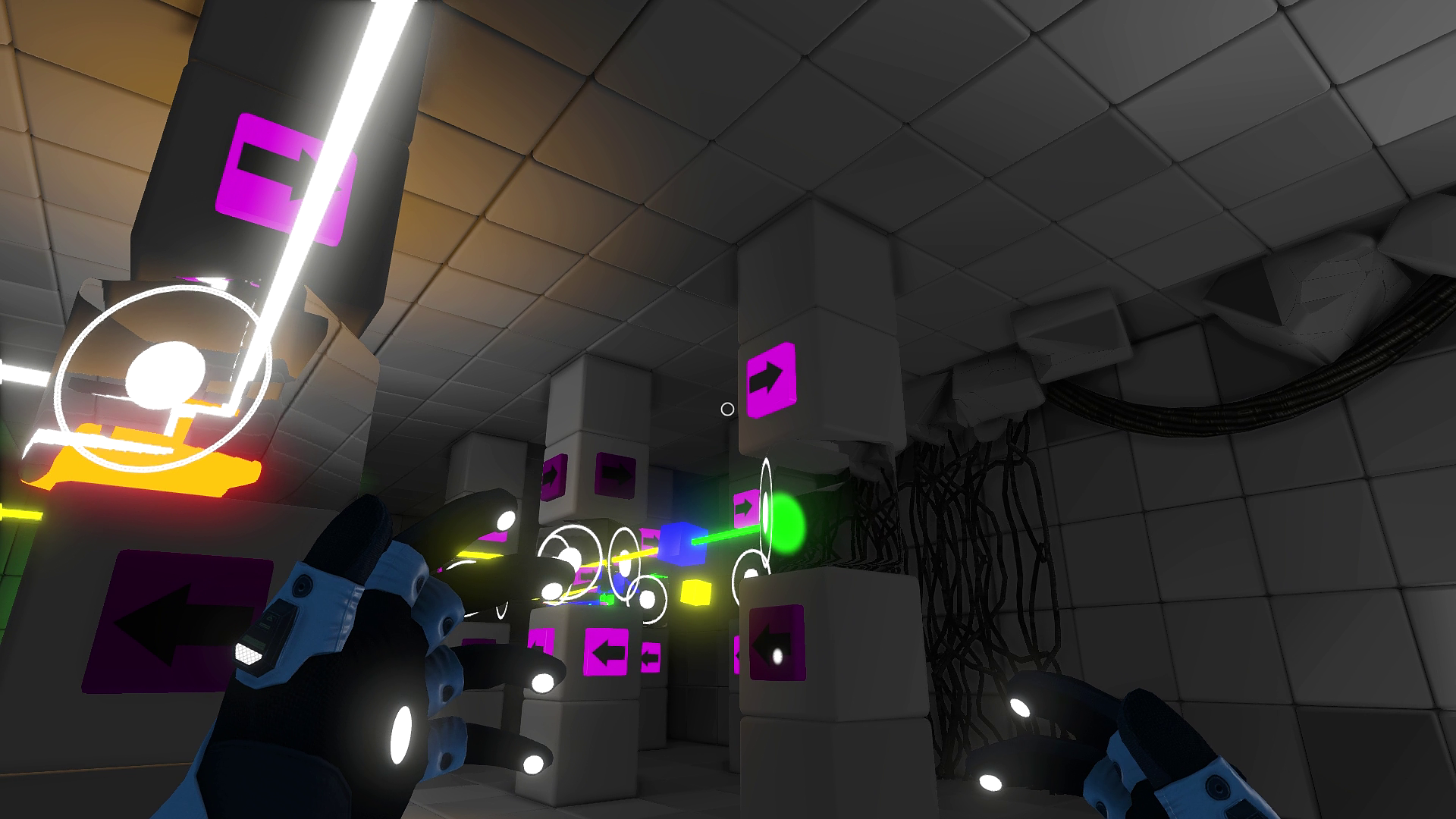
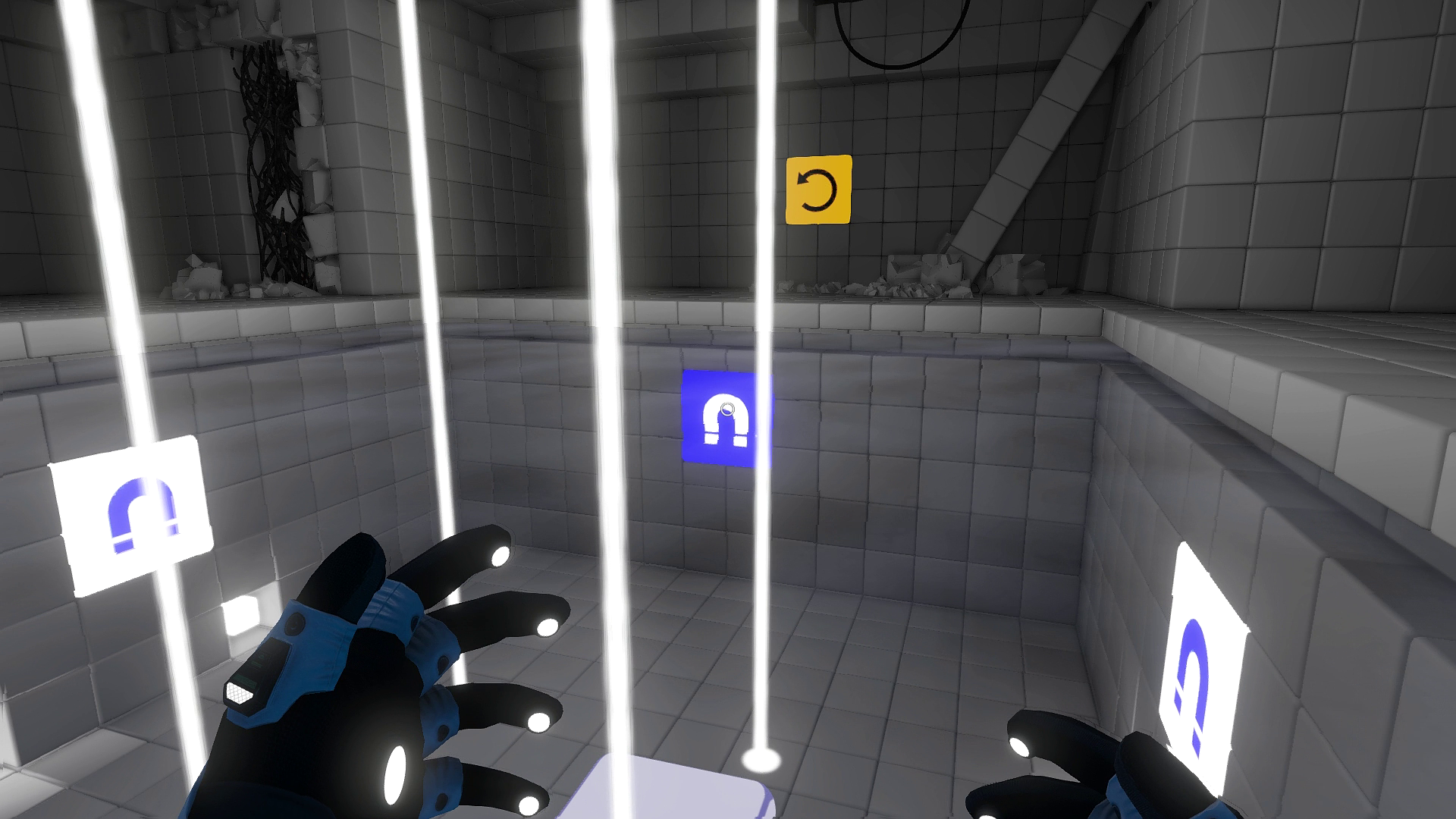
    You see, QUBE (which stands for Quick Understanding of Block Extrusion) does what it says on the tin. You must make your way from point A to point B (the exit) using blocks that extrude from the walls and floor. Each colour of blocks behave in a different way: red blocks are regular and extrude one press at a time, yellow extrudes as a group, blue as a spring, and purple as a room rotation. Using different combinations of these blocks will allow you to traverse the environment, and in turn, get to another sector.

    When I write it down like that it makes the game sound a lot easier than it actually is, but with each new sector comes a new way to use and present this basic building blocks. Sector 4 for example turns out all of the lights, meaning you can only see the colours of a set of blocks when you turn those specific blocks on. I thoroughly enjoyed a sector where you played with exposed electrical wires; multiple grayed out coloured blocks would be laid out before you, and it was up to you to use your block extruding techniques into guided these wires into powering the grayed out blocks. It was thoroughly enjoyable, and made for a new way of looking at the world.

    vlcsnap-2016-03-13-00h48m56s151

    I didn’t feel the graphics was anything great throughout my playthrough; yes, the cubes look polished and the presentation is slick throughout, but at the end of the day, you’re still only looking at a bunch of basic cubes, something modern game engines can do with relative ease. I did enjoy the music though (whenever it made an appearance), as it’s mellow tones and sometimes dramatic bass made the experience feel more alive and serious, something I would never thought I’d say about a puzzle platformer.

    The story, to, is actually fairly complex and some great icing on an otherwise tasty cake. The back and forth between two characters saying things completely at odds against at each other leaves you as a player constantly guessing as to what the true intentions of the facility really is. Even in the games final moments, I genuinely didn’t know what was going to happen. It was exicting, and another reason to keep me motivated throughout the games 2 hour play time.

    vlcsnap-2016-03-13-00h49m21s133

    I suppose what I enjoyed most about Q.U.B.E was the fact that no one thing ever felt out of place or every overstayed its welcome. Puzzles and new mechanics would be shown to the player fairly frequently, pushing them to learn a new method of getting past a section in a short amount of time. Each new mechanic would be iterated time and time again, meaning nothing ever felt repetitive, despite the core building blocks of the game (protruding red, blue, yellow and purple blocks) being exactly the same. It’s extremely clever, and I have to had it to the guys at Toxic Games; they done a fantastic job.

    So, is Q.U.B.E a game I should have played when it first come out? Doing a little digging around on Google tells me I made the right choice by playing the game now; the original game (not the directors cut) had no story, and no voice acting, meaning the game was 100% about the puzzles. Whilst these puzzles are good in their own right, I can’t help but feel the game would have felt a little more boring if they were the only thing to experience. Should you not have played the game by now, by all means give it a go; I know I’ll certainly be getting my other half to play the game since she loved portal so much, and I hope if you do play the game, you feel the same way.

    4/5

  • Weekly Gaming: The Walking Dead: Michonne: In too Deep (PC)

    Weekly Gaming: The Walking Dead: Michonne: In too Deep (PC)

    Hey all!

    I wanted to do less episodic gaming this year (as I swear I played far too many episodic games last year, which is kind of cheating when you’re meant to be completing a game a week!), but here I am, playing another Telltale episodic game. My reasoning for this one is that VGChartz.com needed someone to review Michonne, and since I’ve recently completed watching theTV show from scratch, I wanted to see how one of my favourite characters played out in a game.

    http://www.vgchartz.com/article/263526/the-walking-dead-michonne-episode-1-in-too-deep-pc/

    Unfortunately, as my review above will attest, it does not turn out well at all. When you make a character driven series like The Walking Dead, you have to make sure you actually care about the characters, something Michonne doesn’t allow you, as the player, to do in any way, shape or form.

    If I had to give the game a score out of 5 (like I usually do), I’d give it a 2/5 so far, as it genuinely doesn’t live up to any expectations the previous telltale games set.

    Until next week!

    -Dan

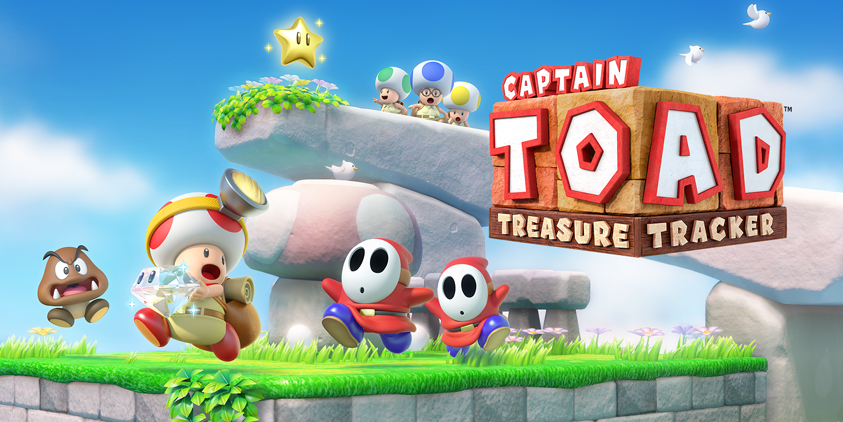
  • Weekly Gaming: Captain Toad: Treasure Tracker

    Weekly Gaming: Captain Toad: Treasure Tracker

    SI_WiiU_CaptainToadTreasureTracker

    I say games are charming quite often on this blog, and with most of these games I usually see them in a positive light. A lot of indie games come under this category, mainly because their aesthetic is so fantastic and cute that it leaves an impression that bypasses the actual gameplay. In these instances, the gameplay could be horrendous, but with the aesthetics looking so damn gorgeous I proceed to overlook a few grievances that would otherwise degrade the experience as a whole (I still write about the gameplay problems, but my overall score may be slightly higher due to the aesthetics alone).

    Captain Toad manages to be both a charming game in the aesthetic department, as well as in the gameplay one. It’s combination of simple mechanics with oh-so troubling puzzles makes for one of the best experiences I’ve had playing with another person in a long time.

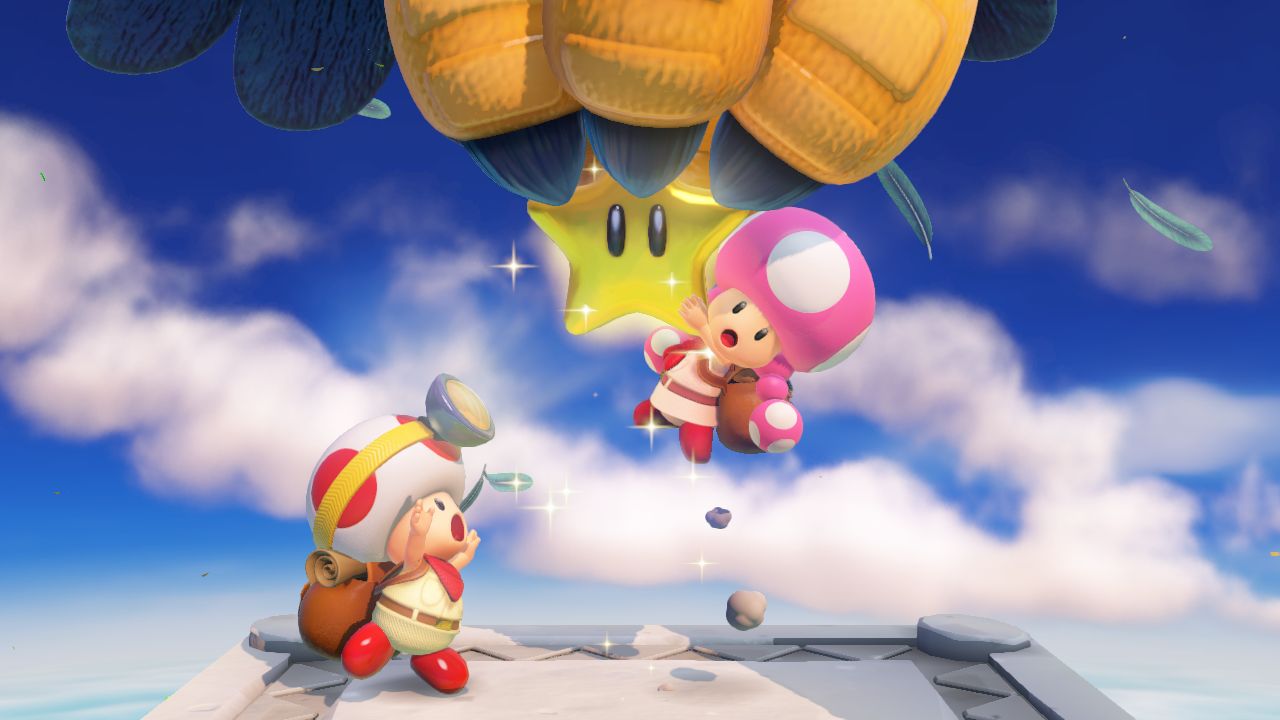
    So where to begin? Well from a story standpoint, there isn’t much to be had here. Like many Nintendo games the story is rather light, with Toadette being stolen by a giant evil-looking bird being the main reason Toad starts off on his adventure. This story flips back and forth throughout the game’s 70-odd stages, with Toad in turn being stolen, meaning Toadette has to take her turn at trying to rescue her other half. At the end of the day, the story is not necessary to enjoy Captain Toad: Treasure Tracker at all, so it’s mostly here to service a few fans with cute cut-scenes here and there.

    toad-main

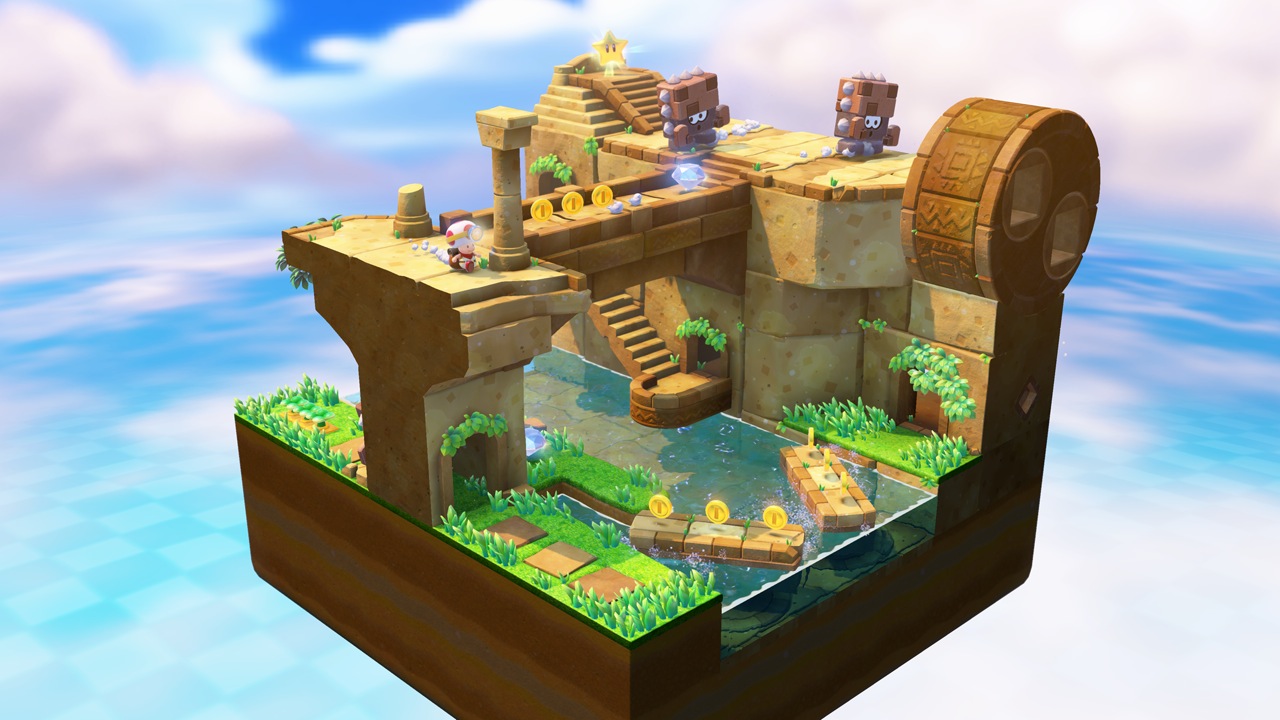
    The gameplay revolves around Toad (or Toadette!) having to navigate around a small map, all whilst collecting 3 diamonds and making their way to the golden star at the end. Each stage is extremely small, with most being able to be completed within 2 to 3 minutes should you brisk your way through them.

    These stages would be easier if it wasn’t for the limitation that Toad (and Toadette!) cannot jump. This limitation (which I believe is explained through the fact Toad has a large backpack on that holds lots of coins), helps to make every single stage extremely interesting and complex. Trying to get to a diamond which is hidden at the top of the stage becomes a chore of puzzle solving rather than action, which is great, as it gives you just as much time to take in the stunning levels with all their intricacies.

    My oh my how the levels shine! They are genuinely a testament to the amount of polish and attention to detail Nintendo can put into a game after all these years. Every blade of grass, every brick in a wall, and every character that moves about the screen is all so stunningly rendered I have no idea how Nintendo could make anything prettier in the future. This is pixar, but given to the user to control at their own pace.

    2558115-wiiu_captaintoad_scrn01_e3

    Whilst most of the campaign/story’s will entail making your way across these tiny stages, there are some deviations. These come in the form of some literal on-rails sections (where toad must throw turnips from a train cart at enemies throughout a course), and some boss encounters. These stages really help to mix up the campaign, with the same rules applying (no jumping), it makes for some challenging encounters.

    Captain Toad: Trasure Tracker isn’t without its faults though. One annoyance does manifest, and it’s in the game’s hidden mode. Titled “Hide and seek”, this fantastic little addition to each level is hidden behind a barrier: you must own the Toad amiibo. Tap your amiibo to the wii u gamepad on a level you’ve already completed, and a pixelated toad will invade it, with your soul objective being to find him somewhere within the stage. It’s a shame that for a lot of people that just bought the game without the amiibo they’ll never see this mode, as it’s easily the most fun I had with the game. Me and my partner would swear consistently as we scanned every nook and cranny of a course trying to locate a little pixelated Toad, calling him a little shit when we’d find him hiding behind a rock or a fucker when we’d find him jumping between windows. It’s seriously such a good game mode I’m tempted to try the gameplay idea myself with an iOS/Android game doing exactly the same.

    One other annoyance with Captain Toad: Treasure Tracker is it’s lack of difficulty. Whilst the puzzles are brilliant, and each level is masterfully designed, there just isn’t any challenge to the game. Yes, there may be times I would spend an extra minute or two staring at a stage wondering how to get to the final diamond, but overall these moments were few and far between. Maybe that’s a testament to Nintendo’s fantastic level designers, but for me, I genuinely wish it could have been harder so that I’d have spend more time taking in the gorgeous levels.

    2733255-captain-toad-treasure-tracker-2

    There’s plenty of replayability though, with each level having 3 different things to collect. There’s the star (which is always the end of the level), the three diamonds, and the optional objective. You’re not able to know the optional objective until after you’ve finished a level, so many times you’ll need to go back in again to do it. All three of these optionals should be enough to keep you entertained for hours, but with only one disadvantage: you’ll wish there was more once the games credits has rolled.

    Despite my grievances and as I said at the start of this review, the charm of Captain Toad Treasure Tracker manages to really pull through. Taken in it’s entirety, Nintendo have managed to make one of my favourite games of 2016, and to think, it’s only just begun makes me even more excited for what else I’m going to play this year.

    5/5

  • Weekly Gaming: 1010 (iOS)

    Weekly Gaming: 1010 (iOS)

    I’ve been going around my friends house a lot lately and watching Fairy Tail with him and his sister. On one of these days, his sister happened to be playing a game that looked like Tetris on her iPad at the corner of my eye. Seeing her pic this intriguing game up now and then to give it another go piqued my interest, so I asked her what game it was and set about downloading it.

    FUCK THE NEATNESS
    It always starts off well like this, but it’s your own desire to keep everything neat and tidy that’ll be your downfall.


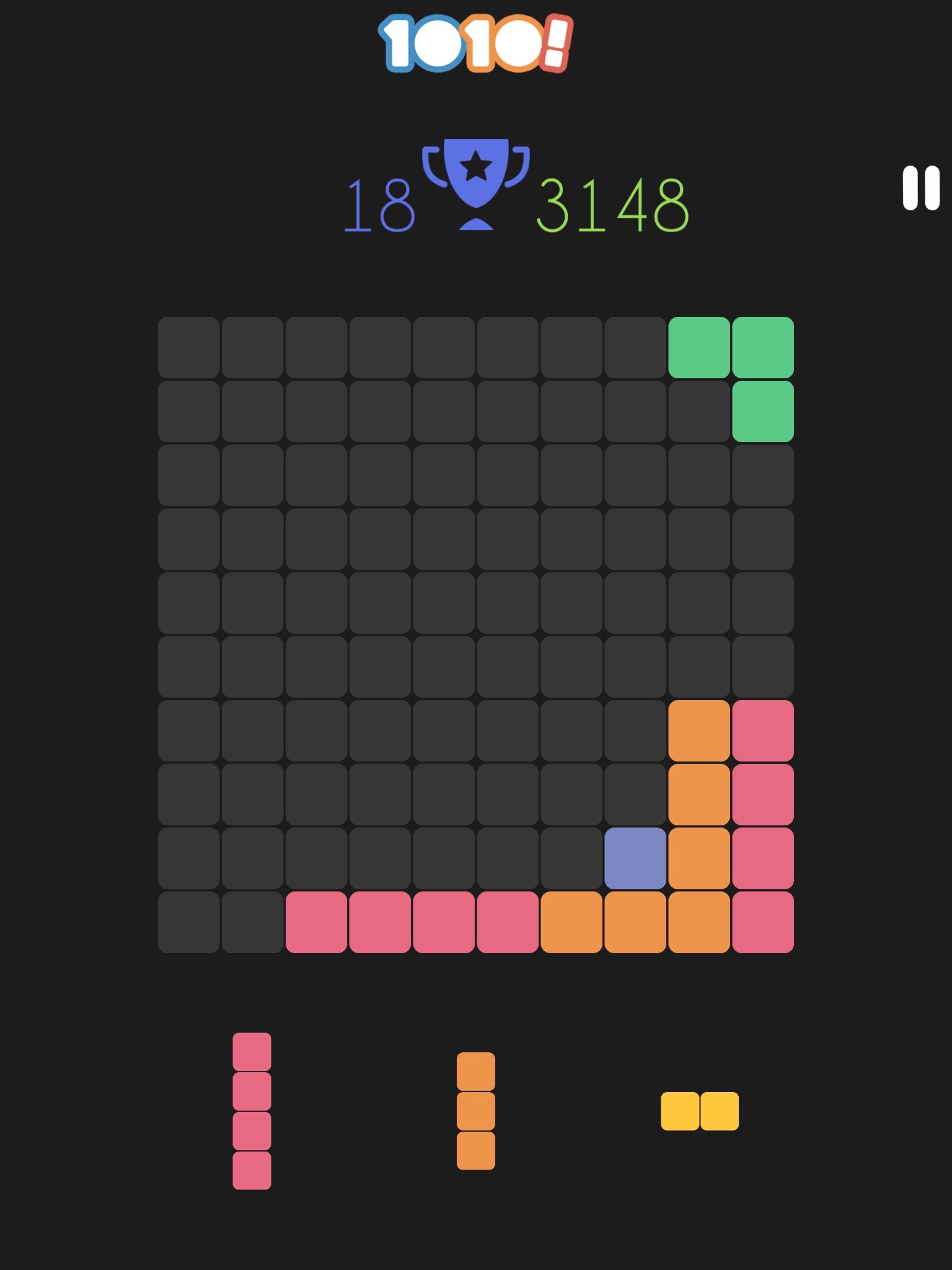
    That game in question is 1010!, a puzzle/strategy game where the only obstacle is yourself. The game starts off simple enough: you have a blank grid taking up theist majority of the screen, with three tetriminos at the bottom. It’s your task to put these tertiminos anywhere you would like on the screen, trying to make lines (either horizontally or vertically) to destroy them. Should you not be able to put a tetrimino on the grid its game over.

    The first couple of times you play the game, chances are you’ll try and sign everything up so it looks perfect and straight, just like you would in Tetris. Problem is (as you’ll soon find out) making everything look lovely does not mean you’ll have a good game. There were many times where I would make it so that all I needed was a straight piece, then find the next three tetriminos all being shapes other than I needed, ending the game.

    FUCK THE GAME OVERS
    Get used to this screen, you’ll be seeing it a lot

    You soon start to realise (and master) that in order to do well in 1010! you must get rid of lines as soon as they appear. Yes, in doing so you’ll have a messy board with shapes and remnants of tetriminos sticking out all over the place, but at the end of the day the more space you have to play with, the easier life will be when it comes to sticking the new tetriminos on the grid.

    It’s such a simple game, but is both a blast to play, and sticks to the design philosophy I love so much: keep it simple but hard. The only obstacle in this game is yourself; should you start organising everything neatly, you only have yourself to blame when the next random tile comes on screen that you can’t place.

    FUCK THE CROWDEDNESS
    This is getting a little too crowded for my comfort…

    Your score goes up for each tetrimino that you place on the grid, with destroying a line netting you more points. It’s your objective to last as long as possible, which is why being neat and tidy is not a good idea for survivability, and why I was finally able to beat my friends sisters high-score after a few hours of constant retrying.

    The games addictive, and it’s not hard to see why. It’s simple, but damn well bloody hard, and you only have yourself to blame should anything cock up. You might spend the first couple of tries blaming the game when you have nowhere else to place tetriminos, but you soon start to realise; it’s all you.

    1010! is free on iOS and Android, with the option to pay for the in-game ads to disappear. I found I needed to spend that £1.49, as the ads take up 5-10 seconds of your time between games, when all you want to do is jump straight back in after your own idiocy got you killed.

    4/5


  • Weekly Gaming: Hyper Light Drifter (PC)

    Weekly Gaming: Hyper Light Drifter (PC)

    Hi all!

    So this week I finally got hold of a copy of Hyper Light Drifter that I backed over 2 and a half years ago. Suffice to say, I was excited to play the game after this much anticipation, and it certainly lived up to my expectations.

    I can only hope that eventually all the other Kickstarter games I’ve backed are eventually released…. (I WISH).

    Anyway, if you wish to give the review  a good read, click the link below to see it in all it’s glory on VGChartz.com!

    http://www.vgchartz.com/article/263775/hyper-light-drifter-pc/

    As always, thank you for your support, and I look forward to seeing you next week for another game I’ll be completing from my ever-growing games collection!

    -Dan

  • Weekly Gaming: Unravel (PC)

    Weekly Gaming: Unravel (PC)

    vlcsnap-2016-02-28-01h05m39s317

    Hi all!

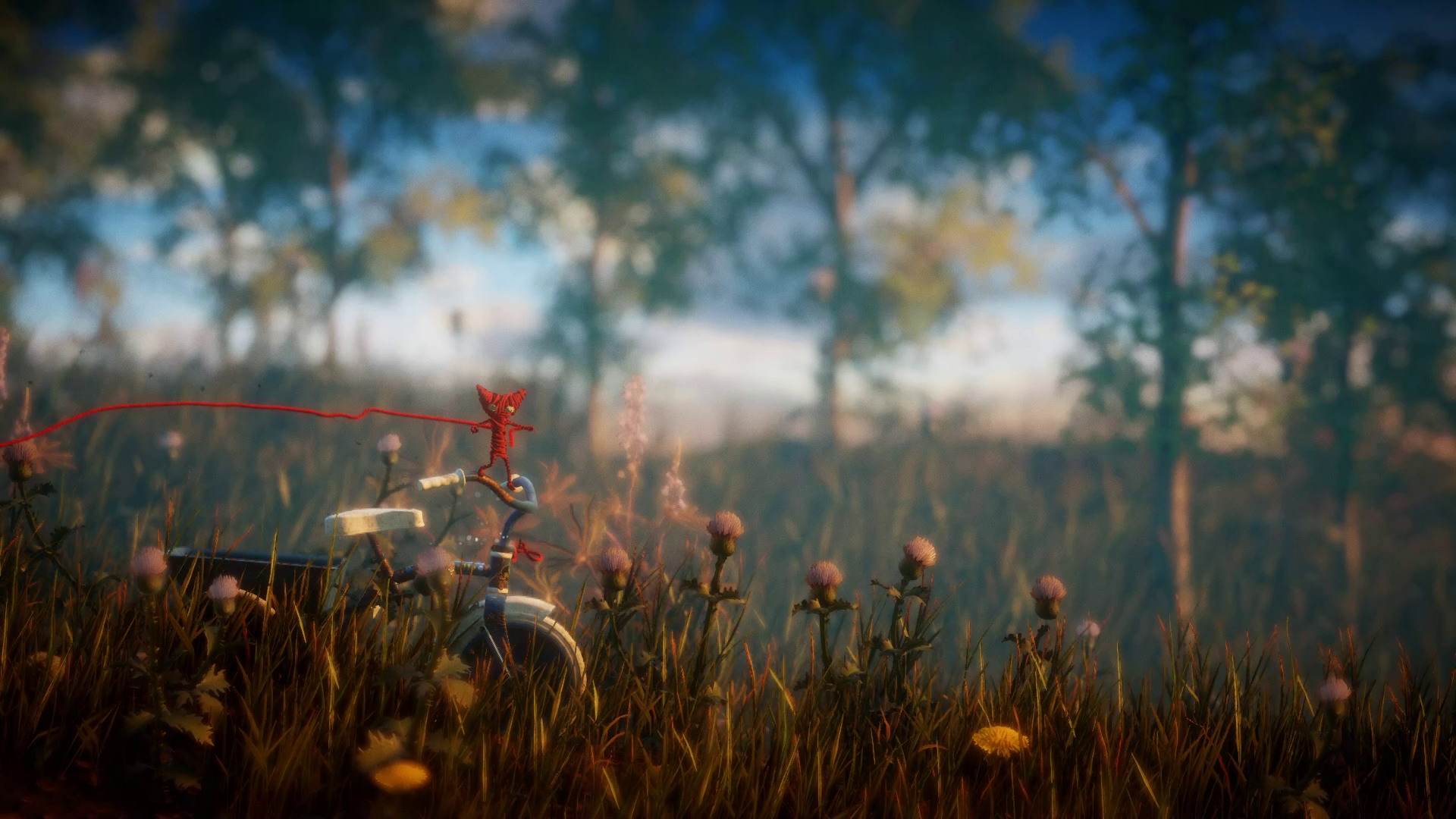
    So this week I take a look at Unravel, Coldwood Interactive’s first indie game. You can read the review over at VGChartz.com below:

    http://www.vgchartz.com/articles/adminnew/?task=edit&story=263431

    I hope you enjoy! and by all means, if you agree, disagree, or want to start a conversation on Unravel, you can always comment below!

    -Dan