Tag: Unity

  • Gaming Week 42: Anna (PC, Mac, Linux)

    Gaming Week 42: Anna (PC, Mac, Linux)

    Anna Title Screen
    Anna is made using the Unity engine, something which stuck out to me instantly when I observed the terrain they had used (Grass and mountains.) They’ve done a good job of making this engine their own, but mishaps in controls remind you that they didn’t spend much time polishing certain mechanics.

    I’ve always noticed Anna on the Steam store, appearing here and there whenever I boot up my PC, but I never took the time to find out what it was. Eventually, I watched the trailer video and looked through some screenshots, and decided that it was easily worth the couple of quid Steam was asking for, every sale helps to feed a developer right?

    Well the first time I booted up the game, I was introduced to a screen that wanted my username and password, something I didn’t have and I had no intention of making. Upon pressing cancel, I couldn’t go any further, the game just closed and wouldn’t let me do anything unless I registered or already had a account. This was extremely frustrating, and goes against the first rule of business/game design: don’t annoy the customer. The customer is doing you a favour by buying your product, giving them easy access to said product is the best way to go about it. Making them make accounts before they can even do anything? That’s just annoying.

    FUCK THE SCARINESSSSSSSS
    Each room is scarily rendered, giving a strange atmosphere that keeps you on edge the whole time. Music is played every few minutes, which is calming, but puts you in a false state of security when things can happen at any moment.

    The gameplay of Anna is similar to a old fashioned adventure game, where you must explore an environment, clicking, examining and picking up as much as possible, all to try and progress to the next area. Items that are picked up can be combined, and must be used on real-world objects in order to open to doorways, solve puzzles and progress the narrative that Anna tells. It’s a simple system, but one that is mechanically broken at times, for example I had one occasion where the story wouldn’t progress until a bell went off, something which I had no control over, so was sat exploring and wondering around for 15 minutes before I could progress. Overall, despite its flaws, the play style suits the horror genre perfectly, matching Amnesia: The Dark Descent whilst also adding it’s own twist in the narrative department.

    Graphics are lovely on Highest quality setting, with most of the game taking place indoors, you’d be hard pressed to realise its a Unity game. Dreampainters (the developer) have done a great job putting loving care into each environment, making sure it all gets used to it’s maximum potential. Even though you spend 2-4 hours in just 3/4 rooms, you’re always finding something new, prolonging your fear just when you start to feel comfortable in one area.

    The story is told at a slow pace through voices that are heard as the player is exploring areas and solving problems. Your character occasionally talks out loud and tries to respond to these voices, but it always falls on deaf ears. It’s a great way to tell a story, as its done at the players own pace, allowing you to absorb as much or as little information as you’d like.

    ALLLL THE HANDSSSS
    Symbols appear quite often, and are a good way to change the atmosphere of a room. It keeps you on edge, allowing the game to mess with you in interesting and different ways.

    So with all the good bits out the way and done with, we now get onto the bad bits. I found that the puzzle solutions to the game were a bit arbitrary, with no clear concise way for a player to solve them unless a guide is consulted or a player manually tries every item with every other item. It made the game annoying at times, meaning I spent about 45 minutes walking around the first area, with no way to know what I was meant to be doing, or how I would even get to the objective. The hints didn’t help either, being so loose that they could apply to anything. For example, at one stage I had a branch, which I thought would be good to use as a fire, or to move rocks. Turns out this branch is fantastic for moving boulders that looked the size of the player, something I would never have guessed until I actually started using each item with each object in the world. This same branch can apparently unwedge a knife out of a table, so whilst playing Anna, get used to unconventional thinking, and a lot of trial and error with items and objects.

    Anna starts out promising, with it’s beautiful graphics and scenery, but can quite quickly become frustrating due to the very nature its game mechanics work. Dreampainters would be wise in future to spend a bit more time working on their puzzles, as the rest of their game exceeds the poor mechanics implemented in puzzle solutions.

    2/5
  • One of my biggest strides in a long time

    So I’ve been working on my game today, and I haven’t made any progress in a while, until today that is.

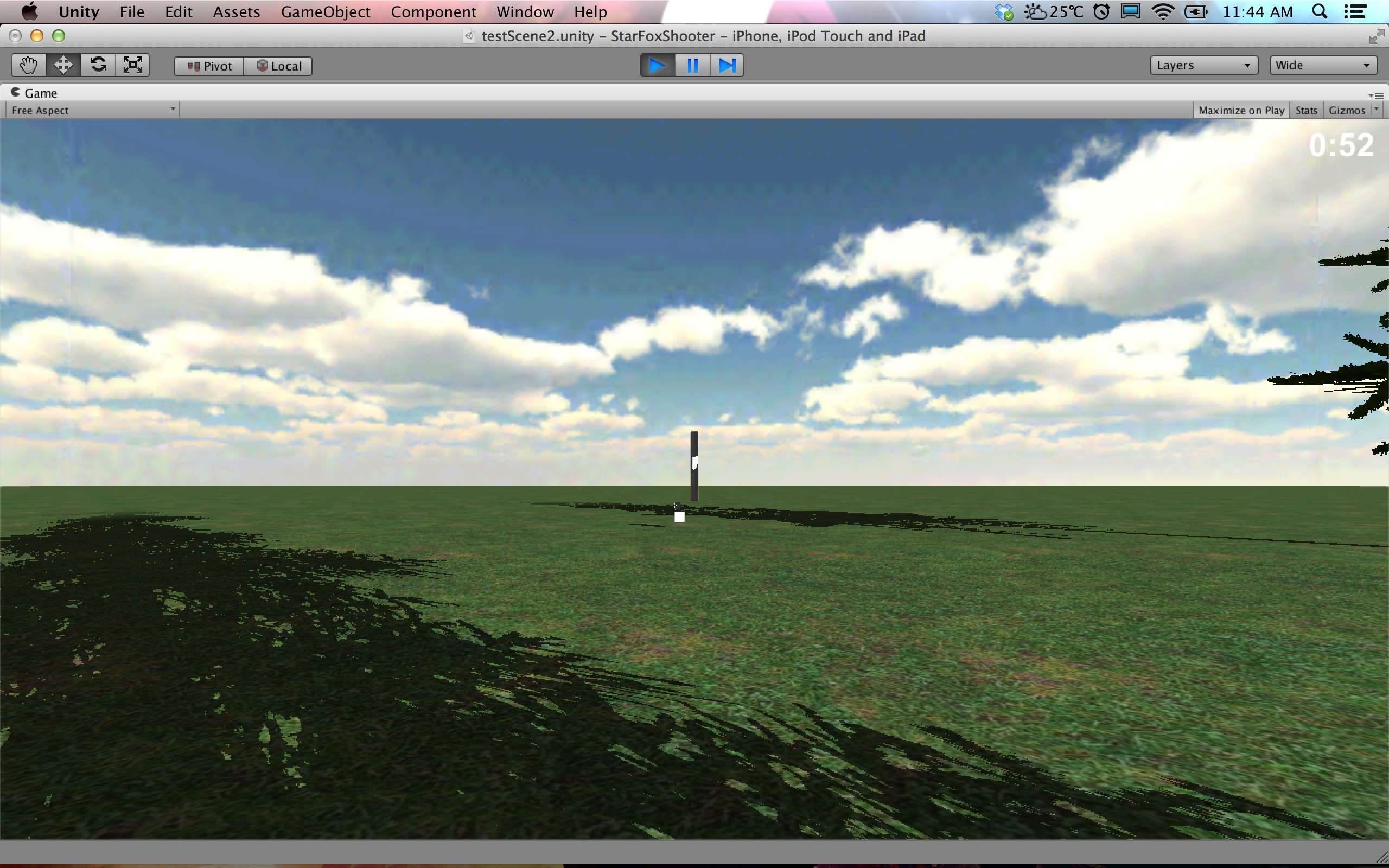
    I’ve finally been able to make my level randomly generated. I mean it’s rudimentary at the moment, and looks like crap, BUT it’s just a case of art assets not being up to scratch. In theory the logic behind the level generation works and is perfect for what I need.

    I currently only have 2 levels to choose from, a open field and a forest. My game object travels at a set pace in front of the player, and generates content far enough ahead that the world looks like one continuos level. Once this content is used and goes off screen, it is destroyed and frees up space in the ram.

    Next I’m going to work on getting the physics of my player set up. Currently the player can travel anywhere they want, I need to change this and just allow them to move left and right, not up and down. The game ends when they touch the ground or a obstacle.

  • Shadows!

    Shadows!

    As you may or may not be aware, I’m using Unity to make my current project as I have experience with the platform from my university dissertation and it’s very easy and fast to get a working prototype up and running. It’s always been my thinking that once I get to a certain point in my game, I would pay for the pro version of Unity, to allow my game to take on a fidelity level similar to that of a PS3 or 360. It seems that’s no longer the case! With unity 4.2, they’ve included hard shadows for free! Take a look:

    FUCK THE SHADOWS
    SHADOWSSSSS!!!!!

    This is fantastic, and allows for my game to finally start taking shape. Every day that I work on it, I get a little bit closer to what I want to produce. It’s amazing.

  • Expansion

    Expansion

    I felt I needed to expand on my idea I put forward to other day, as I didn’t really put across any of the specifics of this project. (mainly because I don’t have specifics yet, just a bunch of ideas!)

    But here are some pics of what I have planned so far:

    Vice Versa
    The initial ideas of my platformer

    So my initial idea was to switch between realities so that the world changed, and maybe the physics was different (so the character could jump further/higher). I liked this idea, so decided on 3 different worlds that you chose between; Normal, Future, and 3D. (Which for the moment, don’t have any different physics, but this may change in due time.)

    My thinking was that you could come across stumbling blocks in one dimension, that would be solved by jumping to another dimension. An example of which I’ve provided below:

    LETS DO THE TIME WARP AGAINNNNNN
    Here, a player jumps between dimensions to get past obstacles

    In this example, the character needs to get to the other end of the level, but the gap between the platforms is too large, so they switch to the 3D dimension and rotate the camera, enabling them to see a hidden switch, like the example below:

    YO DAWGGG, THATS A SWITCH RITE?
    The switch to 3D camera allows the player to find things that wouldn’t usually be seen

    Using this switch, the player then extracts a drawbridge, which allows the character to continue across the level, until they reach a new gap that has no switches and is impossible to jump across. The player then switches to the last dimension, the future, where everything is destroyed and desolate. Here, a tree has fallen in place of the gap, and allows the player to advance. Finally, in this example, the player can only advance in the normal dimension, since debris and a black hole are blocking the paths in the future and 3D dimensions. The player then finishes the level.

    Although these are very simple examples, I feel that using this game mechanic can present a lot of challenges to a player, and give my game a unique twist on the platforming genre.

    I’ll update more over the coming days.

  • My idea

    My idea

    So, these last few days I’ve been wanting to make something from scratch, but I feel the big game I want to make is too advanced for me right now, so I’ve decided to scale it back and make a platformer for now. This platformer will allow me to recall a lot of what I’ve learnt in Unity in the past, but will also allow me to learn some fundamental differences between developing 2 years ago at uni and developing now.

    So my ideas for the new game are as follows:

    • Game will be a 2D side-scroller, with 3 levels tops.
    • Game will have 3 characters, each with unique abilities that can be swapped between at any time. (Enabling player to jump further, or be immune to a certain enemy.)
    • The game will have 3-4 different types of enemies.
    • There will be lives, a timer, and a progress tracker for progress through a stage.
    • All textures/characters/ 3D models will be made using Blender.

    If I have enough time/feel the game isn’t good enough, I may invest some time into the following:

    • Alternate realities which the player can switch between in order to get past problems. (E.g. Water turns to lava in one dimension, but gravity is heavier.)

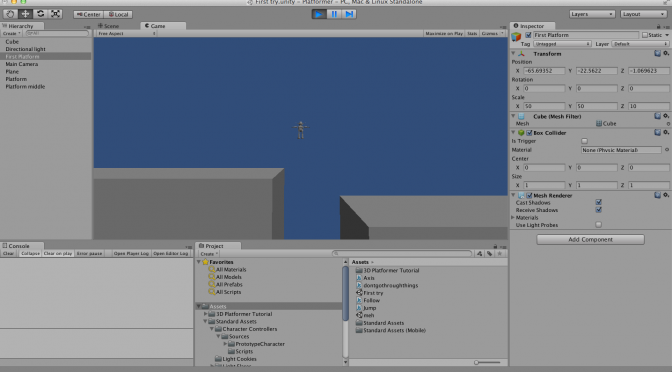
    Today I started some of this using Unity, making a bunch of rudimentary cubes to make platforms, and a player cube that can be controlled. On top of this I made the camera linked to the player, so as the character progresses along the stage, the camera follows suit.

    LOOK AT HIM FLYYYYYY
    An example of my character jumping over a gap.

    This will be a challenge, but that’s the point of all of this, so I can develop and improve my skills to one day make a game that people will love, and I can be proud of.