Author: Dan

  • Gaming Week 20: Dust, an Elysian Tale (XBLA)

    Gaming Week 20: Dust, an Elysian Tale (XBLA)

    FUCKKKKK IT'S SO ABSTRACTTTT
    Dust looks pretty cool here

    Dust is a very unique game in its ability to portray very serious topics, whilst looking like something a kid would play with its art style. This isn’t a bad thing by any stretch, in fact it adds to Dust’s ability to get your pre-conceived notions and turn them on their head. So although this may look like a game about furries, overlook that and you’ll be transported into a very deep and troubling world where it’s realities aren’t too far from our own.

    You start Dust as a person (fox?) that’s just been caught by a tiny flying fox stealing a sword. Turns out that the sword talks, and explains that it can only be welded by it’s true owner, therefore it hasn’t been stollen. You’ll come to know these characters as Dust (your main protagonist and playable character) Fidget (the flying little fox that’s the swords guardian) and the blade of ahrah (Dust’s sentient sword). It may sound like a strange set up, but the characters are very likeable  and with Dust being a blank slate that doesn’t remember anything about his past, it makes for a good set up to a long adventure.

    One of the many places Dust shines amongst other platformers is in it’s action, which is stunning both visually and technically. It’s fantastic when you pull of a huge combo, without being hit by any enemies, and whilst knowing it took a bit of skill to pull it off. The combat is very fast and precise, making sure that you’re always on the ball, whilst also being welcoming for new players and casual alike. You have your basic attacks (X to swing sword, and B to spin sword extremely fast.) and a magic attack, courtesy of Fidget, (the Y button.) but where these mix to become a unique action game is the combination of magic and standard attacks. If you press Y to make fidget cast some fireballs, you can then press B to whirlwind these fireballs into many more, attacking and homing in on enemies all over the screen. This makes for massive combos and helps to keep the player experimenting with different attack methods for different enemy encounters. It’s a fantastic take on traditional platforming action, and one I certainly enjoyed playing with.

    Dust’ art style is fantastic, all hand drawn and beautifully crafted to make sure the land of Falana is as majestic and dynamic as the gameplay itself. Characters are drawn with exceptional detail, whilst levels look like something out of a painting. To top this, the action maintains a stunning 60fps, ensuring the whole game, from aesthetics to action, are beautifully crafted.

    Quests are given during the campaign, and every level (except one at the end of the game) can be returned to and played as many times as you like. It makes sure that you return to areas time and time again, to not only complete quests, but to find hidden items, play hidden dungeons, and level up from defeating many enemies. All of these side missions make for some light-hearted adventure, but its in the story that you’ll see Dust shine through on some very serious topics. Racism, murder, family and culture are all big topics in the main campaign, but not once does it feel out of place. Every thing is explained and broken down, and you can always point parallels to our own world we live in, making for a surreal but enlightening experience.

    Pros:

    • Fantastic art style really brings the world of Falana alive
    • Great characters with very deep backgrounds and stories
    • Stylised combat makes for great gameplay

    Cons:

    • Combat can be challenging at times, with no direction of what to do

    Dust: An Elysian Tail will be coming to Steam/Windows in the coming months, (reports were stating April, but that’s come and past with nothing to show) so I think as soon as it comes out, you should grab yourself a copy. Dean Dodrill took 3 and a half years making this, and it shines through in every aspect.

    4/5

  • Gaming Week 19: Far Cry 3 Blood Dragon (XBLA)

    Gaming Week 19: Far Cry 3 Blood Dragon (XBLA)

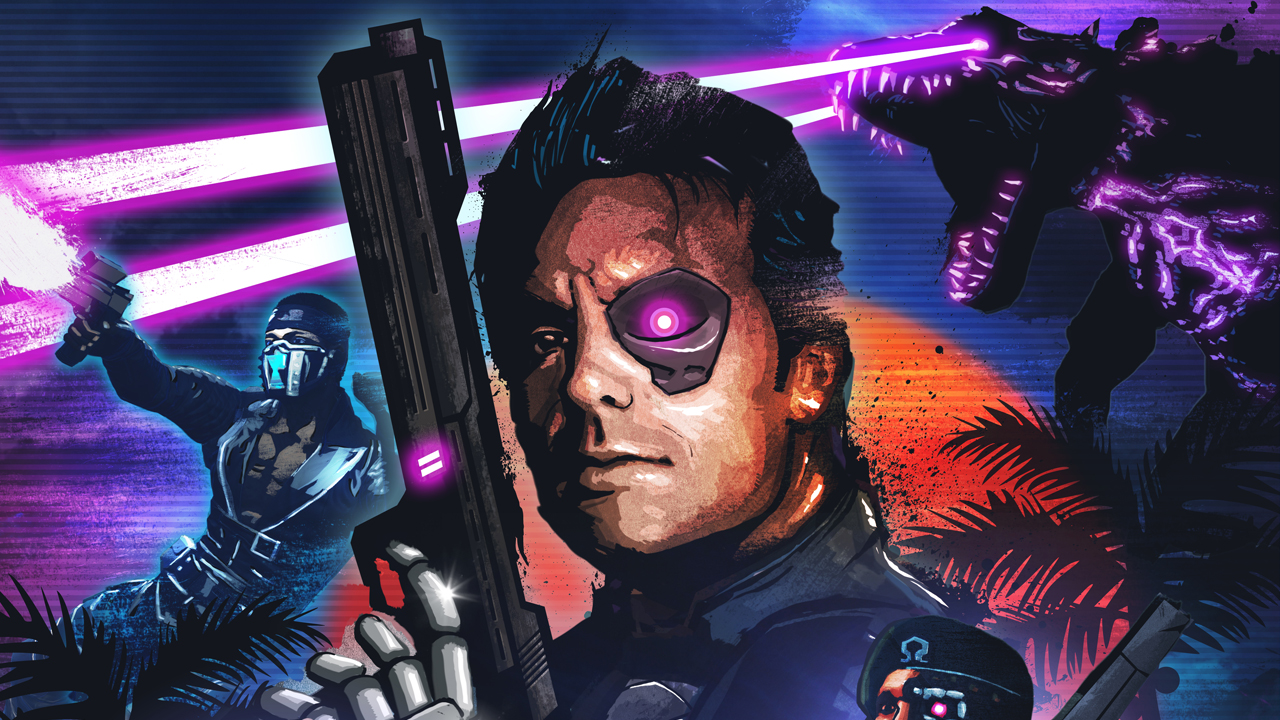
    RWARRRR I'M A BLOOD DRAGON!
    How badass is this?

    Far Cry 3 was a fantastic release last winter, combining a gorgeous open world with a solid story, it made for a very fun and addictive game. Fast forward 6 months and we have the release of Far Cry 3: Blood Dragon, a stand alone expansion that doesn’t require the original game to work. So the question is, what is Blood Dragon? The answer isn’t as straight forward as you may think.

    Blood Dragon is Far Cry 3, except, it technically isn’t. The main setting and plot for Blood Dragon centres around an alternate universe in which the world has undergone 2 apocalypses (I shit you not) and the 80’s are here to stay. At face value, this is basically a few reskins of the original Far Cry 3 whilst also messing things up for comedic value, but some of the changes really are hooking, and make for a unique gaming experience in its own right. If you want to see how far they went with the 80’s theme, here’s the announcement trailer, it may damn well blow your mind:

    Combat is the same as Far Cry 3; you walk around a big island which gives you a wealth of different options to which you can kill people, including the new animals, the Blood Dragons. These beasts are huge, terrifying, and can fire lasers from their eyes! They’re certainly a force to be reckoned with, but can also be used to your advantage. (They can’t see very far, and love to eat cyber hearts, chuck a cyber heart into a enemy base and watch the mayhem unfold.) All these mechanics help to give you freedom over the island, whether you want to be a stealthy ninja, or a rambo in the making is completely up to your play style. You’ll be rewarded more for assassinating people without being seen, but be destructive enough and you won’t notice the difference in XP bonuses.

    Character progression has slightly changed from Far Cry 3, which makes it easier to progress, but not necessarily for the best . Where as before you could choose what new skills you wish to learn, allowing you to pursue any specific traits you want, (be it stealth, health or damage) you now have a straight path with no deviation. Your character can level up to 30, by which time he’s acquired all the skills available in the game. It’s not a bad skill tree by any means, it just takes away some of your freedom of how you want play the game.

    Enemies in Blood Dragon are the same as they’ve been in Far Cry 3; you get normal humans, which can be split into different types, as well as animals. There are your traditional types of human classes, some are heavy and take a lot to bring down, others are lightening fast, nimble, and quick to kill. Then theres the animals, which are pretty easy to hunt and kill, and don’t offer any rewards for killing. This is massive change from the crafting system of Far Cry 3, and a feature I missed quite a lot. With the crafting system, you took the game at your own pace, something that is missing in Blood Dragon. Overall, not much has changed since the original, the biggest innovation being the Blood Dragons themselves, whose presence is overwhelming at times, and certainly adds a new dynamic to the game.

    Pros:

    • Fantastic value for 1200MSP (£9.99)
    • Great addition to the Far Cry series
    • Addictive gameplay ensures you’ll 100% the game in no time

    Cons:

    • Short to complete 100% (5 hours 50 minutes to 100% all collectibles, side missions and main campaign, nothing left to do but a empty island)

    Overall, Far Cry 3: Blood Dragon is a great buy for those of you who didn’t quite get their fill of free roaming a new island in the original Far Cry 3. It does fall short on content, but is genuinely quite original in an increasingly over-saturated market.

    4/5

  • How Thomas Was Alone has changed my thinking on platformers and emotion in games.

    Thomas was alone is a strange strange game that I’m falling in love with in a weird and wonderful way. Its a game about some programming errors (represented as squares and rectangles) that each have their own personalities, and are trying to find their way through this strange and confusing world. Each character has his/her own opinions on the others, and each have their own motives. It’s really quite crazy how much Mike Bithell has made me care about a mere set of squares and rectangles. He stripes away all of the pretty graphics, and shows that in order to care for a character you need a story/personality, not fancy art.

    This has really changed my mindset in regards to my own game, and has got me in turmoil at the moment as to what I want my game to look like. I mean, you don’t need a gorgeously realistic character to feel empathy for a character, you just need a good backstory, and a good distinctive personality for the player to relate. It’s amazing how I remember each of the shapes names, but genuinely can’t recall anyones name from something like Game of Thrones.

    I’ll post more in the coming weeks of character design, and let my imagination go wild. I want to take all my gaming habits into consideration for this project, and everything I’ve ever read, so here’s to hoping I come up with something pretty original.

  • Quick update on my future weekly gamings

    Hi all!

    Just a quick update really, in the future I’m going to give my weekly gaming article a review score. As much as I think reading a whole article will give a better idea about how a person feels about a game more than a score, sometimes a score is a good way to sum it up. (especially with my writing skills, I sometimes can’t articulate my feelings on a game.)

    So as of today, I’ll be going through all my old reviews and giving them a score, whilst also giving any future review a score.

    The scoring system will be as follows:

    1/5: Do not touch this game, its a waste of money and I feel for the devs that made it.

    2/5: A lot of flaws makes for a strange game. Buy it if you must, but be warned, it’s not for everyone.

    3/5: A great game in its own right. Stands up to scrutiny, but could of been so much more.

    4/5: Fantastic game that the majority of people should enjoy. Some flaws make for a few drawbacks, but nothing too bad/game breaking.

    5/5: It’s hard to fault this game, people may have niggles, but in its own right it’s perfect representation of the game the developers were trying to portray, and won’t be bested for a while yet.

    So that’s how I’ll be signing each review off in future, over and out guys!

  • Gaming Week 18: Antichamber (PC)

    Gaming Week 18: Antichamber (PC)

    YOU GO UP!
    Does this mean I have to go down?

    I’ve wanted to play Antichamber since I first ever laid eyes on it about 2 years ago. It looked so different, and so fantastically intelligent, that I just wanted to experience this new way of gaming. It doesn’t go so far as to invent any new ways of gaming, but intelligently pushes you to the limits, ensuring you poke and prod the game environment until you understand its rules, and as a result, feel empowered in this puzzle world.

    You start Antichamber in a black empty room, with no context as to where you are, and what to do. You spin your mouse around to discover you’re in first person view. From here you can then adjust the settings of your computer using a wall, and just clicking the elements you want to change. Its a pretty nifty way of doing things, and I feel it’s quite intelligent game design to show the player how to control your character silently, and very early; allowing the player to find out things through trial and error rather then assuming every player is dumb and show controls up front.

    Once you’ve got to grips with the controls, it then allows you to select a room, which as you find out, is a puzzle in itself. Every room in this game is a puzzle, in fact, many puzzles  within puzzles, and it all screws with your head. You’re never quite sure if you’re just not looking hard enough, or whether you haven’t progressed far enough in the game to apply new skills you’ve learnt to old puzzles.

    MY HEAD! IT HURTSSSS
    Perspective 1 of a scene
    IT FUCKS WITH YOUR HEAD MANNNN
    Perspective 2 of the same scene

    The first few rooms ease you into the style of how Antichamber will play out, and then will successfully turn that on its head to mess with you. It does all have a set of rules/boundaries, which you will come to know with time, although at the start this may feel like a lie, push through and you’ll get to understand the world in which Antichamber inhabits. Rooms may continue forever until you just turn around and come back the way you came, where as others may look like a dead end in a certain light. It’s all fantastically designed to mess with your mind as much as you can take.

    Eventually you’ll come across a gun, but not any gun you’ve seen in other games. This gun picks up and disperses cubes, something which expands the puzzle element of the game no end. Cubes need to be placed in certain holes to open doors, whilst also being a restrained quantity, which can lead to some very annoying situations of starting a room again just so you can allocate your cubes correctly. The gun gets updated 4 more times in the game, allowing more creative ways to manipulate cubes, whilst also allowing you to revisit previous rooms to try and solve problems again. It’s a fantastic way to make you feel like you’ve accomplished something with every few minutes, whilst also being annoyed that you didn’t see it sooner.

    SO HARDDD
    After 5 hours of play time, this was the amount of puzzles I had solved. There’s still more to go.

    Pros:

    • Fantastic puzzles that really do mess with your head
    • Gorgeously realised art style

    Cons:

    • No story makes for confusing motivation
    • Little to no replayability after completion due to knowing all the solutions

    So I waited until this game came on sale to buy it, (£7.49) but in hindsight, £15 is actually pretty good value for the time I got out of Antichamber, and given the chance, I’d happily recommend it for all to play.

    4/5

  • Gaming Week 17: Gears of War: Judgement (360)

    Gaming Week 17: Gears of War: Judgement (360)

    This actually looks like a EA cover...
    They all look so cool!

    (This review won’t touch multiplayer, just the main campaign.)

    Gears of War judgement starts as it means to go on: A mediocre GoW game that can’t quite reach the highs of the previous instalments. New ways of playing don’t help to make the game anymore immersive, and it all just ends up leaving a player deflated once finished.

    So the premise for GoW: Judgement is that it’s a prequel, based around Damon Baird, Augustus Cole, Sofia Hendrik and Garron Paduk, just months after emergence day. Baird and his band of merry men, are put on trial for activating a light mass bomb that could of been used for other purposes, and against orders not to. Most of the campaign missions follow Baird and his crew through recollections of what happened up to the point of activating the bomb, and slightly after. It’s quite a good story telling mechanic, and allows for some interesting new ways to play. One of these is to activate a declassified mission at the start of each level; with this, Baird (or whoever is telling the story at the time) add’s some every details to their account of what happened, to which you then have to play out. It certainly added some variety to the combat, making players use only a shield in some levels, or adding fog to a field to reduce visibility. It’s a new mechanic that I’d love to see in other games in the future. Overall the story of GoW: Judgement doesn’t really add anything to the overall universe of Gears. Maybe I’m a vocal minority when I say this, but It feels pointless, and not needed at all.

    Gameplay is the same as old games, with only 1 new enemy to spice things up. The environments are things we’ve all seen before, which is a shame, because People Can Fly and Epic had the chance to explore some really nice locations that maybe weren’t touched by the locusts yet or were in the process of being destroyed by the locust horde.

    The look and feel of GoW Judgement hasn’t changed since the original many years ago, it’s just been refined to the point of no longer having any advantages. Controller layout has changed, which caused some confusion early on, but I’m sure was made to streamline the Gears experience and bring it up to par with the rest of the industry at the moment. Combat takes place like any other game in the franchise, with enemies popping up from a hole, whilst you duck and cover behind anything in the vicinity. I think one reviewer made the point of cover systems feeling like space invaders many years ago with the original Gears, and to some extent that comparison still holds true. There’s not much you can do with a genre when you’re forced to sacrifice game play for realism, and the Gears series have definitely backed themselves into a corner when it comes to innovation.

    Pros:

    • Solid narration leads to new interesting game play
    • As addictive as previous Gears of War games

    Cons:

    • Boring and non-essential story
    • Short levels make it feel more like a set of side missions than a main campaign (Some levels can be finished in 3 minutes)

    Overall, GoW: Judgement was a short game that didn’t bring anything new to the table in the third person shooter category of games. It may be a must have for die hard Gears fans, but it certainly can be skipped by the mass of consumers.

    2/5

  • The problems with game mechanics

    Hi all,

    So recently I’ve been thinking more about the structure of my game, and considering whether I want levels in the traditional sense (Like Mario, or most other platformers in the world.)  or whether I want one linear long journey (similar to limbo).

    Thinking about this comes up with a lot of problems most people wouldn’t dream of when considering how a game is made. I want my game to feel like the player has gone on a journey, that they’ve accomplished something, and I feel breaking the game down into levels would destroy that feeling as there’d be chunks of the journey the player never experienced. There are also disadvantages to having one long, continuous  journey though; players can get very bored very quickly, especially if there isn’t much difference in the scenes.

    My idea for ending the levels was that Jacob would have to board a train in the future dimension, which would carry his journey along. That’s where I came up with the snag that the player would miss out on a lot of land.

    I discussed this with my friends, and one suggested I still break the game up with end of levels, but I do so in a intelligent way e.g. Jacob comes across an abandoned camp site where he can then sleep the night before transitioning to the next level. I like this idea a lot, as it means I can make levels separate and independently of one another, but can still keep a journey going, allowing players to feel like they’ve accomplished something.

    This is definitely the way I want to go forwards with the game, I just now need to start thinking about level design, and actually implementing these levels.

  • Gaming Week 16: Deadlight (PC)

    Gaming Week 16: Deadlight (PC)

    FUCKKKKK
    Deadlight for PC

    Deadlight throws you into a realistic, post-apocalyptic world where a man can only move left and right. Joking aside, this is a truly realised world, where a simple platformer can have more depth and style then I’ve seen before (I shall overlook Limbo for now, although it is definitely in the same league.)

    ALL THE CARS
    Vista’s are gorgeous, something that can rarely be said for a 2D platformer

    Deadlight follows the story of Randell Wayne, a man who wakes up to all manner of chaos unfolding before him, at which point you have to take control of him and set off. During the course of the game, you’ll learn about Randells past, and his current relationship with other characters, ensuring that you’re clued up on what’s happening in this world. The main things you’ll be avoiding in this game are Zombies. These stupid, slow creatures feel slightly out of place in a platformer, but do allow for some interesting puzzle sequences (e.g. shouting for them to follow you onto a bridge, which you can then activate to make them fall to their death.) The other obstacles to avoid are typical platformer tropes, holes in the ground, spikes etc, and don’t really do much to advance the genre in anyway. There are some chase sequences that are worth noting, but nothing that hasn’t been done before.

    So, as I’ve already said before, Deadlight is a platformer, but you wouldn’t think that from looking at screenshots. The graphics look like something that’s been pulled from a FPS, with rich, vivid environments that truly adds to the unique style Deadlight attempts. Just look at the screenshots I’ll post throughout this review and you’ll see what I mean. The one criticism I do have with the art style is that it doesn’t take advantage of its time period in ways that I think could be fantastic for this game. It’s based in the 80’s, meaning Tequila Works could of played with peoples nostalgia by putting pop references here and there. I wouldn’t say it’s lack of 80’s culture detracts from the world, not by any means, I just feel it could of helped pull the player in a bit more.

    2D MADNESSSSS
    Enemies can come from the foreground and background to attack you on your 2D plane, be warned.

    The controls are solid, and Randell feels fantastic to control. There are a few glitches where you are sure you should of made a jump, and instead die, but overall the controls are flawless. Later on in the game, you gain control of a gun, which does make the game a bit easier, but Tequila Works balanced this by rationing the ammo. It does add some risk/reward scenarios, which is always a good thing, and even mixes things up when you’re not sure whether to use your last bullet on the zombie in front of you. Another nifty mechanic Tequila Works add is a slingshot, which can be used to get around puzzles. In some instances there may be lifts that can be only activated from a switch hidden behind a wall, these occasions are rare but rewarding when the solution shines through.

    Pros:

    • Gorgeously realised world
    • Solid platformer
    • Strong story allows for an in depth character progression with Randell

    Cons:

    • Glitches lead to some frustration
    • Despite fantastic graphics, a lot of the game is spent indoors

    So overall I’m thoroughly impressed with Deadlight, its definitely inspired me with my own game, and is definitely something I would strive to match in terms of game play and art direction. I’d recommend fans of platformers to give it a go, it’s pretty cheap, and is a good 3-4 hours worth of gameplay.

    4/5

  • The ideas behind project TimeShift

    Hi guys and gals! Hope everyone is all good and fine. I decided I should explore my concept more, and give it a proper working title, so that’s it! Project TimeShift! (working title)

    The project name gives a lot of the game away, but I hope to still keep quite a few secrets to keep the game fun and new for most people. If you don’t want any spoilers in this game, then I suggest you stop reading, as I’m going to be revealing a lot of the plot devices about project TimeShift.

    Firstly, I’ve named the main character Jacob McCarthy. He’s an 11 year old boy who’s being evacuated from London during World War 2 (much to his dismay). The year is 1940, and the Nazi’s have invaded and conquered France, so Britain initiates its second evacuation.

    Jacob comes under the care of an old, abusive man called Jack Prophet, where he has to work on his farm. Slaving day and night, and being hit at every opportunity, Jacob wants and needs to get away, no matter what the cost.

    Eventually, Jacob will stumble across a portal, which’ll teleport him to another time (The future) where the world is burnt and baron. After finding a device that allows him to teleport to a time period he’s previously visited, Jacob sets off on a adventure to get back to his mum in London, hoping that she’s alright along the way.

    The game will play with these time shifting abilities to mess with the player, making sure that they explore every time period before finishing a level. Some puzzles could include a canyon that can’t be crossed until Jacob plants a tree in the past, allows it to grow in the present, and die in the future to become a bridge. All these mechanics will feed into each other, and allow the player to explore all time periods whilst also gaining information about the world Jacob inhabits if they so wish.

    I want this game to be subtle, so I’m trying to be intelligent about all the decisions I have to make in design. For example the main menu. I don’t want to hold the players hand all the way through, or be so blatant about the controls that I stick a diagram up, I want to player to unconsciously learn the controls/mechanics just by playing. So the main menu will be a platformer (like the rest of the game) and selecting a option (like new game) will make Jacob teleport, telling the player that the button they just pressed makes Jacob teleport. It’s a clever way to portray the controls, without making the player feel like a 2 year old.

    I’ll update more on this in the coming days, I’m finally starting to get some concrete ideas that are definitely sticking, and would like the world to know. Any comments then please let me know, any feedback is welcome 🙂

  • Gaming Week 15: Borderlands 2 (360)

    Gaming Week 15: Borderlands 2 (360)

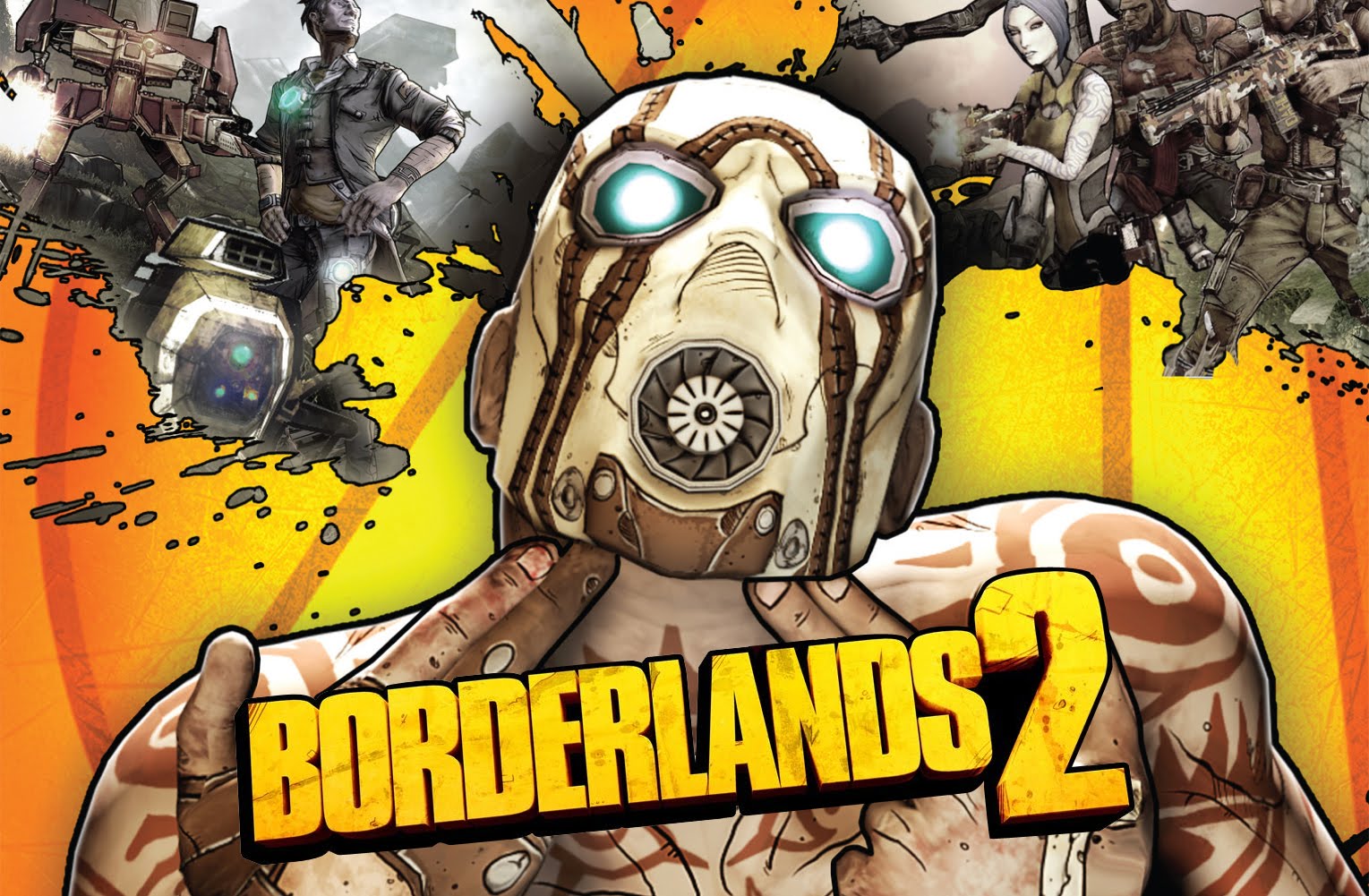
    FUCKK PSYCHOS
    Psychos…. psychos everywhere

    I’ll sum this up now: Borderlands 2 takes the successful formula of the first game, and goes to town, making sure it impresses and expands upon everything that made the first one such a runaway hit. If does nothing new to the formula, but certainly makes sure that you’re left satisfied, something that the 36 hours of gaming I’m endured can certainly ascertain to.

    If you’ve played Borderlands 1, then you know what you’re in for. Borderlands 2 encompasses a big open world full of objectives, and a whole lot of loot waiting for you to collect. The guns are ridiculous and over the top, but thats the whole point, and it’s fantastic. The sheer size of this game is enough to put anyone in awe, it truly is a big game. Don’t get me wrong, a lot of the side objectives do have you running to places you’ve been before, but that’s part of the appeal, as the reward may be damn well worth it.

    Everything about Borderlands 2 is a lot more polished then its original outing; animations are smoother, graphics are more crisp and sleek, and overall everything feels a lot more refined. This certainly helps Gearbox studios stand out of the crowd when it comes to AAA shooters, and gives a different experience to the traditional military shooter.

    Characters are probably my favourite part of this whole game. They’re memorable, quirky, and fantastically realised. Some familiar faces will meet and greet you, but it’s the new characters which really show the talent behind the writers and animators. My favourite of these has to be Tiny Tina, a early teen that has been around bandits far too much in her young, short life. Gearbox went out of their way to ensure that the voice actors were top notch, which has been confirmed by the industry by voice actors winning awards for their amazing work.

    I do have some complaints when it comes to the general story though. I feel that there was technically no need for this sequel, which shines through in the overall arc of the story. I believe not even Gearbox thought the original would be as successful as it was, and therefore had to rush and scramble around to make a cash cow.

    Pros:

    • Fantastic character design
    • Addictive gameplay ensure hours of fun
    • Highly polished and realised world

    Cons:

    • Feels like a needless sequel (in a story sense)
    • Very buggy

    Overall, I’d recommend Borderlands 2 to anyone that enjoys a FPS. It may look like an RPG, but you rarely have to think about the RPG elements, and can just focus on the fun and joy of finding loot and killing lots of bandits. A highly fun and entertaining game.

    4/5

  • Gaming Week 14: Uncharted 3: Drake’s Deception (PS3)

    Gaming Week 14: Uncharted 3: Drake’s Deception (PS3)

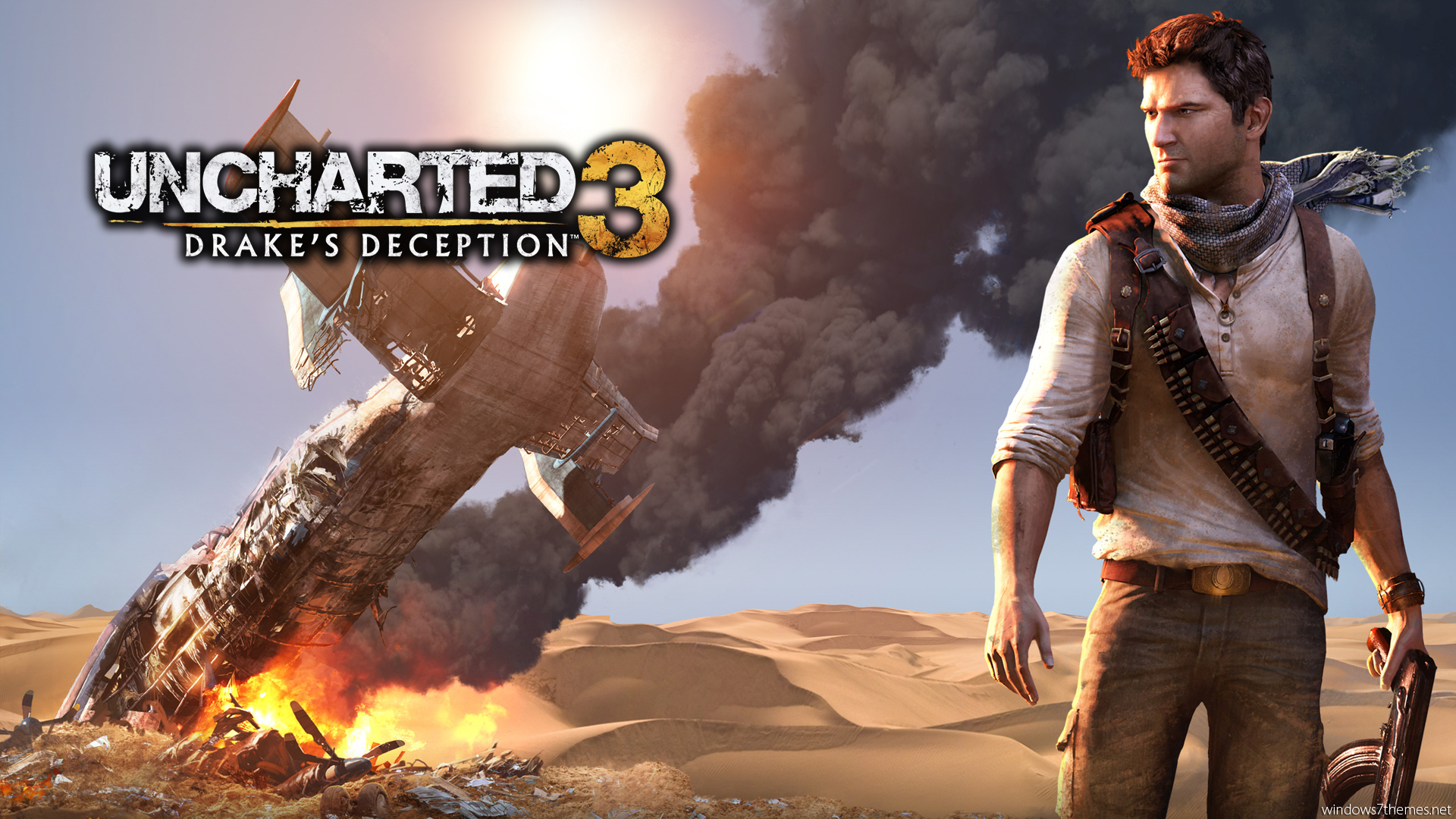
    LOOK AT THE SAND
    Nathan knows how to pose

    Oh Nathan Drake, you careless adventurer you. How you made me not give a single damn in the first unchartered, then flipped my perception on its head in the 2nd is beyond my comprehension. So here we are with your third outing, and I must say, you’ve certainly impressed.

    The Uncharted series have been a mixed bag of highs and lows for myself. The first one, I was extremely unimpressed. I could see why people enjoyed it, but I felt like it was a poor mans Tomb Raider and was just a knock off. It was stunning in graphics, it wasn’t original in gameplay or story telling, it was just meh all the way through. This all changed with the second game. In Uncharted 2, Naughty Dog left me stunned at every turn. With improved art assets, and dynamically scripted sequences like the train level, (a level in which the game keeps dynamically generating a train journey whilst you progress across it, giving the feeling of a real train ride and not scripted/linear) I felt convinced that Naughty Dog had found their true potential, and had run with it.

    Uncharted 3 was more of Uncharted 2, albeit with quite a few bugs and a detracting story. It felt like a game that was never intended to be made, and quite a few plot points felt arbitrary, maybe even pointless. The action sequences were fantastic, bringing the series to a high point (but maybe not topping) of what was achieved in Uncharted 2. One example of this strength is a level in which Drake is fighting on a plane, all whilst enemies are trying to throw him off, with the back bay door open and crates falling out. This all adds to a dynamic feel of the game, as if you wouldn’t get the same scene twice if you tried. It truly adds to the immersion of the moment, and allows Uncharted 3 to feel more intense than any action movie.

    Uncharted 3’s game mechanics are still the same as old, ensuring old and new players alike feel in control the whole time. Enemies are the same as before, which can be a bad thing at times, for example when a level has multiple floors and enemies above are slaughtering you. This could be attributed to bad level design, but most of the levels are gorgeous and well thought out, so I’ll give Naughty Dog the benefit of the doubt.

    Nathan Drake and all the cast are fantastically well thought out, and compliment each other in everything that is done. Relationships are brought to tearing point, but it helps to portray an interesting character development arc that ends on a high note. I would gladly say that Naughty dog make some of the most believable characters in any game series of this generation.

    Pros:

    • Gorgeous landscapes and cities add to an immersive world
    • Great witty banter between characters
    • Fantastic action sequences that rival a film production any day

    Cons:

    • Very buggy (my character would fall out of the world often)
    • Story had many plotholes

    So to conclude, Uncharted 1 was meh, Uncharted 2 was AMAZING, and Uncharted 3 was alright, therefore I feel the whole series would rate as a 4/5 in a game review chart.

    3/5

  • Gaming Week 13: I am Alive (360)

    Gaming Week 13: I am Alive (360)

    BUT NOT FOR MUCH LONGERRRR
    He certainly is

    I am Alive is the survival game from Ubisoft set in the future, after a catastrophic event has fallen mankind, and left only a few survivors on earth. A few people may remember the original trailer from 2008:

    If you count yourself as one of those people, then prepare to be disappointed, as Ubisoft changed majority of the formula from what they was showing in the original trailer, and instead made a fairly action orientated third person adventure game. This isn’t necessarily a bad thing mind you, but I think majority of the gaming community would agree that the original trailer showed a lot of promise and originality in an otherwise over-saturated market.

    The game centres around a unnamed protagonist who is searching for his wife and daughter in his hometown of Haventon, after a year of walking across the states to reach there. We are greeted with a view of the decaying city, with no access except across a broken bridge. It’s here that the game introduces you to the concept of stamina, and by god you better get used to it.

    Stamina is one of the main game mechanics you have to use in I am alive, effecting everything, from climbing a mountain, to literally just breathing. In theory, stamina fits perfectly in this post-apocalyptic world, ensuring that a player thinks about every action before he or she goes ahead. In reality though, this mechanic just becomes a frustrating barrier to you actually enjoying the world of Haventon. So many times I would just want to explore and see the inhabitants of this desolate town, but it’s broken up every few seconds with climbing, just to make sure you can breath again before running down the same flag pole to go down the same street you were just walking down. It’s frustrating, and genuinely detracts from the game.

    Characters in I am Alive are very believable, to the point I actually really felt attached to the little girl called Mei that you have to carry around and care for. The artists should be proud of what they’ve done with the people, showing true human nature in a world without morales.

    Action sequences follow a scripted pattern of aiming your gun at someone until they either decide to surrender, or shoot them on the spot. This is interesting at first, but leads to a routine later on in the game, meaning enemy encounters just aren’t that great, and leave a lot to be desired.

    Pros:

    • Great characters
    • Ok climbing mechanics

    Cons:

    • Stamina is too frustrating
    • Save points too far apart (leading me to lose an hours worth of gameplay at one point)

    Overall I am Alive just felt underwhelming. There was some challenge in the way it set the mechanics, but really, it all felt like these challenges were just there to mask the terrible game underneath, with all of its many flaws.

    3/5

  • Gaming Week 12: VVVVVV (PC)

    Gaming Week 12: VVVVVV (PC)

    VVVVVV
    The captain and his crew in happy times

    VVVVVV was my first foray into Terry Cavanagh’s (Creator of Super Hexagon) games, which in my opinion is a fantastic jumping point into the madness and simplicity he’s become famous for. Although this was made 3 years ago, I still think it’s a fantastic example of how graphics aren’t what makes a game, and how the mechanics of a game are what keeps it interesting.

    VVVVVV looks like a classic 8bit retro game, it’s not much to look at, but it gets the job done. It conveys a captain on his ship who suddenly has inter-dimensional problems and loses all of his crew. Thus begins an epic adventure to find his shipmates, and bring them back. (A note to those who may not know, VVVVVV is named after the names of the 6 crew members: Captain Viridian, Doctor Violet, Doctor Victoria, Officer Vermillion, Professor Vitellary and Chief Verdigris.)

    Controls are very simple, and mechanics are quick to grasp. Your character and run left and right, and can flip gravity through pressing the space bar. This propels your captain to the ceiling and vice versa. It is through this gravity flipping mechanic that you are met with challenges which require very specific and tight controls to navigate the obstacle course of objects and spikes which kill you in one hit.

    Such a big map!
    The dungeons of VVVVVV are dispersed between open world areas

    Although the game mechanics are simple, it doesn’t stop the game from being hard. VVVVVV takes from the Super meat boy school of thought, and gives you a very tried and tested control system, to then challenge you to the point of ripping out your hair. It’s hard in places, but you know it’s not bullshit on the games part, it was your own fault for pressing right too soon, or not jumping when you was meant to. You make the mistakes here, so it’s only yourself you can be annoyed at.

    YOU CAN'T HANDLE THE TRUTH!
    Can you handle the Truth?

    The difficulty curve is perfect for a game of this size and scope, and allows you to progress at a steady rate through the 6 different dungeons hiding each crew member. You may come across hitches that keep you stuck for ages, but overcoming them makes you better as a player, and teaches you new mechanics about VVVVVV.

    Game length wise, the game is modest in providing about 2 hours worth of entertainment, which can be extended with multiple playthroughs and getting all of the collectibles. This is perfect in length, and I feel any longer would have just resulted in a game which outstays its welcome. Some may find a lot of value in this amount of time (especially when it was provided in quite a few humble bundles) where as others (like myself) may be calling out for more.

    Pros:

    • Addictive gameplay
    • Fantastic Soundtrack

    Cons:

    • May not be to everyones taste with unique graphics

    Overall I feel VVVVVV is a must play for anyone looking into game design and game philosophy. It shows that games don’t have to have fantastic graphics in order to be fun, whilst also showing that a lot can be done with a few sets of simple rules. Here’s to hoping that with Terry’s latest success from Super Hexagon, he sets out to make another VVVVVV.

    3/5

  • Expansion

    Expansion

    I felt I needed to expand on my idea I put forward to other day, as I didn’t really put across any of the specifics of this project. (mainly because I don’t have specifics yet, just a bunch of ideas!)

    But here are some pics of what I have planned so far:

    Vice Versa
    The initial ideas of my platformer

    So my initial idea was to switch between realities so that the world changed, and maybe the physics was different (so the character could jump further/higher). I liked this idea, so decided on 3 different worlds that you chose between; Normal, Future, and 3D. (Which for the moment, don’t have any different physics, but this may change in due time.)

    My thinking was that you could come across stumbling blocks in one dimension, that would be solved by jumping to another dimension. An example of which I’ve provided below:

    LETS DO THE TIME WARP AGAINNNNNN
    Here, a player jumps between dimensions to get past obstacles

    In this example, the character needs to get to the other end of the level, but the gap between the platforms is too large, so they switch to the 3D dimension and rotate the camera, enabling them to see a hidden switch, like the example below:

    YO DAWGGG, THATS A SWITCH RITE?
    The switch to 3D camera allows the player to find things that wouldn’t usually be seen

    Using this switch, the player then extracts a drawbridge, which allows the character to continue across the level, until they reach a new gap that has no switches and is impossible to jump across. The player then switches to the last dimension, the future, where everything is destroyed and desolate. Here, a tree has fallen in place of the gap, and allows the player to advance. Finally, in this example, the player can only advance in the normal dimension, since debris and a black hole are blocking the paths in the future and 3D dimensions. The player then finishes the level.

    Although these are very simple examples, I feel that using this game mechanic can present a lot of challenges to a player, and give my game a unique twist on the platforming genre.

    I’ll update more over the coming days.

  • My idea

    My idea

    So, these last few days I’ve been wanting to make something from scratch, but I feel the big game I want to make is too advanced for me right now, so I’ve decided to scale it back and make a platformer for now. This platformer will allow me to recall a lot of what I’ve learnt in Unity in the past, but will also allow me to learn some fundamental differences between developing 2 years ago at uni and developing now.

    So my ideas for the new game are as follows:

    • Game will be a 2D side-scroller, with 3 levels tops.
    • Game will have 3 characters, each with unique abilities that can be swapped between at any time. (Enabling player to jump further, or be immune to a certain enemy.)
    • The game will have 3-4 different types of enemies.
    • There will be lives, a timer, and a progress tracker for progress through a stage.
    • All textures/characters/ 3D models will be made using Blender.

    If I have enough time/feel the game isn’t good enough, I may invest some time into the following:

    • Alternate realities which the player can switch between in order to get past problems. (E.g. Water turns to lava in one dimension, but gravity is heavier.)

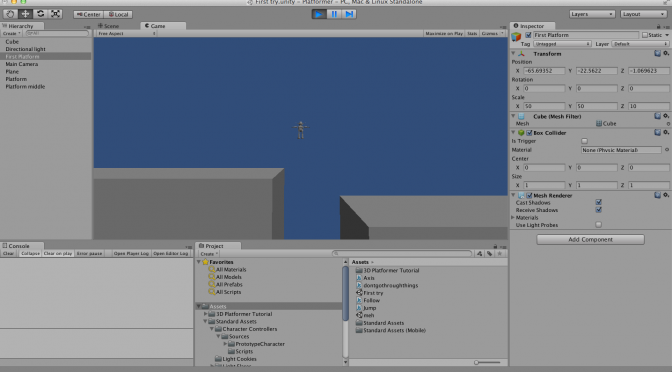
    Today I started some of this using Unity, making a bunch of rudimentary cubes to make platforms, and a player cube that can be controlled. On top of this I made the camera linked to the player, so as the character progresses along the stage, the camera follows suit.

    LOOK AT HIM FLYYYYYY
    An example of my character jumping over a gap.

    This will be a challenge, but that’s the point of all of this, so I can develop and improve my skills to one day make a game that people will love, and I can be proud of.